QUESTION IMAGE
Question
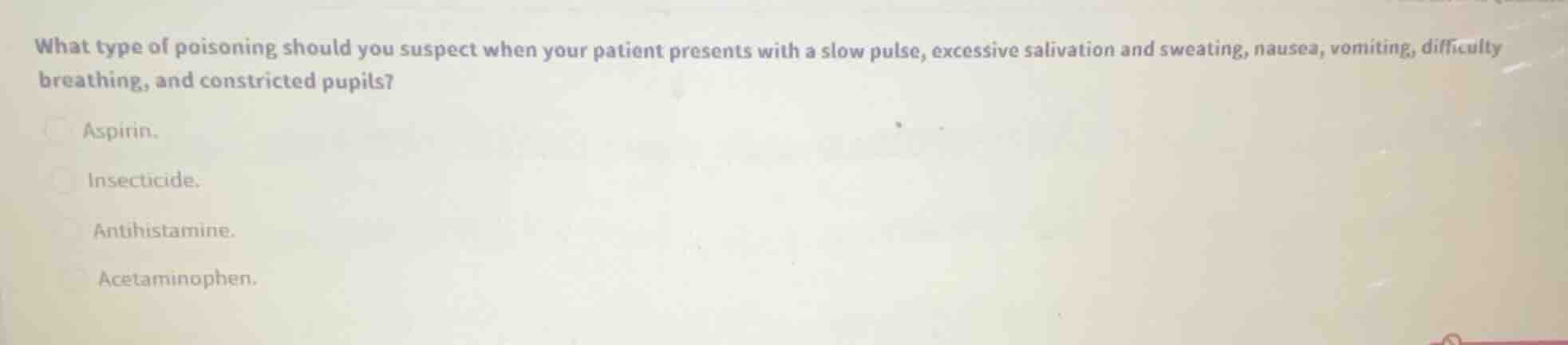
what type of poisoning should you suspect when your patient presents with a slow pulse, excessive salivation and sweating, nausea, vomiting, difficulty breathing, and constricted pupils?
aspirin.
insecticide.
antihistamine.
acetaminophen.
Analyze the clinical presentation
Using the Organophosphate Poisoning knowledge point
- The patient presents with a slow pulse (bradycardia), excessive salivation, sweating (diaphoresis), nausea, vomiting, difficulty breathing (bronchospasm/bronchorrhea), and constricted pupils (miosis).
- These signs and symptoms represent a classic cholinergic toxidrome, commonly remembered by the mnemonic SLUDGEM (Salivation, Lacrimation, Urination, Defecation, Gastrointestinal upset, Emesis, Miosis).
Match toxidrome to the options
Using the Organophosphate Poisoning knowledge point
- Organophosphates and carbamates, which are commonly found in insecticides, inhibit the acetylcholinesterase enzyme, leading to an accumulation of acetylcholine and overstimulation of the parasympathetic nervous system.
- Aspirin (salicylate) overdose typically presents with tachypnea, tinnitus, hyperthermia, and metabolic acidosis.
- Antihistamine overdose presents with anticholinergic symptoms (dry mouth, rapid heart rate, dilated pupils, hot/dry skin).
- Acetaminophen overdose primarily causes delayed hepatotoxicity without these acute cholinergic signs.
- Therefore, insecticide poisoning is the correct clinical suspicion.

Snap & solve any problem in the app
Get step-by-step solutions on Sovi AI
Photo-based solutions with guided steps
Explore more problems and detailed explanations
- (A) Aspirin.
- (B) Insecticide. (Correct answer)
- (C) Antihistamine.
- (D) Acetaminophen.