QUESTION IMAGE
Question
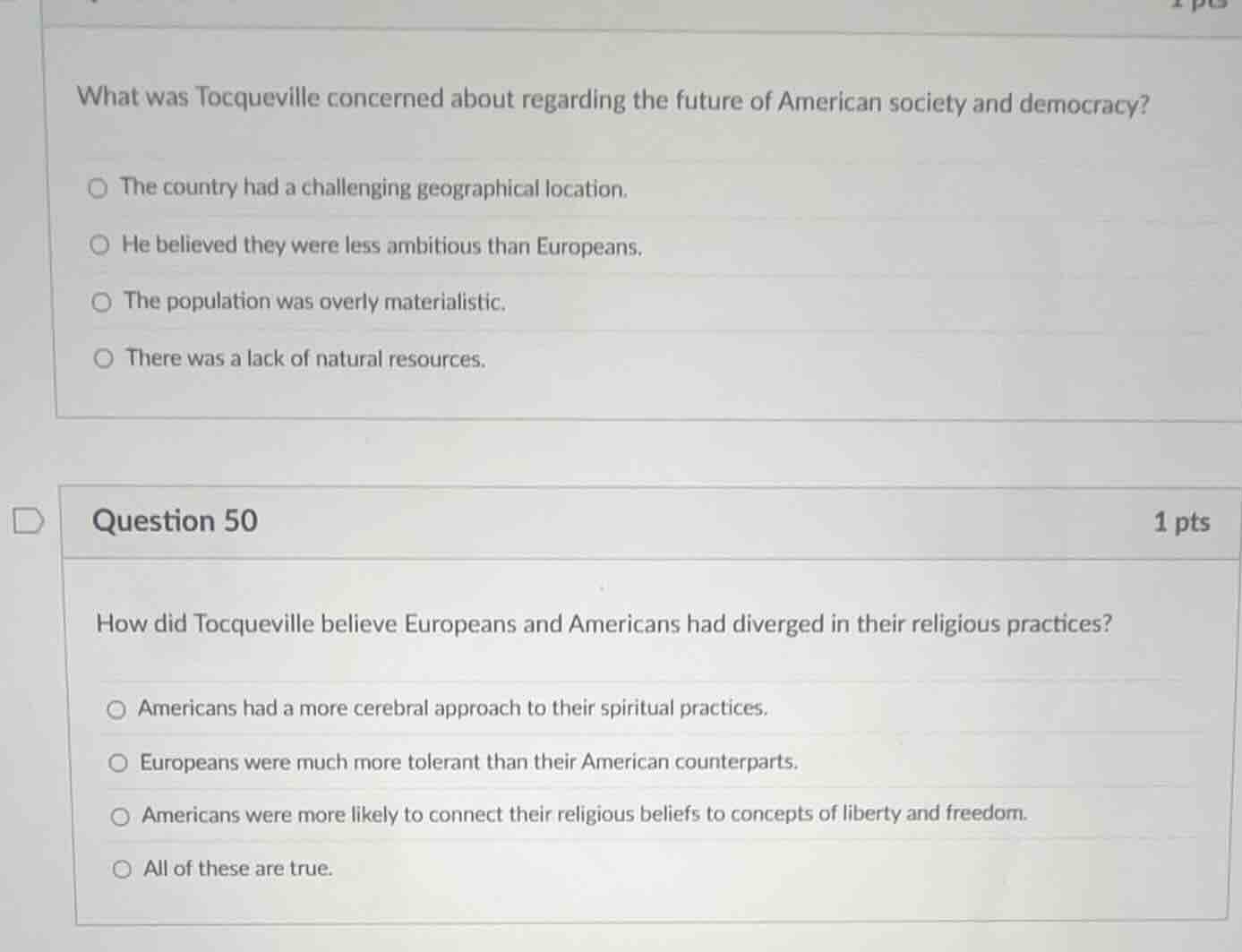
what was tocqueville concerned about regarding the future of american society and democracy?
- the country had a challenging geographical location.
- he believed they were less ambitious than europeans.
- the population was overly materialistic.
- there was a lack of natural resources.
question 50
how did tocqueville believe europeans and americans had diverged in their religious practices?
- americans had a more cerebral approach to their spiritual practices.
- europeans were much more tolerant than their american counterparts.
- americans were more likely to connect their religious beliefs to concepts of liberty and freedom.
- all of these are true.
🆕 New Concept Discovered: Analyzing Tocqueville's Democracy in America
Understanding Alexis de Tocqueville's observations on American culture, materialism, and religion.
Step 1: Analyze the first question on Tocqueville's concerns
The first question asks: "What was Tocqueville concerned about regarding the future of American society and democracy?"
In his seminal work Democracy in America, Alexis de Tocqueville observed that while equality of conditions fostered a high standard of living, it also bred a strong passion for physical well-being and material goods. He was deeply concerned that this intense focus on acquiring wealth and comfort—overly materialistic tendencies—could lead to individualism, where citizens withdraw from public life, thereby weakening democratic institutions and making society vulnerable to "democratic despotism."
- The country had a challenging geographical location: Incorrect. Tocqueville actually viewed America's physical isolation and vast geography as highly advantageous.
- He believed they were less ambitious than Europeans: Incorrect. He noted Americans were highly ambitious, though their ambition was often focused on commercial and material success.
- The population was overly materialistic: Correct. He warned that excessive materialism could distract citizens from their civic duties.
- There was a lack of natural resources: Incorrect. America was rich in natural resources.
Step 2: Analyze the second question on religious practices
The second question asks: "How did Tocqueville believe Europeans and Americans had diverged in their religious practices?"
Tocqueville observed a unique relationship between religion and politics in the United States. While in Europe, religion and the spirit of freedom often clashed (with the church aligned with monarchical power), in America, the two were intimately connected. He noted that Americans saw religious faith as indispensable to the maintenance of republican institutions and the preservation of liberty.
- Americans had a more cerebral approach to their spiritual practices: Incorrect. American religious practices were often highly emotional and practical rather than purely intellectual or cerebral.
- Europeans were much more tolerant than their American counterparts: Incorrect. Tocqueville did not argue this; rather, he noted the strong social pressure to conform to religious norms in America, but also highlighted the political conflicts surrounding religion in Europe.
- Americans were more likely to connect their religious beliefs to concepts of liberty and freedom: Correct. Tocqueville famously argued that in America, the "spirit of religion" and the "spirit of freedom" marched in common harmony.

Snap & solve any problem in the app
Get step-by-step solutions on Sovi AI
Photo-based solutions with guided steps
Explore more problems and detailed explanations
First Question:
- The population was overly materialistic.
Question 50:
- Americans were more likely to connect their religious beliefs to concepts of liberty and freedom.