QUESTION IMAGE
Question
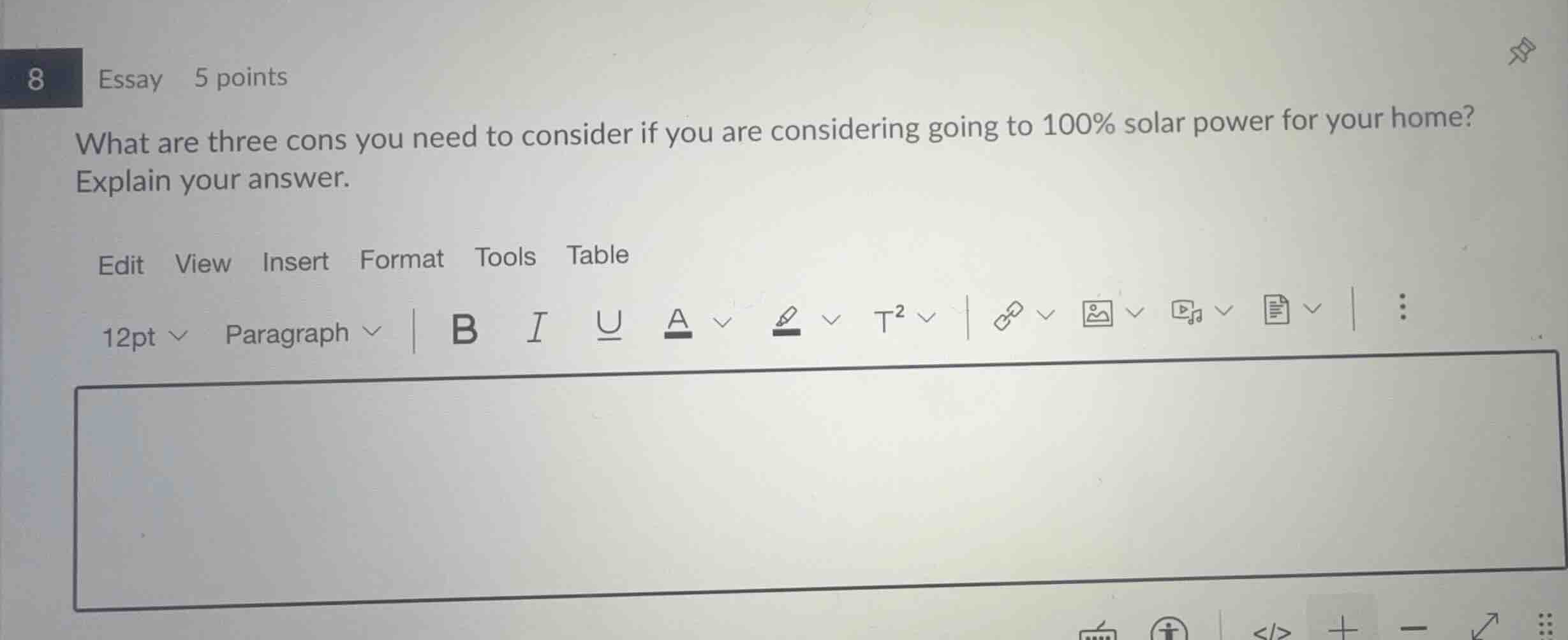
what are three cons you need to consider if you are considering going to 100% solar power for your home? explain your answer.
Intermittency and weather dependence
Using the Solar Energy Cons and Renewable Energy Challenges knowledge points
- Solar panels require sunlight to generate electricity.
- Power generation drops significantly on cloudy days and is zero at night.
- Going 100% solar requires a reliable backup system or battery storage to bridge these gaps.
High initial setup and storage costs
Using the Solar Energy Cons and Renewable Energy Challenges knowledge points
- Purchasing panels, inverters, and mounting hardware requires a large upfront investment.
- Achieving 100% independence requires large-capacity battery storage systems (like lithium-ion batteries).
- These batteries are expensive to purchase and must be replaced every 5 to 15 years.
Space and roof suitability constraints
Using the Solar Energy Cons and Renewable Energy Challenges knowledge points
- Generating 100% of a home's energy requires a large number of solar panels.
- Many homes lack sufficient, unshaded roof space facing the correct direction (south/west in the Northern Hemisphere).
- Heavy shading from trees, nearby buildings, or complex roof angles can prevent reaching full capacity.

Snap & solve any problem in the app
Get step-by-step solutions on Sovi AI
Photo-based solutions with guided steps
Explore more problems and detailed explanations
Three major cons to consider when transitioning to 100% residential solar power are:
- Intermittency and Weather Dependence: Solar energy generation relies entirely on sunlight. Power output drops significantly during cloudy days and ceases completely at night, requiring a reliable alternative energy source or storage system to maintain continuous power.
- High Upfront and Battery Storage Costs: The initial purchase and installation of panels, inverters, and especially the large-capacity battery storage systems needed to go 100% off-grid require a substantial financial investment. Additionally, these batteries have a limited lifespan and must be replaced periodically.
- Space and Roof Constraints: To generate enough electricity to cover 100% of a household's energy needs, a large surface area of unshaded, properly oriented roof space is required. Homes with small, heavily shaded, or structurally unsuitable roofs may not be able to support the necessary number of panels.