QUESTION IMAGE
Question
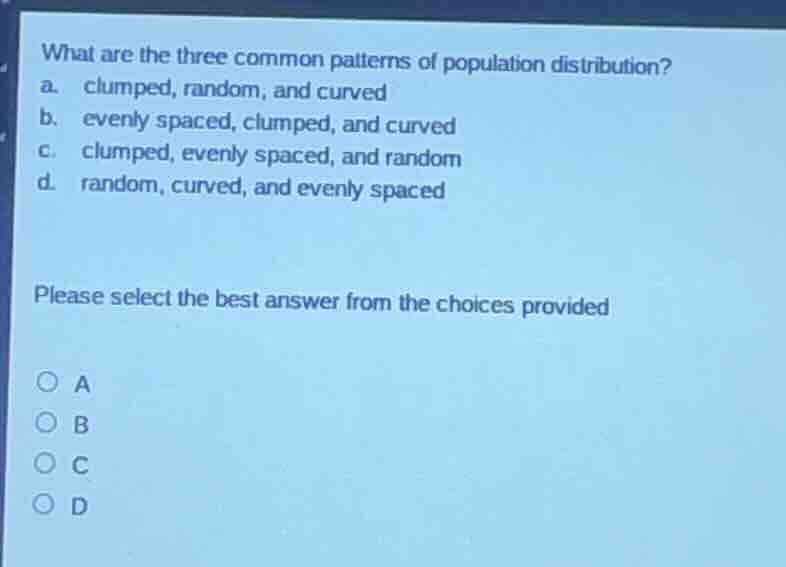
what are the three common patterns of population distribution?
a. clumped, random, and curved
b. evenly spaced, clumped, and curved
c. clumped, evenly spaced, and random
d. random, curved, and evenly spaced
please select the best answer from the choices provided
a
b
c
d
🆕 New Concept Discovered: Population Distribution Patterns
How organisms spread out in space
Step 1: Define population distribution
Population distribution (or dispersion) describes how individuals of a specific species are spaced out across their geographic range. This spatial arrangement depends heavily on environmental conditions, resource availability, and social interactions.
Step 2: Identify the three main patterns
In ecology, there are three primary, universally recognized patterns of population distribution:
- Clumped (or aggregated): Individuals gather in groups or patches (often around resources like water or food, or for safety). This is the most common pattern in nature.
- Uniform (or evenly spaced): Individuals maintain a relatively consistent distance from one another. This often happens due to competition for limited resources or territorial behavior.
- Random: The position of each individual is independent of the others, occurring in environments where resources are consistent and there are no strong attractions or repulsions between individuals.
Step 3: Match with the given options
Let's evaluate the choices provided in the question:
- a. clumped, random, and curved (Incorrect: "curved" is not a distribution pattern)
- b. evenly spaced, clumped, and curved (Incorrect: "curved" is not a distribution pattern)
- c. clumped, evenly spaced, and random (Correct: matches all three ecological patterns)
- d. random, curved, and evenly spaced (Incorrect: "curved" is not a distribution pattern)
Therefore, option c (which corresponds to selection C) is the correct answer.

Snap & solve any problem in the app
Get step-by-step solutions on Sovi AI
Photo-based solutions with guided steps
Explore more problems and detailed explanations
C