QUESTION IMAGE
Question
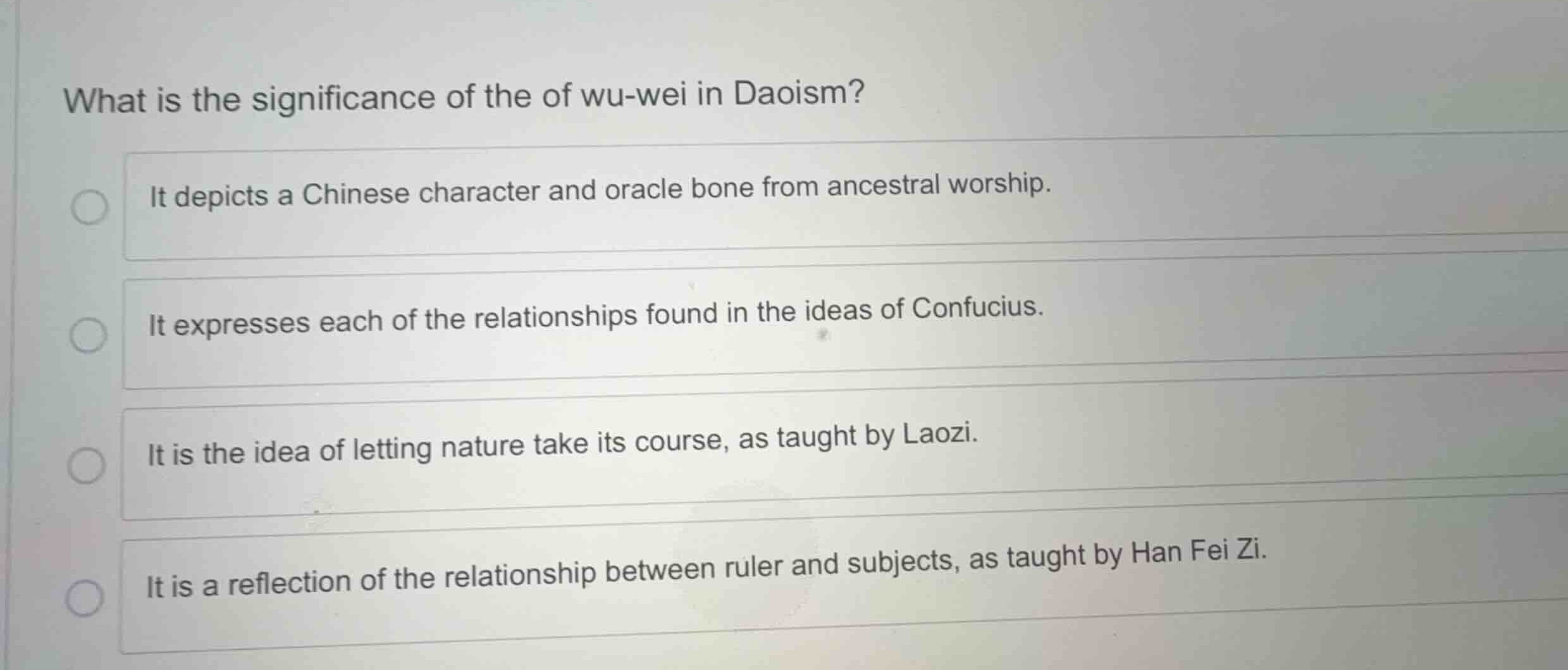
what is the significance of the of wu-wei in daoism?
it depicts a chinese character and oracle bone from ancestral worship.
it expresses each of the relationships found in the ideas of confucius.
it is the idea of letting nature take its course, as taught by laozi.
it is a reflection of the relationship between ruler and subjects, as taught by han fei zi.
Define the concept of wu-wei
The term wu-wei (无为) is a core concept in Daoism (Taoism). It is literally translated as "non-action" or "effortless action."
Analyze the philosophical meaning
Rather than doing nothing, wu-wei refers to acting in alignment with the Dao (the natural flow of the universe). It means avoiding forced, unnatural actions and letting things take their natural course.
Identify the founder and key figures
This philosophy is central to the teachings of Laozi, the traditional founder of Daoism, as written in the Daodejing.
Evaluate the given options
- Option 1: "It depicts a Chinese character and oracle bone..." This refers to early Chinese writing and ancestral worship, not wu-wei.
- Option 2: "It expresses each of the relationships found in the ideas of Confucius." This describes Confucianism, which focuses on social hierarchies and relationships, not Daoist wu-wei.
- Option 3: "It is the idea of letting nature take its course, as taught by Laozi." This perfectly matches the definition of wu-wei in Daoism.
- Option 4: "It is a reflection of the relationship between ruler and subjects, as taught by Han Fei Zi." This describes Legalism, not Daoism.

Snap & solve any problem in the app
Get step-by-step solutions on Sovi AI
Photo-based solutions with guided steps
Explore more problems and detailed explanations
- (A) It depicts a Chinese character and oracle bone from ancestral worship.
- (B) It expresses each of the relationships found in the ideas of Confucius.
- (C) It is the idea of letting nature take its course, as taught by Laozi. (Correct answer)
- (D) It is a reflection of the relationship between ruler and subjects, as taught by Han Fei Zi.