QUESTION IMAGE
Question
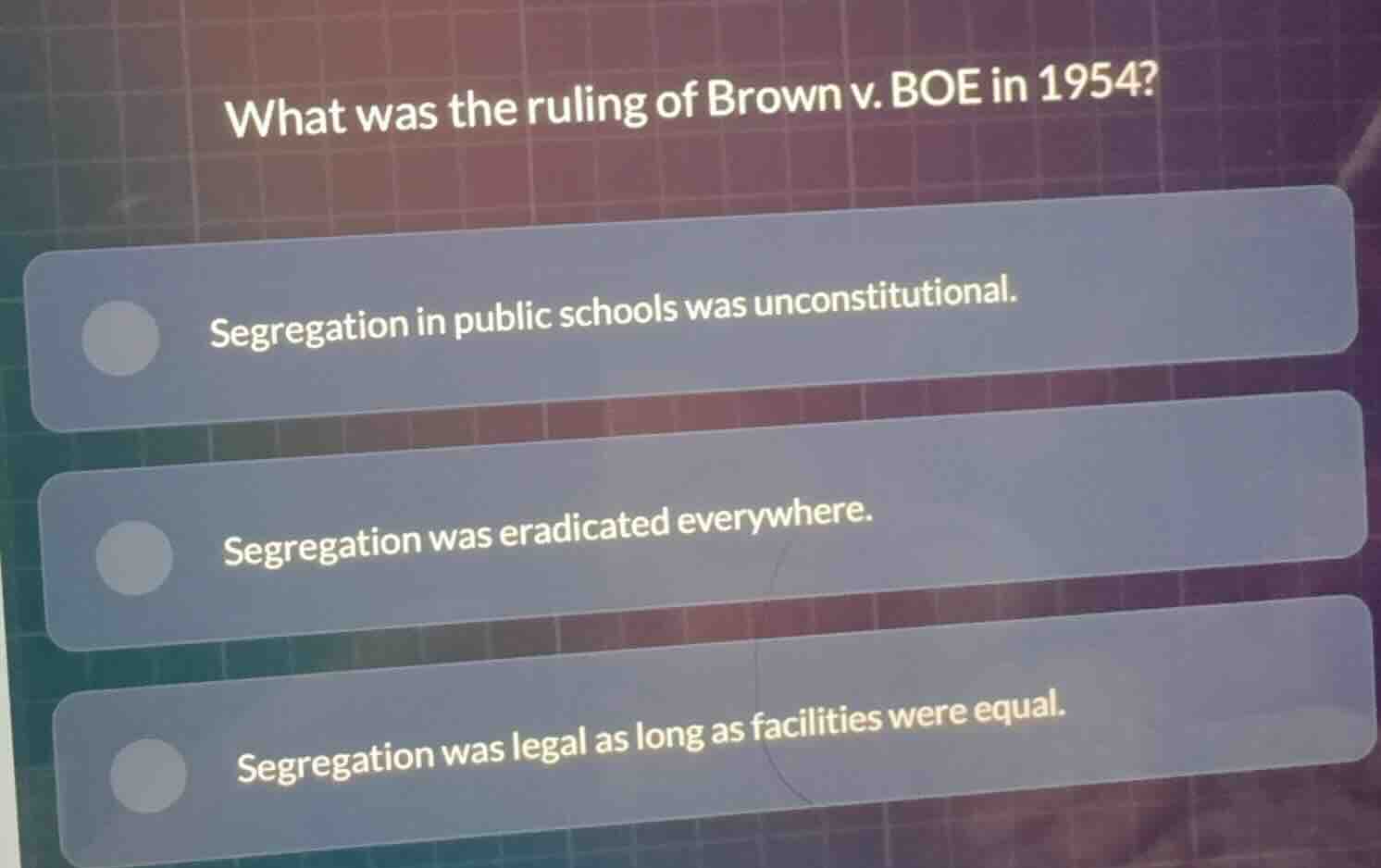
what was the ruling of brown v. boe in 1954?
segregation in public schools was unconstitutional.
segregation was eradicated everywhere.
segregation was legal as long as facilities were equal.
⚡ Using what you learned: core goals of the civil rights movement
Step 1: Analyze the case of Brown v. Board of Education (1954)
The landmark Supreme Court case Brown v. Board of Education of Topeka (1954) directly challenged the "separate but equal" doctrine established by Plessy v. Ferguson (1896) in the context of public education.
Step 2: Evaluate the options
- "Segregation in public schools was unconstitutional."
The Supreme Court ruled unanimously that racial segregation in public schools violated the Equal Protection Clause of the Fourteenth Amendment because separate educational facilities are inherently unequal. This matches the historical ruling.
- "Segregation was eradicated everywhere."
This is incorrect. The ruling was specifically limited to public education and did not instantly eradicate all forms of segregation across other public or private sectors.
- "Segregation was legal as long as facilities were equal."
This describes the "separate but equal" doctrine from Plessy v. Ferguson, which Brown v. Board of Education overturned.

Snap & solve any problem in the app
Get step-by-step solutions on Sovi AI
Photo-based solutions with guided steps
Explore more problems and detailed explanations
Segregation in public schools was unconstitutional.