QUESTION IMAGE
Question
what questions do you have?
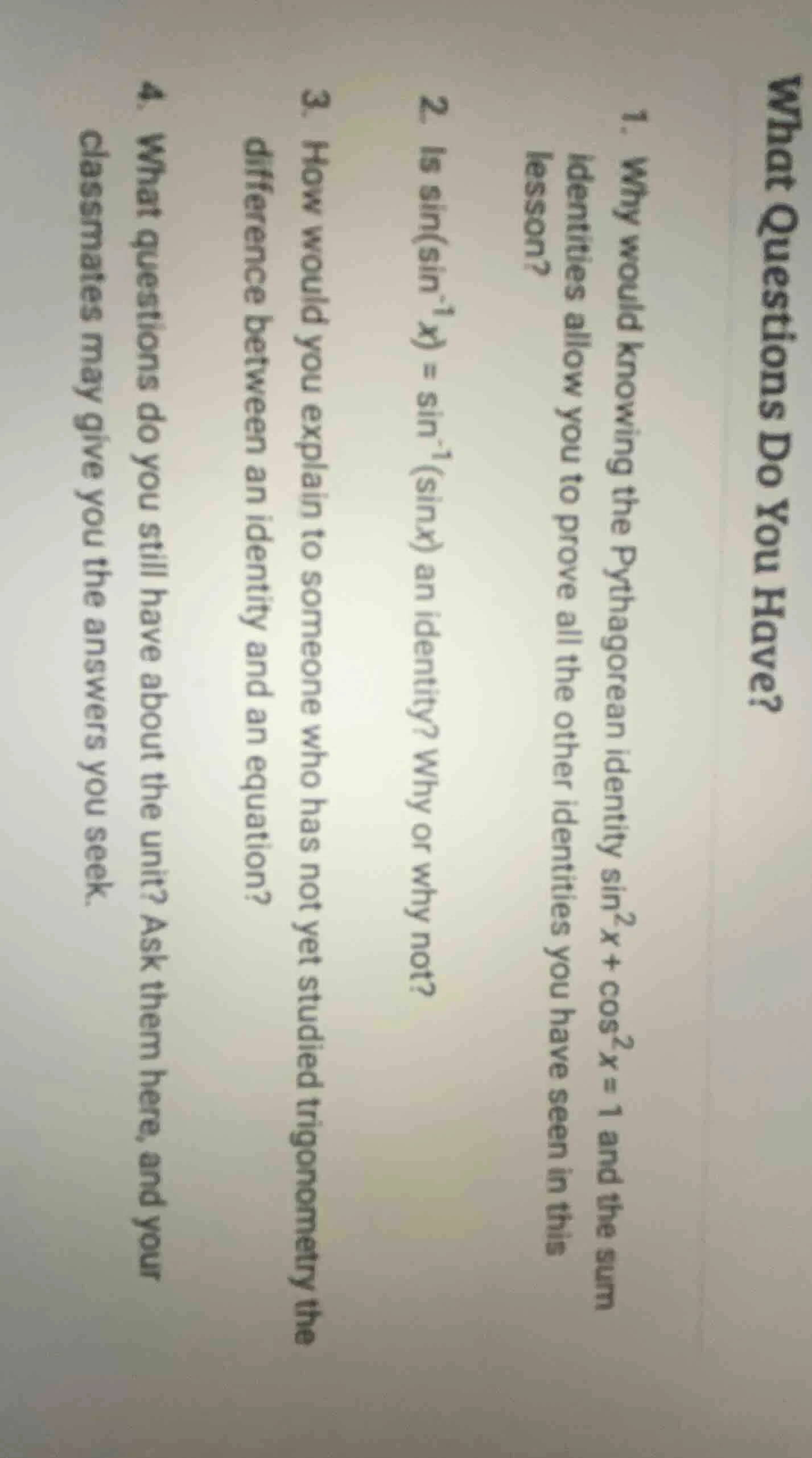
- why would knowing the pythagorean identity $\sin^2 x + \cos^2 x = 1$ and the sum identities allow you to prove all the other identities you have seen in this lesson?
- is $\sin(\sin^{-1} x) = \sin^{-1}(\sin x)$ an identity? why or why not?
- how would you explain to someone who has not yet studied trigonometry the difference between an identity and an equation?
- what questions do you still have about the unit? ask them here, and your classmates may give you the answers you seek.

Snap & solve any problem in the app
Get step-by-step solutions on Sovi AI
Photo-based solutions with guided steps
Explore more problems and detailed explanations
- You can rearrange $\sin^2 x + \cos^2 x = 1$ (divide by $\cos^2 x$ or $\sin^2 x$) to derive $\tan^2 x + 1 = \sec^2 x$ and $1 + \cot^2 x = \csc^2 x$, and use sum identities to derive double-angle, half-angle, etc., identities.
- No, it is not an identity. $\sin(\sin^{-1} x) = x$ for $x \in [-1, 1]$, while $\sin^{-1}(\sin x) = x$ only for $x \in [-\frac{\pi}{2}, \frac{\pi}{2}]$, so they are not equal for all valid inputs.
- An identity is true for all values of the variable within its domain, while an equation is only true for specific values of the variable.
- (Example question) How can we use the Pythagorean identity to simplify complex trigonometric expressions?