QUESTION IMAGE
Question
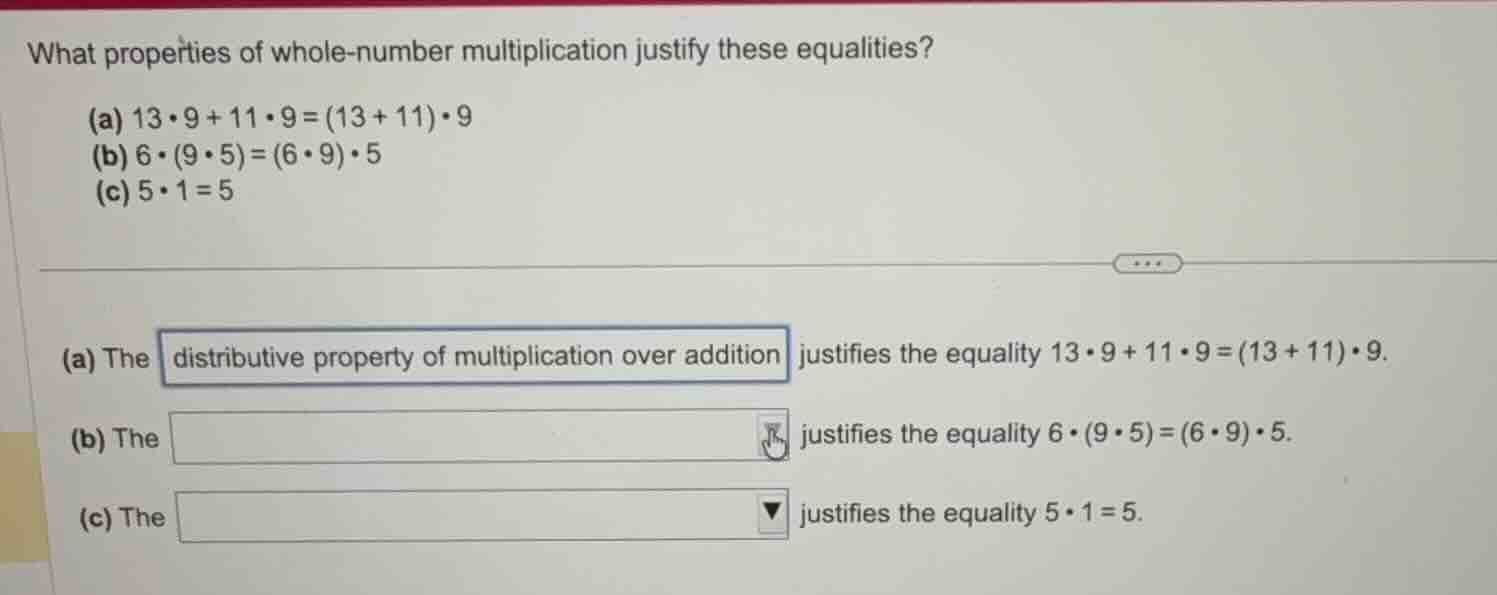
what properties of whole-number multiplication justify these equalities?
(a) \\(13 \cdot 9 + 11 \cdot 9 = (13 + 11) \cdot 9\\)
(b) \\(6 \cdot (9 \cdot 5) = (6 \cdot 9) \cdot 5\\)
(c) \\(5 \cdot 1 = 5\\)
(a) the distributive property of multiplication over addition justifies the equality \\(13 \cdot 9 + 11 \cdot 9 = (13 + 11) \cdot 9\\).
(b) the justifies the equality \\(6 \cdot (9 \cdot 5) = (6 \cdot 9) \cdot 5\\).
(c) the justifies the equality \\(5 \cdot 1 = 5\\).
Analyze equality (a)
The equality is \(13 \cdot 9 + 11 \cdot 9 = (13 + 11) \cdot 9\).
This shows multiplication by \(9\) being distributed over the addition of \(13\) and \(11\).
This is justified by the distributive property of multiplication over addition.
Analyze equality (b)
The equality is \(6 \cdot (9 \cdot 5) = (6 \cdot 9) \cdot 5\).
This shows that the grouping of the numbers being multiplied does not change the product.
This is justified by the associative property of multiplication.
Analyze equality (c)
The equality is \(5 \cdot 1 = 5\).
This shows that multiplying any number by \(1\) results in the number itself.
This is justified by the identity property of multiplication.

Snap & solve any problem in the app
Get step-by-step solutions on Sovi AI
Photo-based solutions with guided steps
Explore more problems and detailed explanations
Question 1
(a) The <blank>distributive property of multiplication over addition</blank> justifies the equality \(13 \cdot 9 + 11 \cdot 9 = (13 + 11) \cdot 9\).
Question 2
(b) The <blank>associative property of multiplication</blank> justifies the equality \(6 \cdot (9 \cdot 5) = (6 \cdot 9) \cdot 5\).
Question 3
(c) The <blank>identity property of multiplication</blank> justifies the equality \(5 \cdot 1 = 5\).