QUESTION IMAGE
Question
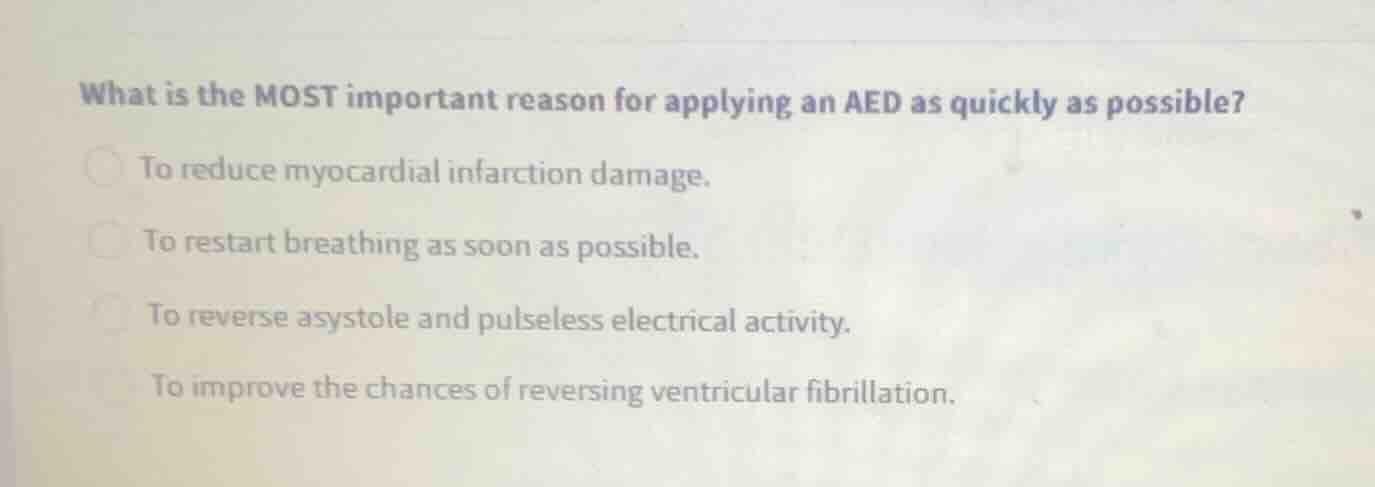
what is the most important reason for applying an aed as quickly as possible?
to reduce myocardial infarction damage.
to restart breathing as soon as possible.
to reverse asystole and pulseless electrical activity.
to improve the chances of reversing ventricular fibrillation.
<pre_analysis>
{
"quality": "clear",
"question_count": 1,
"skills_matched": [
"direct_cot",
"multiple_choice_formatter",
"explain_then_answer",
"tutor"
],
"needs_drawing": false,
"concepts_used": [
"AHA Guidelines"
],
"new_concepts": [
"AED Mechanism of Action",
"Defibrillation Physiology"
],
"current_concepts": [
"AHA Guidelines",
"AED Mechanism of Action",
"Defibrillation Physiology"
]
}
</pre_analysis>
<reasoning>
Analyze the function of an AED
An Automated External Defibrillator (AED) is designed to detect and treat specific shockable cardiac arrest rhythms. The two primary shockable rhythms are pulseless ventricular tachycardia (pVT) and ventricular fibrillation (VF). The electrical shock delivered by an AED momentarily depolarizes the entire myocardium, allowing the heart's natural pacemaker to resume an organized, perfusing rhythm.
Evaluate the physiological impact of delay
In ventricular fibrillation, the heart muscle fibers quiver chaotically instead of contracting in a coordinated fashion, resulting in zero cardiac output. For every minute that defibrillation is delayed, the chance of survival from VF cardiac arrest decreases by approximately 7% to 10%. Over time, VF deteriorates into non-shockable rhythms like asystole due to myocardial oxygen depletion. Therefore, rapid application of an AED is critical to successfully terminating VF before irreversible damage or asystole occurs.
Assess the incorrect options
- To reduce myocardial infarction damage: While a myocardial infarction (heart attack) can lead to cardiac arrest, an AED does not treat or reduce the localized tissue damage caused by a blocked coronary artery.
- To restart breathing as soon as possible: An AED is designed to treat electrical cardiac dysfunction, not directly restore spontaneous ventilation.
- To reverse asystole and pulseless electrical activity: Asystole (flatline) and pulseless electrical activity (PEA) are non-shockable rhythms. An AED will not deliver a shock for these rhythms, as defibrillation is ineffective for them.
Select the correct option
Using the AHA Guidelines knowledge point, the primary therapeutic goal of rapid defibrillation is to terminate ventricular fibrillation. Thus, the most important reason for applying an AED as quickly as possible is to improve the chances of reversing ventricular fibrillation.
</reasoning>
<answer>
<mcq-option>To reduce myocardial infarction damage.</mcq-option>
<mcq-option>To restart breathing as soon as possible.</mcq-option>
<mcq-option>To reverse asystole and pulseless electrical activity.</mcq-option>
<mcq-correct>To improve the chances of reversing ventricular fibrillation.</mcq-correct>
</answer>
<post_analysis>
{
"subject": "Natural Science",
"question_type": "Multiple Choice",
"knowledge_point": [
"Natural Science",
"Medicine and Health",
"Emergency Medical Services"
]
}
</post_analysis>
Snap & solve any problem in the app
Get step-by-step solutions on Sovi AI
Photo-based solutions with guided steps
Explore more problems and detailed explanations
<pre_analysis>
{
"quality": "clear",
"question_count": 1,
"skills_matched": [
"direct_cot",
"multiple_choice_formatter",
"explain_then_answer",
"tutor"
],
"needs_drawing": false,
"concepts_used": [
"AHA Guidelines"
],
"new_concepts": [
"AED Mechanism of Action",
"Defibrillation Physiology"
],
"current_concepts": [
"AHA Guidelines",
"AED Mechanism of Action",
"Defibrillation Physiology"
]
}
</pre_analysis>
<reasoning>
Analyze the function of an AED
An Automated External Defibrillator (AED) is designed to detect and treat specific shockable cardiac arrest rhythms. The two primary shockable rhythms are pulseless ventricular tachycardia (pVT) and ventricular fibrillation (VF). The electrical shock delivered by an AED momentarily depolarizes the entire myocardium, allowing the heart's natural pacemaker to resume an organized, perfusing rhythm.
Evaluate the physiological impact of delay
In ventricular fibrillation, the heart muscle fibers quiver chaotically instead of contracting in a coordinated fashion, resulting in zero cardiac output. For every minute that defibrillation is delayed, the chance of survival from VF cardiac arrest decreases by approximately 7% to 10%. Over time, VF deteriorates into non-shockable rhythms like asystole due to myocardial oxygen depletion. Therefore, rapid application of an AED is critical to successfully terminating VF before irreversible damage or asystole occurs.
Assess the incorrect options
- To reduce myocardial infarction damage: While a myocardial infarction (heart attack) can lead to cardiac arrest, an AED does not treat or reduce the localized tissue damage caused by a blocked coronary artery.
- To restart breathing as soon as possible: An AED is designed to treat electrical cardiac dysfunction, not directly restore spontaneous ventilation.
- To reverse asystole and pulseless electrical activity: Asystole (flatline) and pulseless electrical activity (PEA) are non-shockable rhythms. An AED will not deliver a shock for these rhythms, as defibrillation is ineffective for them.
Select the correct option
Using the AHA Guidelines knowledge point, the primary therapeutic goal of rapid defibrillation is to terminate ventricular fibrillation. Thus, the most important reason for applying an AED as quickly as possible is to improve the chances of reversing ventricular fibrillation.
</reasoning>
<answer>
<mcq-option>To reduce myocardial infarction damage.</mcq-option>
<mcq-option>To restart breathing as soon as possible.</mcq-option>
<mcq-option>To reverse asystole and pulseless electrical activity.</mcq-option>
<mcq-correct>To improve the chances of reversing ventricular fibrillation.</mcq-correct>
</answer>
<post_analysis>
{
"subject": "Natural Science",
"question_type": "Multiple Choice",
"knowledge_point": [
"Natural Science",
"Medicine and Health",
"Emergency Medical Services"
]
}
</post_analysis>