QUESTION IMAGE
Question
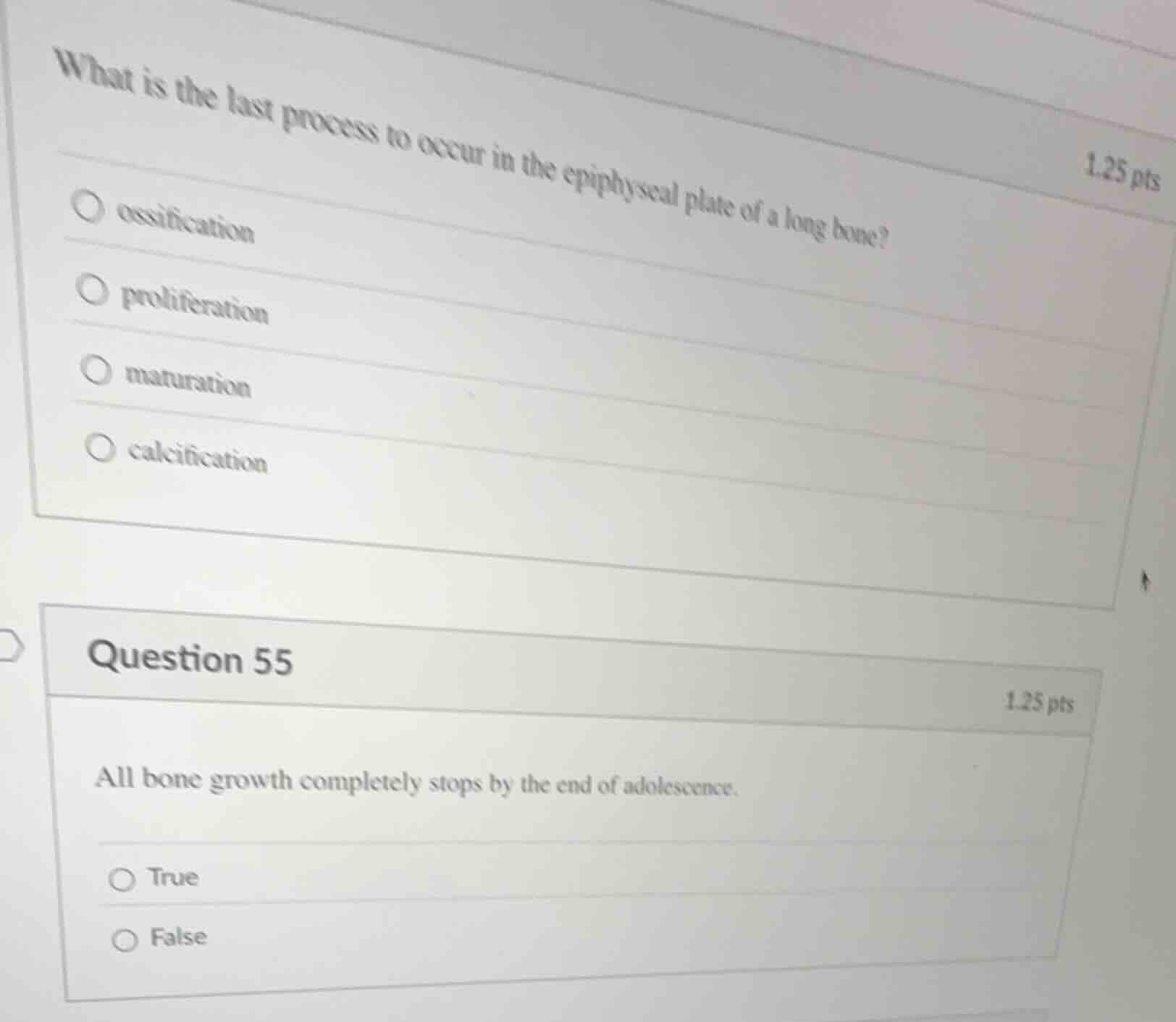
what is the last process to occur in the epiphyseal plate of a long bone?
- ossification
- proliferation
- maturation
- calcification
question 55
all bone growth completely stops by the end of adolescence.
- true
- false
Analyze the epiphyseal plate zones
The epiphyseal plate is organized into functional zones from the epiphyseal side to the diaphyseal side:
- Reserve (resting) zone: Anchors the plate to the epiphysis.
- Proliferation zone: Chondrocytes undergo rapid mitosis.
- Hypertrophy (maturation) zone: Chondrocytes stop dividing and enlarge.
- Calcification zone: The surrounding cartilage matrix calcifies, and chondrocytes die.
- Ossification (osteogenic) zone: Osteoblasts deposit bone matrix on the calcified cartilage.
Thus, the last process to occur in this sequence is ossification.
Analyze bone growth limits
The second question states: "All bone growth completely stops by the end of adolescence."
While longitudinal bone growth (lengthwise growth at the epiphyseal plate) stops after adolescence when the epiphyseal plates close, appositional bone growth (growth in width/thickness) continues throughout life in response to mechanical stress, physical activity, and weight changes. Therefore, the statement is False.

Snap & solve any problem in the app
Get step-by-step solutions on Sovi AI
Photo-based solutions with guided steps
Explore more problems and detailed explanations
Question 1
- ossification (Correct answer)
- proliferation
- maturation
- calcification
Question 2
- True
- False (Correct answer)