QUESTION IMAGE
Question
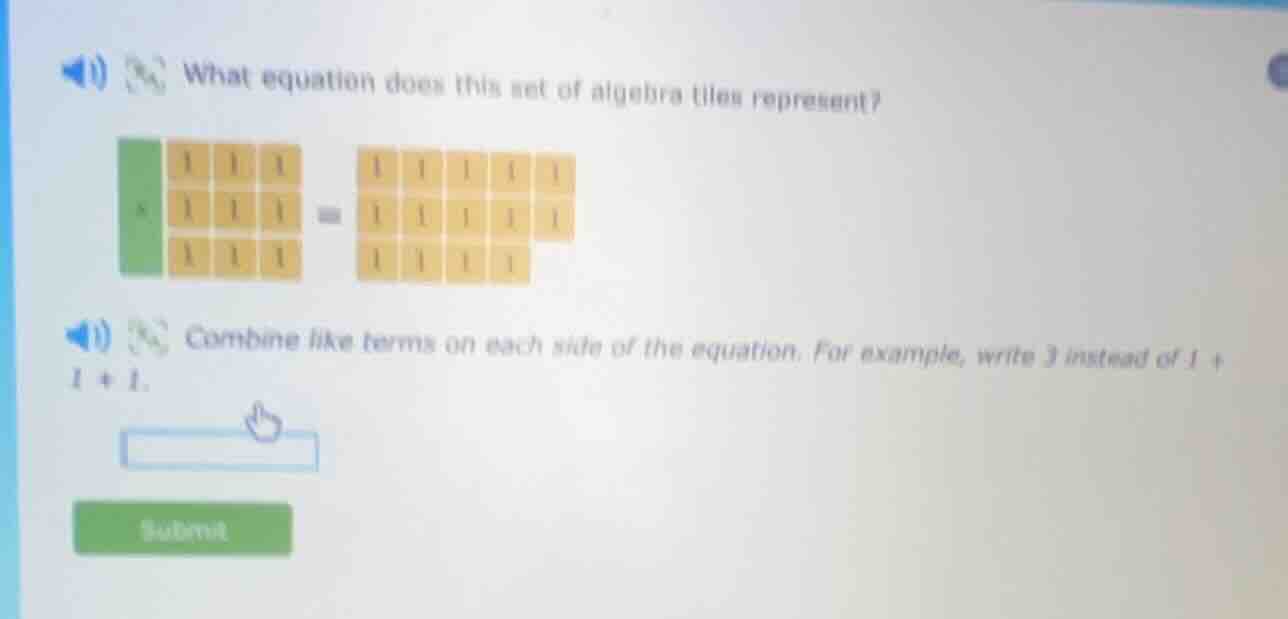
- what equation does this set of algebra tiles represent? 1) combine like terms on each side of the equation. for example, write 3 instead of 1 + 1 + 1. submit
Part 1: Determine the equation from algebra tiles
Step 1: Analyze left - hand side (LHS)
The left - hand side has a green tile labeled \(x\) and three rows of three unit tiles (the yellow tiles with \(1\)s). Each row has 3 unit tiles, and there are 3 rows. So the number of unit tiles on the LHS is \(3\times3 = 9\), and we also have the \(x\) tile. Wait, actually, looking at the arrangement, the left - hand side is \(x+3\times3\)? No, wait, the left - hand side: the green tile is \(x\), and then there are 3 rows, each with 3 unit tiles. So the left - hand side is \(x + 9\)? Wait, no, let's count the number of unit tiles on the left. Each of the three rows has 3 unit tiles, so \(3\times3=9\) unit tiles, and one \(x\) tile. Wait, no, maybe the left - hand side is \(x + 3\times3\)? Wait, no, looking at the right - hand side: let's count the unit tiles on the right. The right - hand side has two rows of 5 unit tiles and one row of 4 unit tiles? Wait, no, let's count again. First row: 5, second row: 5, third row: 4. So total unit tiles on the right: \(5 + 5+4=14\)? Wait, no, 5 + 5 is 10, plus 4 is 14? Wait, no, maybe I misread. Wait, the left - hand side: the green tile is \(x\), and then there are 3 columns of 3 unit tiles? Wait, no, the left - hand side: the green tile (x) and then 3 rows, each with 3 unit tiles. So the left - hand side is \(x+9\)? Wait, no, maybe the left - hand side is \(x + 3\times3\), and the right - hand side: let's count the number of 1s. First row: 5, second row: 5, third row: 4. So \(5 + 5+4 = 14\)? Wait, no, 5+5 is 10, 10 + 4 is 14. Wait, but maybe the left - hand side is \(x+3\times3=x + 9\), and the right - hand side: let's count again. First row: 5, second row: 5, third row: 4. So 5+5 + 4=14? Wait, no, maybe I made a mistake. Wait, the left - hand side: the green tile is \(x\), and then 3 rows, each with 3 unit tiles. So the number of unit tiles on the left (excluding \(x\)) is \(3\times3 = 9\), so LHS is \(x + 9\). The right - hand side: first row 5, second row 5, third row 4. \(5+5 + 4=14\)? Wait, no, 5+5 is 10, 10+4 is 14. Wait, but maybe the left - hand side is \(x+3\times3\) and the right - hand side is \(5 + 5+4\). Wait, no, maybe the left - hand side is \(x+9\) and the right - hand side is \(14\)? Wait, no, let's look again. Wait, the left - hand side: the green tile (x) and 3 rows, each with 3 unit tiles (so 9 unit tiles). The right - hand side: first row 5, second row 5, third row 4. So 5+5 + 4 = 14. So the equation is \(x + 9=14\).
Step 2: Combine like terms (but in this case, on the left we have \(x\) and 9, on the right we have 14. Wait, the second part says "Combine like terms on each side of the equation". So on the left - hand side, the like terms: the \(x\) is a variable term, and the 9 is a constant term. Wait, no, maybe I misread the first part. Wait, maybe the left - hand side is \(x+3\times3\), and the right - hand side is \(5 + 5+4\). Wait, no, let's count the unit tiles again. Left - hand side: 1 \(x\) tile and 9 unit tiles (3 rows, 3 columns). Right - hand side: 5+5 + 4=14 unit tiles. So the equation is \(x + 9=14\). When we combine like terms, on the left side, the constant term is 9 (since \(3\times3 = 9\)) and the variable term is \(x\). On the right side, \(5+5 + 4=14\). So the equation after combining like terms is \(x + 9=14\).

Snap & solve any problem in the app
Get step-by-step solutions on Sovi AI
Photo-based solutions with guided steps
Explore more problems and detailed explanations
For the first part (equation from algebra tiles): \(x + 9=14\)
For the second part (combining like terms): \(x + 9=14\) (since on the left, the 3 rows of 3 unit tiles combine to 9, and on the right, \(5 + 5+4 = 14\))