QUESTION IMAGE
Question
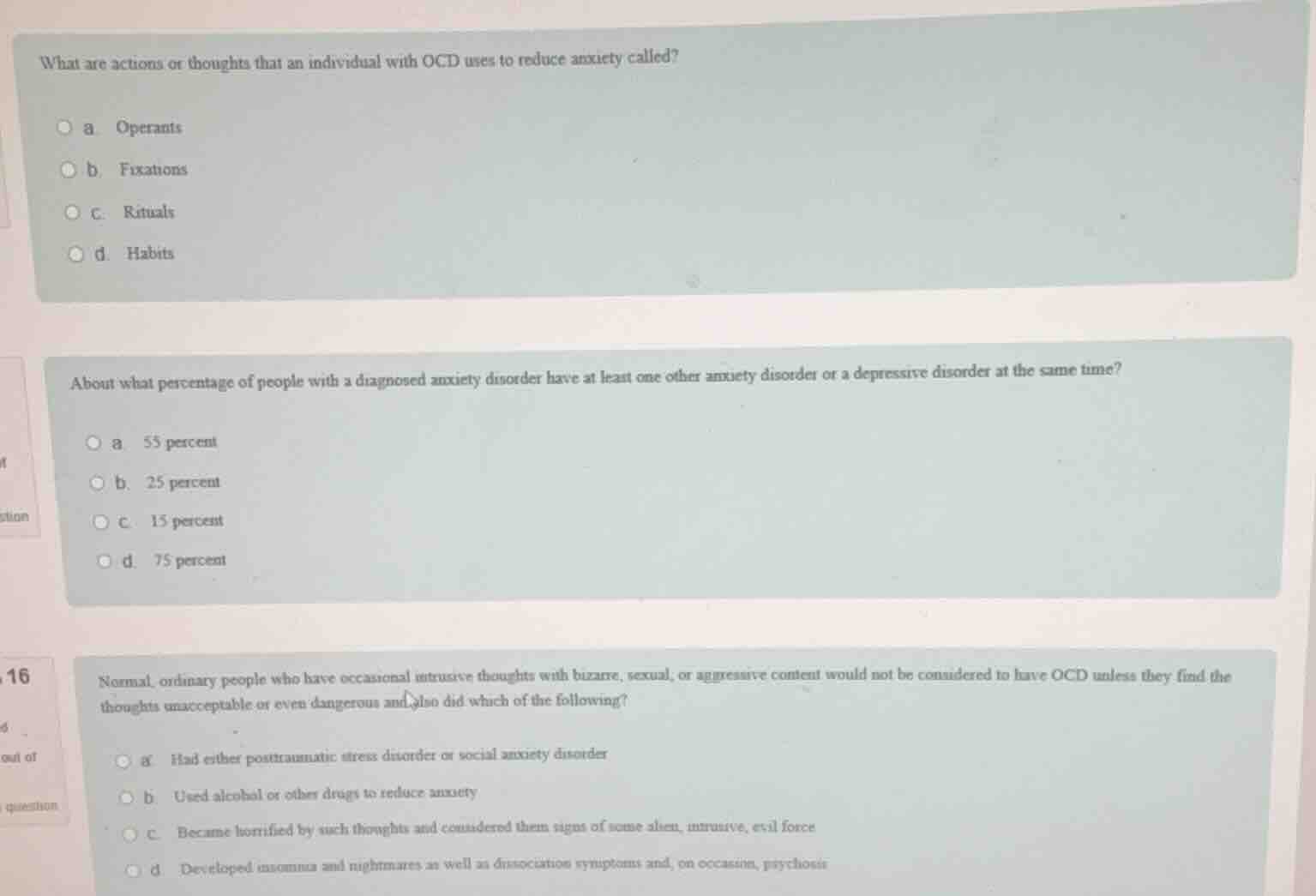
what are actions or thoughts that an individual with ocd uses to reduce anxiety called?
a. operants
b. fixations
c. rituals
d. habits
about what percentage of people with a diagnosed anxiety disorder have at least one other anxiety disorder or a depressive disorder at the same time?
a. 55 percent
b. 25 percent
c. 15 percent
d. 75 percent
normal, ordinary people who have occasional intrusive thoughts with bizarre, sexual, or aggressive content would not be considered to have ocd unless they find the thoughts unacceptable or even dangerous and also did which of the following?
a. had either posttraumatic stress disorder or social anxiety disorder
b. used alcohol or other drugs to reduce anxiety
c. became horrified by such thoughts and considered them signs of some alien, intrusive, evil force
d. developed insomnia and nightmares as well as dissociation symptoms and, on occasion, psychosis
Analyze OCD anxiety-reducing behaviors
In Obsessive-Compulsive Disorder (OCD), individuals perform repetitive behaviors or mental acts to reduce distress. These actions or thoughts are clinically referred to as compulsions or OCD Compulsions. Among the choices provided, "Rituals" is the synonymous term used to describe these structured, repetitive behaviors.
Determine anxiety disorder comorbidity rates
Epidemiological data shows high rates of OCD Comorbidity and general anxiety comorbidity. Approximately 55 percent of individuals diagnosed with an anxiety disorder meet the criteria for at least one other anxiety or depressive disorder simultaneously.
Evaluate cognitive appraisals in OCD
Occasional intrusive thoughts are common in the general population. However, according to cognitive models of OCD, these thoughts develop into clinical obsessions only when individuals appraise them as highly significant, dangerous, or unacceptable. This often involves Thought-action fusion, where they become horrified by the thoughts and interpret them as signs of a dangerous, alien, or evil force.

Snap & solve any problem in the app
Get step-by-step solutions on Sovi AI
Photo-based solutions with guided steps
Explore more problems and detailed explanations
Question 1
- a. Operants
- b. Fixations
- c. Rituals (Correct answer)
- d. Habits
Question 2
- a. 55 percent (Correct answer)
- b. 25 percent
- c. 15 percent
- d. 75 percent
Question 3
- a. Had either posttraumatic stress disorder or social anxiety disorder
- b. Used alcohol or other drugs to reduce anxiety
- c. Became horrified by such thoughts and considered them signs of some alien, intrusive, evil force (Correct answer)
- d. Developed insomnia and nightmares as well as dissociation symptoms and, on occasion, psychosis