QUESTION IMAGE
Question
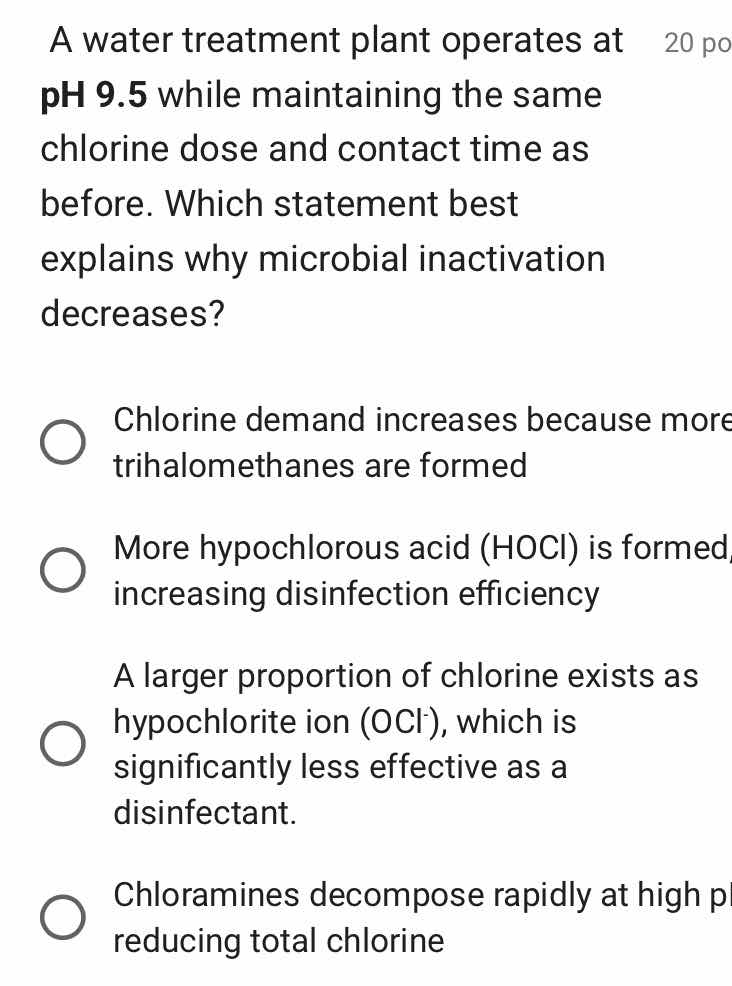
a water treatment plant operates at ph 9.5 while maintaining the same chlorine dose and contact time as before. which statement best explains why microbial inactivation decreases?
- chlorine demand increases because more trihalomethanes are formed
- more hypochlorous acid (hocl) is formed, increasing disinfection efficiency
- a larger proportion of chlorine exists as hypochlorite ion (ocl\\(^{-}\\)), which is significantly less effective as a disinfectant.
- chloramines decompose rapidly at high ph, reducing total chlorine
Analyze chlorine speciation in water as a function of pH
$$
\text{HOCl}
ightleftharpoons \text{H}^+ + \text{OCl}^- \quad (\text{p}K_a \approx 7.5)
$$
Determine dominant species at pH 9.5
$$
\text{pH} = 9.5 \gg \text{p}K_a \implies [\text{OCl}^-] \gg [\text{HOCl}]
$$
Evaluate disinfection efficacy of the dominant species
$$
\text{Disinfection Efficiency: } \text{HOCl} \gg \text{OCl}^-
$$

Snap & solve any problem in the app
Get step-by-step solutions on Sovi AI
Photo-based solutions with guided steps
Explore more problems and detailed explanations
- (A) Chlorine demand increases because more trihalomethanes are formed
- (B) More hypochlorous acid (HOCl) is formed, increasing disinfection efficiency
- (C) A larger proportion of chlorine exists as hypochlorite ion (OCl⁻), which is significantly less effective as a disinfectant. (Correct answer)
- (D) Chloramines decompose rapidly at high pH, reducing total chlorine