QUESTION IMAGE
Question
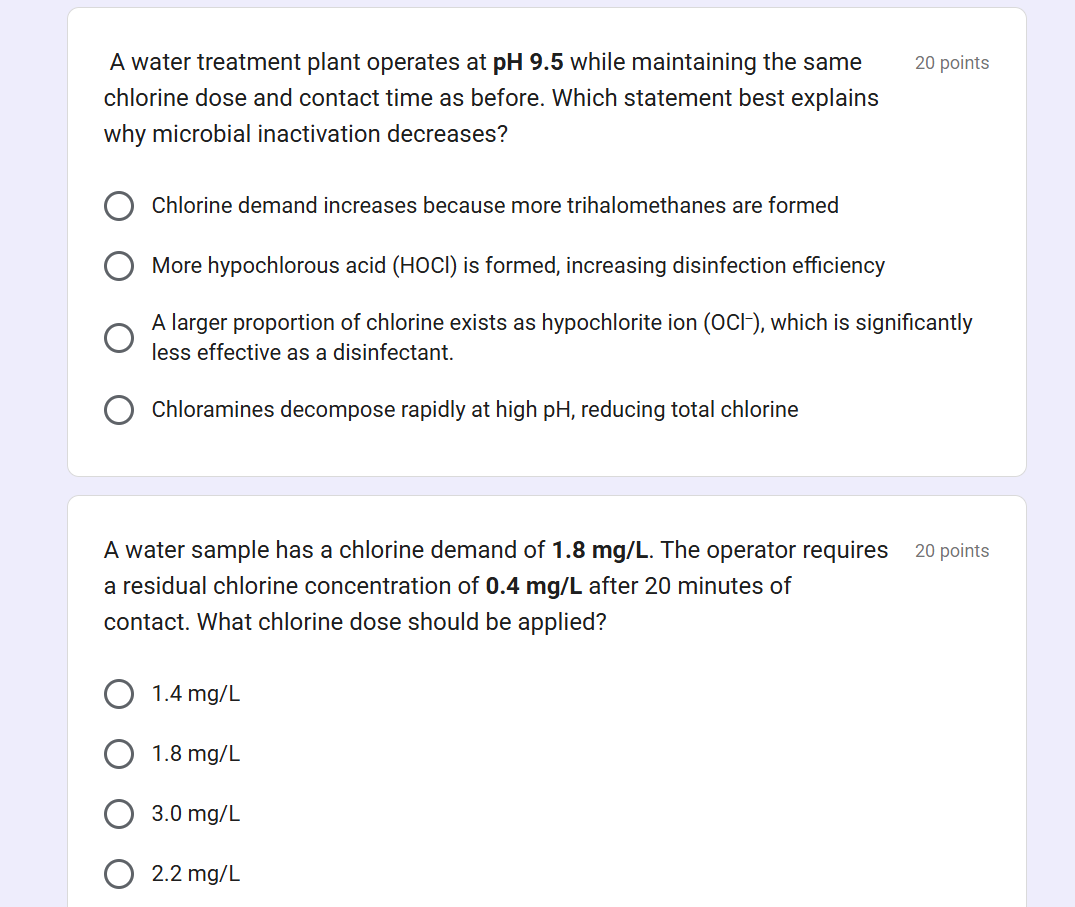
a water treatment plant operates at ph 9.5 while maintaining the same chlorine dose and contact time as before. which statement best explains why microbial inactivation decreases?
chlorine demand increases because more trihalomethanes are formed
more hypochlorous acid (hocl) is formed, increasing disinfection efficiency
a larger proportion of chlorine exists as hypochlorite ion (ocl^-), which is significantly less effective as a disinfectant.
chloramines decompose rapidly at high ph, reducing total chlorine
a water sample has a chlorine demand of 1.8 mg/l. the operator requires a residual chlorine concentration of 0.4 mg/l after 20 minutes of contact. what chlorine dose should be applied?
1.4 mg/l
1.8 mg/l
3.0 mg/l
2.2 mg/l
🆕 New Concept Discovered: Chlorine Speciation and Mass Balance
How pH affects disinfection and how dose relates to demand.
Step 1: Analyze the first question (pH effect on disinfection)
When chlorine gas or hypochlorite is added to water, it establishes a pH-dependent equilibrium between hypochlorous acid (\(\text{HOCl}\)) and hypochlorite ion (\(\text{OCl}^-\)):
- \(\text{HOCl}\) is a highly effective, fast-acting disinfectant because its neutral charge allows it to easily penetrate microbial cell walls.
- \(\text{OCl}^-\) is a much weaker disinfectant (about 80 to 100 times less effective than \(\text{HOCl}\)) because its negative charge is repelled by the negatively charged cell walls of microorganisms.
The acid dissociation constant (\(\text{p}K_a\)) for this reaction is approximately \(7.5\).
- At \(\text{pH} < 7.5\), \(\text{HOCl}\) is the dominant species.
- At \(\text{pH} > 7.5\), \(\text{OCl}^-\) becomes the dominant species.
At a high \(\text{pH}\) of \(9.5\), almost all of the free chlorine exists as the less effective hypochlorite ion (\(\text{OCl}^-\)), which explains why microbial inactivation decreases significantly.
Step 2: Analyze the second question (Chlorine dose calculation)
In water treatment, the relationship between the applied chlorine dose, the chlorine demand (impurities that react with and consume chlorine), and the remaining free chlorine (residual) is defined by the mass balance equation:
Given values:
- \(\text{Chlorine Demand} = 1.8\text{ mg/L}\)
- \(\text{Chlorine Residual} = 0.4\text{ mg/L}\)
Substitute these values into the equation:

Snap & solve any problem in the app
Get step-by-step solutions on Sovi AI
Photo-based solutions with guided steps
Explore more problems and detailed explanations
- First Question:
A larger proportion of chlorine exists as hypochlorite ion (\(\text{OCl}^-\)), which is significantly less effective as a disinfectant.
- Second Question:
\(2.2\text{ mg/L}\)