QUESTION IMAGE
Question
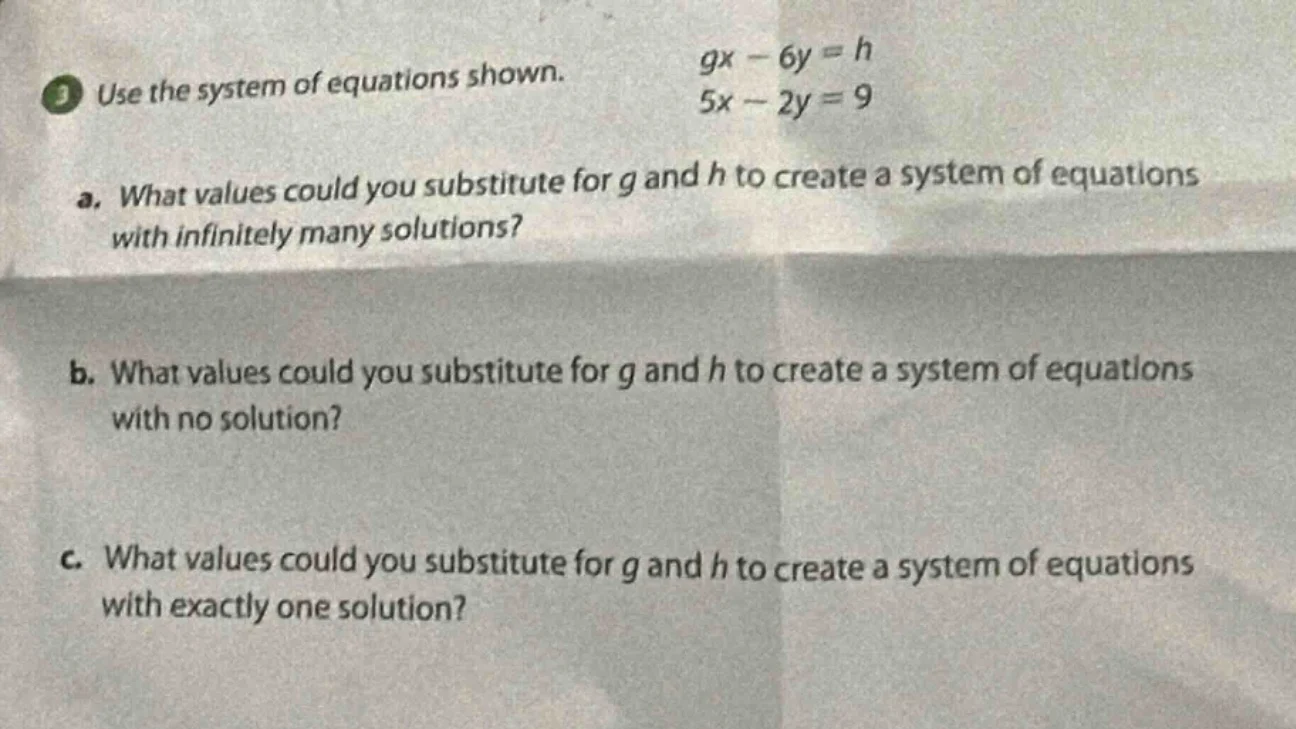
3 use the system of equations shown.
( gx - 6y = h )
( 5x - 2y = 9 )
a. what values could you substitute for ( g ) and ( h ) to create a system of equations with infinitely many solutions?
b. what values could you substitute for ( g ) and ( h ) to create a system of equations with no solution?
c. what values could you substitute for ( g ) and ( h ) to create a system of equations with exactly one solution?
Part a
Step1: Recall condition for infinite solutions
For a system of linear equations \(a_1x + b_1y = c_1\) and \(a_2x + b_2y = c_2\) to have infinitely many solutions, the two equations must be equivalent, i.e., \(\frac{a_1}{a_2}=\frac{b_1}{b_2}=\frac{c_1}{c_2}\).
Given the second equation \(5x - 2y = 9\) and the first equation \(gx - 6y = h\).
First, find the ratio of the coefficients of \(y\): \(\frac{-6}{-2}=3\). So we need \(\frac{g}{5}=3\) and \(\frac{h}{9}=3\) (since \(\frac{b_1}{b_2} = 3\), so \(\frac{a_1}{a_2}\) and \(\frac{c_1}{c_2}\) should also be 3).
Step2: Solve for \(g\)
From \(\frac{g}{5}=3\), multiply both sides by 5: \(g = 5\times3=15\).
Step3: Solve for \(h\)
From \(\frac{h}{9}=3\), multiply both sides by 9: \(h = 9\times3 = 27\).
Step1: Recall condition for no solution
For a system of linear equations \(a_1x + b_1y = c_1\) and \(a_2x + b_2y = c_2\) to have no solution, \(\frac{a_1}{a_2}=\frac{b_1}{b_2}
eq\frac{c_1}{c_2}\).
We already know \(\frac{b_1}{b_2}=\frac{-6}{-2}=3\), so \(\frac{g}{5}=3\) (so \(g = 15\)) and \(\frac{h}{9}
eq3\) (i.e., \(h
eq27\)).
Step2: Determine \(g\) and \(h\)
From \(\frac{g}{5}=3\), we get \(g = 15\). And \(h\) can be any value except 27. For example, if we take \(h = 0\) (any value other than 27), the system will have no solution.
Step1: Recall condition for one solution
For a system of linear equations \(a_1x + b_1y = c_1\) and \(a_2x + b_2y = c_2\) to have exactly one solution, \(\frac{a_1}{a_2}
eq\frac{b_1}{b_2}\).
We know that \(\frac{b_1}{b_2}=\frac{-6}{-2}=3\). So we need \(\frac{g}{5}
eq3\), which means \(g
eq15\). \(h\) can be any real number. For example, let's take \(g = 5\) (not equal to 15) and \(h = 0\).
Step2: Verify
If \(g = 5\) and \(h = 0\), the first equation is \(5x - 6y = 0\) and the second is \(5x - 2y = 9\). Subtracting the second equation from the first: \((5x - 6y)-(5x - 2y)=0 - 9\) \(\Rightarrow - 4y=-9\) \(\Rightarrow y=\frac{9}{4}\), and then we can find \(x\), so there is exactly one solution.

Snap & solve any problem in the app
Get step-by-step solutions on Sovi AI
Photo-based solutions with guided steps
Explore more problems and detailed explanations
\(g = 15\) and \(h = 27\)