QUESTION IMAGE
Question
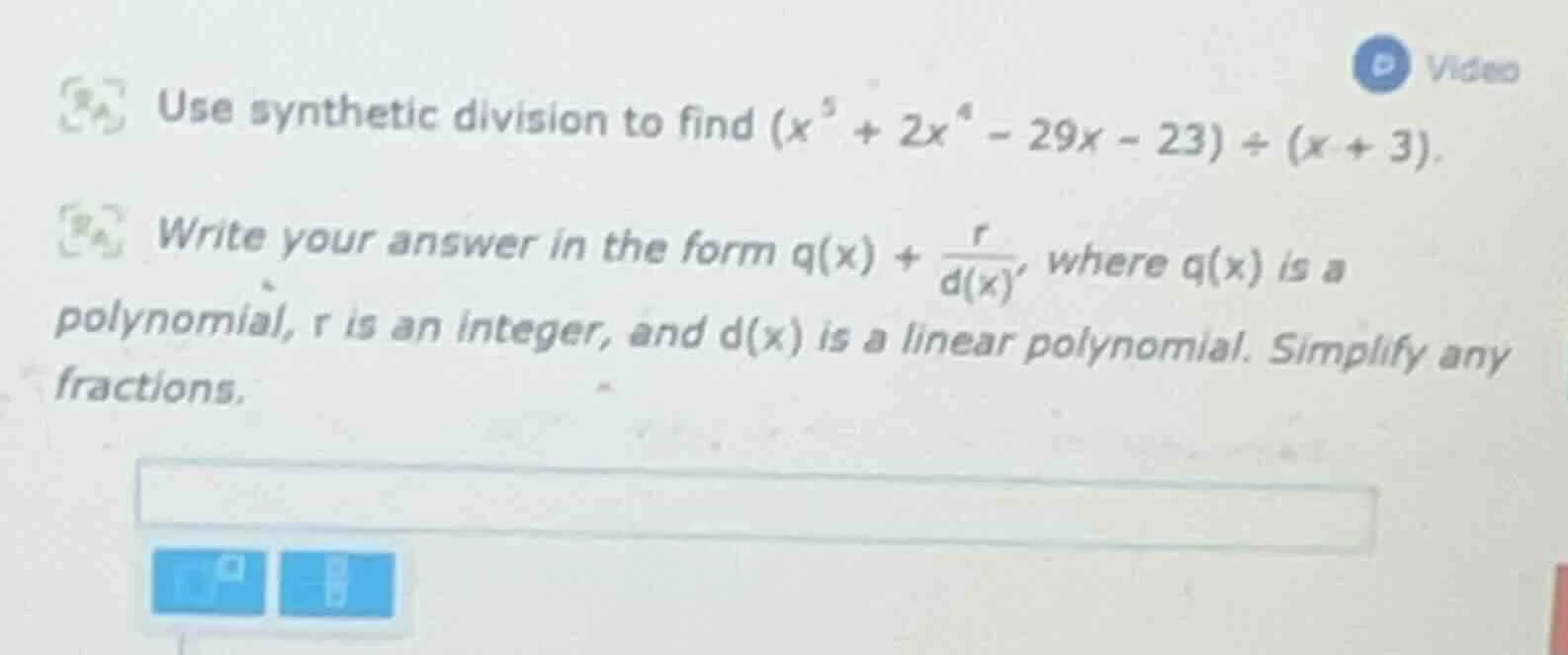
use synthetic division to find ((x^{5} + 2x^{4} - 29x - 23) div (x + 3)). write your answer in the form (q(x) + \frac{r}{d(x)}), where (q(x)) is a polynomial, (r) is an integer, and (d(x)) is a linear polynomial. simplify any fractions.
Step1: Identify the root for synthetic division
For the divisor \(x + 3\), the root is \(x=-3\) (since \(x+3 = 0\) gives \(x=-3\)). The polynomial \(x^{5}+2x^{4}-29x - 23\) can be written as \(x^{5}+2x^{4}+0x^{3}+0x^{2}-29x - 23\) (adding the missing terms with coefficient 0).
Step2: Set up synthetic division
Write the coefficients of the polynomial: \(1, 2, 0, 0, -29, -23\) and the root \(-3\) on the left.
of each step in synthetic division:
- Bring down the first coefficient (\(1\)).
- Multiply \(-3\) by \(1\) to get \(-3\), add to the second coefficient: \(2+(-3)=-1\).
- Multiply \(-3\) by \(-1\) to get \(3\), add to the third coefficient: \(0 + 3=3\).
- Multiply \(-3\) by \(3\) to get \(-9\), add to the fourth coefficient: \(0+(-9)=-9\).
- Multiply \(-3\) by \(-9\) to get \(27\), add to the fifth coefficient: \(-29 + 27=-2\).
- Multiply \(-3\) by \(-2\) to get \(6\), add to the sixth coefficient: \(-23+6=-17\).
The coefficients of the quotient polynomial \(q(x)\) are \(1, -1, 3, -9, -2\) and the remainder \(r=-17\). The degree of \(q(x)\) is one less than the degree of the dividend, so \(q(x)=x^{4}-x^{3}+3x^{2}-9x - 2\), the divisor \(d(x)=x + 3\) and the remainder \(r=-17\).

Snap & solve any problem in the app
Get step-by-step solutions on Sovi AI
Photo-based solutions with guided steps
Explore more problems and detailed explanations
\(x^{4}-x^{3}+3x^{2}-9x - 2+\frac{-17}{x + 3}\) (or \(x^{4}-x^{3}+3x^{2}-9x - 2-\frac{17}{x + 3}\))