Sovi.AI - AI Math Tutor

Scan to solve math questions

QUESTION IMAGE

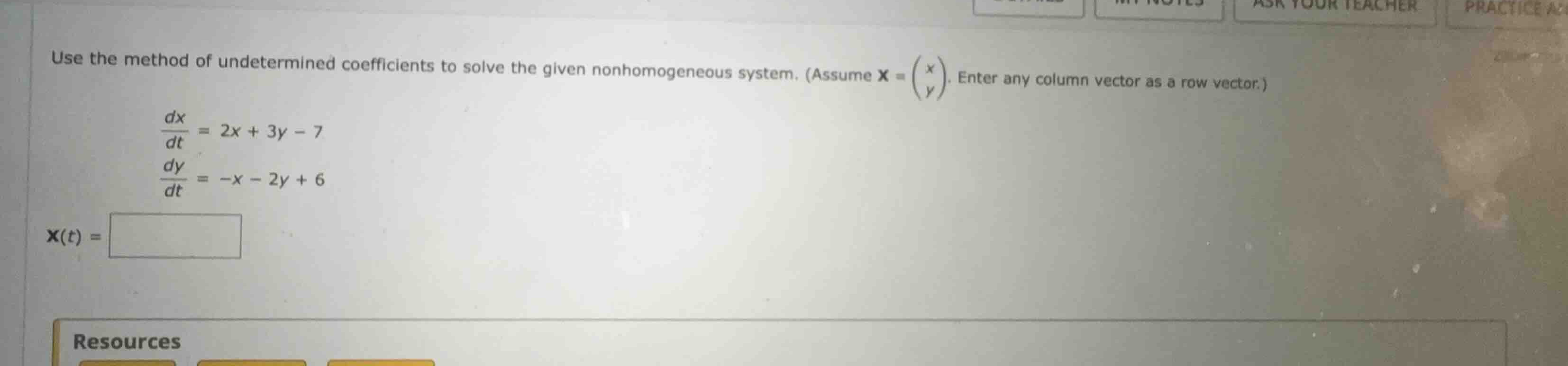
use the method of undetermined coefficients to solve the given nonhomog…

Question

use the method of undetermined coefficients to solve the given nonhomogeneous system. (assume \\(\mathbf{x} = \

$$\begin{pmatrix} x \\\\ y \\end{pmatrix}$$

\\). enter any column vector as a row vector.)

\\\

$$\begin{aligned} \\frac{dx}{dt} &= 2x + 3y - 7 \\\\ \\frac{dy}{dt} &= -x - 2y + 6 \\end{aligned}$$

\\

\\(\mathbf{x}(t) =\\)

Explanation:

Response

<pre_analysis>
{
"quality": "clear",
"question_count": 1,
"skills_matched": [
"step_cot",
"blank_filling_formatter",
"explain_then_answer",
"tutor",
"mastery_adaptive_brevity"
],
"needs_drawing": false,
"concepts_used": [
"Linear Systems of ODEs",
"General Solution of ODE Systems"
],
"new_concepts": [
"Method of Undetermined Coefficients",
"Nonhomogeneous ODE Systems"
],
"current_concepts": [
"Linear Systems of ODEs",
"General Solution of ODE Systems",
"Method of Undetermined Coefficients",
"Nonhomogeneous ODE Systems"
]
}
</pre_analysis>

<reasoning>

Find eigenvalues of the coefficient matrix

Using the Linear Systems of ODEs knowledge point
\[
A =

$$\begin{pmatrix} 2 & 3 \\ -1 & -2 \end{pmatrix}$$

\]
\[
\det(A - \lambda I) = \det

$$\begin{pmatrix} 2-\lambda & 3 \\ -1 & -2-\lambda \end{pmatrix}$$

= \lambda^2 - 1 = 0 \implies \lambda_1 = 1, \lambda_2 = -1
\]

Find eigenvectors for each eigenvalue

Using the General Solution of ODE Systems knowledge point
\[
\lambda_1 = 1: \quad (A - I)\mathbf{v}_1 = \mathbf{0} \implies

$$\begin{pmatrix} 1 & 3 \\ -1 & -3 \end{pmatrix}$$
$$\begin{pmatrix} v_{11} \\ v_{12} \end{pmatrix}$$

=

$$\begin{pmatrix} 0 \\ 0 \end{pmatrix}$$

\implies \mathbf{v}_1 =

$$\begin{pmatrix} 3 \\ -1 \end{pmatrix}$$

\]
\[
\lambda_2 = -1: \quad (A + I)\mathbf{v}_2 = \mathbf{0} \implies

$$\begin{pmatrix} 3 & 3 \\ -1 & -1 \end{pmatrix}$$
$$\begin{pmatrix} v_{21} \\ v_{22} \end{pmatrix}$$

=

$$\begin{pmatrix} 0 \\ 0 \end{pmatrix}$$

\implies \mathbf{v}_2 =

$$\begin{pmatrix} 1 \\ -1 \end{pmatrix}$$

\]
\[
\mathbf{X}_c(t) = c_1 e^t

$$\begin{pmatrix} 3 \\ -1 \end{pmatrix}$$

+ c_2 e^{-t}

$$\begin{pmatrix} 1 \\ -1 \end{pmatrix}$$

\]

Find particular solution using undetermined coefficients

Assume a constant particular solution vector:
\[
\mathbf{X}_p =

$$\begin{pmatrix} a \\ b \end{pmatrix}$$

\]
\[
\mathbf{X}_p' = A\mathbf{X}_p + \mathbf{F}(t) \implies

$$\begin{pmatrix} 0 \\ 0 \end{pmatrix}$$

=

$$\begin{pmatrix} 2 & 3 \\ -1 & -2 \end{pmatrix}$$
$$\begin{pmatrix} a \\ b \end{pmatrix}$$

+

$$\begin{pmatrix} -7 \\ 6 \end{pmatrix}$$

\]
\[

$$\begin{cases} 2a + 3b = 7 \\ -a - 2b = -6 \end{cases}$$

\implies a = -4, \ b = 5 \implies \mathbf{X}_p =

$$\begin{pmatrix} -4 \\ 5 \end{pmatrix}$$

\]

Combine complementary and particular solutions

Combine the solutions:
\[
\mathbf{X}(t) = \mathbf{X}_c(t) + \mathbf{X}_p = c_1 e^t

$$\begin{pmatrix} 3 \\ -1 \end{pmatrix}$$

+ c_2 e^{-t}

$$\begin{pmatrix} 1 \\ -1 \end{pmatrix}$$

+

$$\begin{pmatrix} -4 \\ 5 \end{pmatrix}$$

\]
</reasoning>

<answer>
Use the method of undetermined coefficients to solve the given nonhomogeneous system. (Assume \(\mathbf{X} =

$$\begin{pmatrix} x \\ y \end{pmatrix}$$

\). Enter any column vector as a row vector.)

\(\mathbf{X}(t) =\) <blank>\(c_1 e^t

$$\begin{pmatrix} 3 \\ -1 \end{pmatrix}$$

+ c_2 e^{-t}

$$\begin{pmatrix} 1 \\ -1 \end{pmatrix}$$

+

$$\begin{pmatrix} -4 \\ 5 \end{pmatrix}$$

\)</blank>
</answer>

<post_analysis>
{
"subject": "Mathematics",
"question_type": "Fill-in-the-blank",
"knowledge_point": [
"Mathematics",
"Calculus",
"Nonhomogeneous ODE Systems"
]
}
</post_analysis>

Answer:

<pre_analysis>
{
"quality": "clear",
"question_count": 1,
"skills_matched": [
"step_cot",
"blank_filling_formatter",
"explain_then_answer",
"tutor",
"mastery_adaptive_brevity"
],
"needs_drawing": false,
"concepts_used": [
"Linear Systems of ODEs",
"General Solution of ODE Systems"
],
"new_concepts": [
"Method of Undetermined Coefficients",
"Nonhomogeneous ODE Systems"
],
"current_concepts": [
"Linear Systems of ODEs",
"General Solution of ODE Systems",
"Method of Undetermined Coefficients",
"Nonhomogeneous ODE Systems"
]
}
</pre_analysis>

<reasoning>

Find eigenvalues of the coefficient matrix

Using the Linear Systems of ODEs knowledge point
\[
A =

$$\begin{pmatrix} 2 & 3 \\ -1 & -2 \end{pmatrix}$$

\]
\[
\det(A - \lambda I) = \det

$$\begin{pmatrix} 2-\lambda & 3 \\ -1 & -2-\lambda \end{pmatrix}$$

= \lambda^2 - 1 = 0 \implies \lambda_1 = 1, \lambda_2 = -1
\]

Find eigenvectors for each eigenvalue

Using the General Solution of ODE Systems knowledge point
\[
\lambda_1 = 1: \quad (A - I)\mathbf{v}_1 = \mathbf{0} \implies

$$\begin{pmatrix} 1 & 3 \\ -1 & -3 \end{pmatrix}$$
$$\begin{pmatrix} v_{11} \\ v_{12} \end{pmatrix}$$

=

$$\begin{pmatrix} 0 \\ 0 \end{pmatrix}$$

\implies \mathbf{v}_1 =

$$\begin{pmatrix} 3 \\ -1 \end{pmatrix}$$

\]
\[
\lambda_2 = -1: \quad (A + I)\mathbf{v}_2 = \mathbf{0} \implies

$$\begin{pmatrix} 3 & 3 \\ -1 & -1 \end{pmatrix}$$
$$\begin{pmatrix} v_{21} \\ v_{22} \end{pmatrix}$$

=

$$\begin{pmatrix} 0 \\ 0 \end{pmatrix}$$

\implies \mathbf{v}_2 =

$$\begin{pmatrix} 1 \\ -1 \end{pmatrix}$$

\]
\[
\mathbf{X}_c(t) = c_1 e^t

$$\begin{pmatrix} 3 \\ -1 \end{pmatrix}$$

+ c_2 e^{-t}

$$\begin{pmatrix} 1 \\ -1 \end{pmatrix}$$

\]

Find particular solution using undetermined coefficients

Assume a constant particular solution vector:
\[
\mathbf{X}_p =

$$\begin{pmatrix} a \\ b \end{pmatrix}$$

\]
\[
\mathbf{X}_p' = A\mathbf{X}_p + \mathbf{F}(t) \implies

$$\begin{pmatrix} 0 \\ 0 \end{pmatrix}$$

=

$$\begin{pmatrix} 2 & 3 \\ -1 & -2 \end{pmatrix}$$
$$\begin{pmatrix} a \\ b \end{pmatrix}$$

+

$$\begin{pmatrix} -7 \\ 6 \end{pmatrix}$$

\]
\[

$$\begin{cases} 2a + 3b = 7 \\ -a - 2b = -6 \end{cases}$$

\implies a = -4, \ b = 5 \implies \mathbf{X}_p =

$$\begin{pmatrix} -4 \\ 5 \end{pmatrix}$$

\]

Combine complementary and particular solutions

Combine the solutions:
\[
\mathbf{X}(t) = \mathbf{X}_c(t) + \mathbf{X}_p = c_1 e^t

$$\begin{pmatrix} 3 \\ -1 \end{pmatrix}$$

+ c_2 e^{-t}

$$\begin{pmatrix} 1 \\ -1 \end{pmatrix}$$

+

$$\begin{pmatrix} -4 \\ 5 \end{pmatrix}$$

\]
</reasoning>

<answer>
Use the method of undetermined coefficients to solve the given nonhomogeneous system. (Assume \(\mathbf{X} =

$$\begin{pmatrix} x \\ y \end{pmatrix}$$

\). Enter any column vector as a row vector.)

\(\mathbf{X}(t) =\) <blank>\(c_1 e^t

$$\begin{pmatrix} 3 \\ -1 \end{pmatrix}$$

+ c_2 e^{-t}

$$\begin{pmatrix} 1 \\ -1 \end{pmatrix}$$

+

$$\begin{pmatrix} -4 \\ 5 \end{pmatrix}$$

\)</blank>
</answer>

<post_analysis>
{
"subject": "Mathematics",
"question_type": "Fill-in-the-blank",
"knowledge_point": [
"Mathematics",
"Calculus",
"Nonhomogeneous ODE Systems"
]
}
</post_analysis>