QUESTION IMAGE
Question
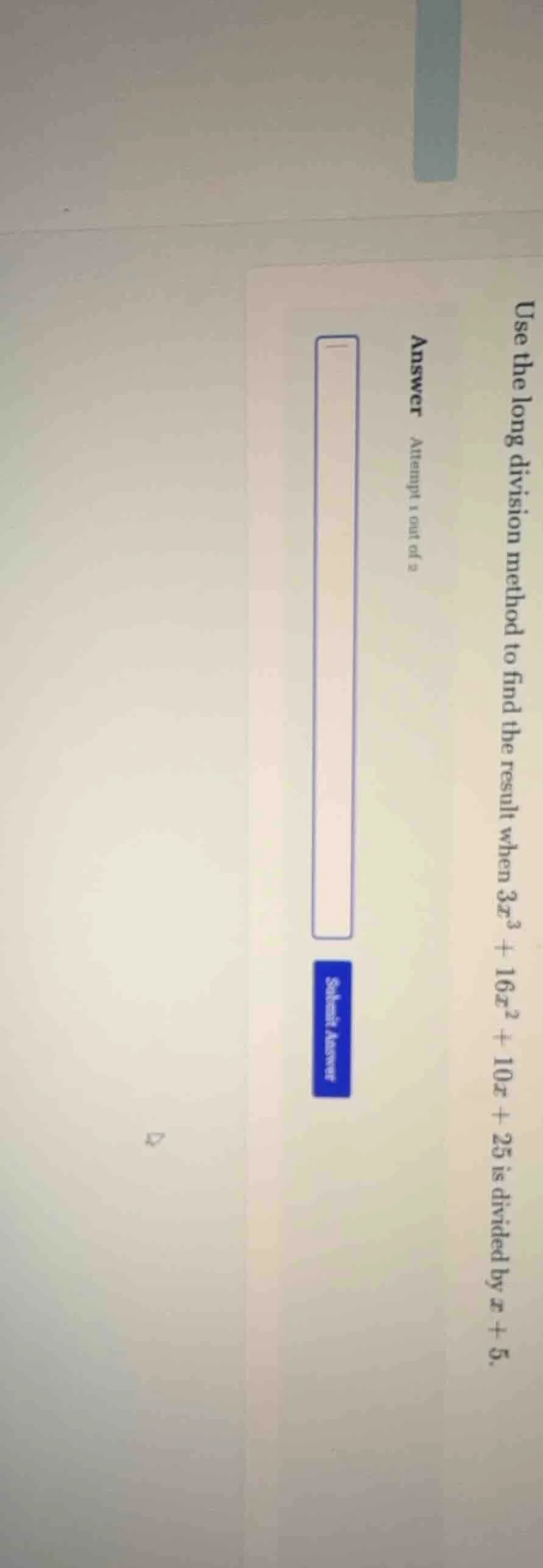
use the long division method to find the result when $3x^3 + 16x^2 + 10x + 25$ is divided by $x + 5$.
answer
attempt 1 out of 2
submit answer
Step1: Divide the leading terms
Divide the leading term of the dividend \(3x^{3}+16x^{2}+10x + 25\) (which is \(3x^{3}\)) by the leading term of the divisor \(x + 5\) (which is \(x\)). So, \(\frac{3x^{3}}{x}=3x^{2}\).
Step2: Multiply and subtract
Multiply the divisor \(x + 5\) by \(3x^{2}\) to get \(3x^{3}+15x^{2}\). Subtract this from the dividend:
\[
\]
Step3: Divide the new leading terms
Now, divide the leading term of the new dividend \(x^{2}+10x + 25\) (which is \(x^{2}\)) by the leading term of the divisor \(x\). So, \(\frac{x^{2}}{x}=x\).
Step4: Multiply and subtract again
Multiply the divisor \(x + 5\) by \(x\) to get \(x^{2}+5x\). Subtract this from \(x^{2}+10x + 25\):
\[
\]
Step5: Divide the new leading terms again
Divide the leading term of the new dividend \(5x + 25\) (which is \(5x\)) by the leading term of the divisor \(x\). So, \(\frac{5x}{x}=5\).
Step6: Multiply and subtract the last time
Multiply the divisor \(x + 5\) by \(5\) to get \(5x + 25\). Subtract this from \(5x + 25\):
\[
(5x + 25)-(5x + 25)=0
\]
Step7: Combine the results
The terms we got from each division step are \(3x^{2}\), \(x\), and \(5\). So the result of the division is \(3x^{2}+x + 5\).

Snap & solve any problem in the app
Get step-by-step solutions on Sovi AI
Photo-based solutions with guided steps
Explore more problems and detailed explanations
\(3x^{2}+x + 5\)