QUESTION IMAGE
Question
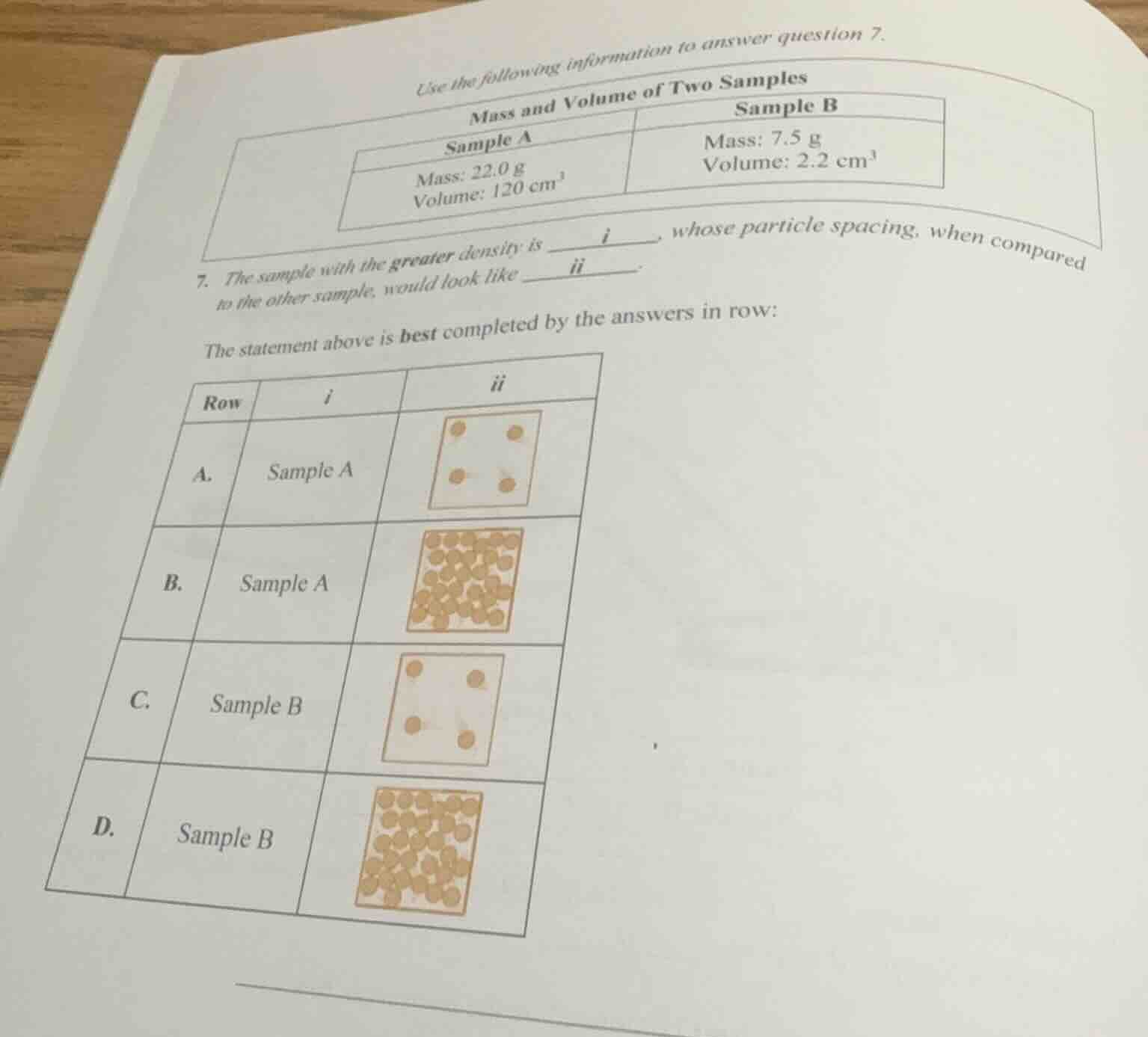
use the following information to answer question 7.
mass and volume of two samples
\
- the sample with the greater density is \\(i\\), whose particle spacing, when compared to the other sample, would look like \\(ii\\).
the statement above is best completed by the answers in row:
\
<pre_analysis>
{
"quality": "clear",
"question_count": 1,
"skills_matched": [
"step_cot",
"multiple_choice_formatter",
"explain_then_answer",
"tutor",
"mastery_adaptive_brevity"
],
"needs_drawing": false,
"concepts_used": [
"Particle Theory of Matter",
"Spaces Between Particles"
],
"new_concepts": [
"Density Calculation"
],
"current_concepts": [
"Density Calculation",
"Particle Theory of Matter",
"Spaces Between Particles"
]
}
</pre_analysis>
<reasoning>
Calculate the density of Sample A
Using the Density Calculation knowledge point
\[
\text{Density}_A = \frac{\text{Mass}}{\text{Volume}} = \frac{22.0\text{ g}}{120\text{ cm}^3} \approx 0.183\text{ g/cm}^3
\]
Calculate the density of Sample B
Using the Density Calculation knowledge point
\[
\text{Density}_B = \frac{\text{Mass}}{\text{Volume}} = \frac{7.5\text{ g}}{2.2\text{ cm}^3} \approx 3.41\text{ g/cm}^3
\]
Compare densities to identify blank i
Using the Density Calculation knowledge point
\[
3.41\text{ g/cm}^3 > 0.183\text{ g/cm}^3 \implies \text{Density}_B > \text{Density}_A
\]
Thus, the sample with the greater density is Sample B.
Relate density to particle spacing for blank ii
Using the Particle Theory of Matter and Spaces Between Particles knowledge points
\[
\text{Greater Density} \implies \text{More particles per unit volume} \implies \text{Closely packed particles}
\]
The diagram representing closely packed particles with minimal spacing is the dense grid of circles shown in row D.
Match findings to the correct option
Combining the results:
- Blank i: Sample B
- Blank ii: Closely packed particle diagram (row D)
</reasoning>
<answer>
<mcq-option>(A) Sample A, widely spaced particles</mcq-option>
<mcq-option>(B) Sample A, closely packed particles</mcq-option>
<mcq-option>(C) Sample B, widely spaced particles</mcq-option>
<mcq-correct>(D) Sample B, closely packed particles</mcq-correct>
</answer>
<post_analysis>
{
"subject": "Natural Science",
"question_type": "Multiple Choice",
"knowledge_point": [
"Natural Science",
"Physics",
"Density and Particle Theory"
]
}
</post_analysis>
Snap & solve any problem in the app
Get step-by-step solutions on Sovi AI
Photo-based solutions with guided steps
Explore more problems and detailed explanations
<pre_analysis>
{
"quality": "clear",
"question_count": 1,
"skills_matched": [
"step_cot",
"multiple_choice_formatter",
"explain_then_answer",
"tutor",
"mastery_adaptive_brevity"
],
"needs_drawing": false,
"concepts_used": [
"Particle Theory of Matter",
"Spaces Between Particles"
],
"new_concepts": [
"Density Calculation"
],
"current_concepts": [
"Density Calculation",
"Particle Theory of Matter",
"Spaces Between Particles"
]
}
</pre_analysis>
<reasoning>
Calculate the density of Sample A
Using the Density Calculation knowledge point
\[
\text{Density}_A = \frac{\text{Mass}}{\text{Volume}} = \frac{22.0\text{ g}}{120\text{ cm}^3} \approx 0.183\text{ g/cm}^3
\]
Calculate the density of Sample B
Using the Density Calculation knowledge point
\[
\text{Density}_B = \frac{\text{Mass}}{\text{Volume}} = \frac{7.5\text{ g}}{2.2\text{ cm}^3} \approx 3.41\text{ g/cm}^3
\]
Compare densities to identify blank i
Using the Density Calculation knowledge point
\[
3.41\text{ g/cm}^3 > 0.183\text{ g/cm}^3 \implies \text{Density}_B > \text{Density}_A
\]
Thus, the sample with the greater density is Sample B.
Relate density to particle spacing for blank ii
Using the Particle Theory of Matter and Spaces Between Particles knowledge points
\[
\text{Greater Density} \implies \text{More particles per unit volume} \implies \text{Closely packed particles}
\]
The diagram representing closely packed particles with minimal spacing is the dense grid of circles shown in row D.
Match findings to the correct option
Combining the results:
- Blank i: Sample B
- Blank ii: Closely packed particle diagram (row D)
</reasoning>
<answer>
<mcq-option>(A) Sample A, widely spaced particles</mcq-option>
<mcq-option>(B) Sample A, closely packed particles</mcq-option>
<mcq-option>(C) Sample B, widely spaced particles</mcq-option>
<mcq-correct>(D) Sample B, closely packed particles</mcq-correct>
</answer>
<post_analysis>
{
"subject": "Natural Science",
"question_type": "Multiple Choice",
"knowledge_point": [
"Natural Science",
"Physics",
"Density and Particle Theory"
]
}
</post_analysis>