QUESTION IMAGE
Question
use the following information to answer question 2.
a circuit made with four identical light bulbs is built with the following features:
- all four lights are turned on and off by one switch.
- each light bulb emits an equal brightness.
- if one light bulb goes out, the other three stay on.
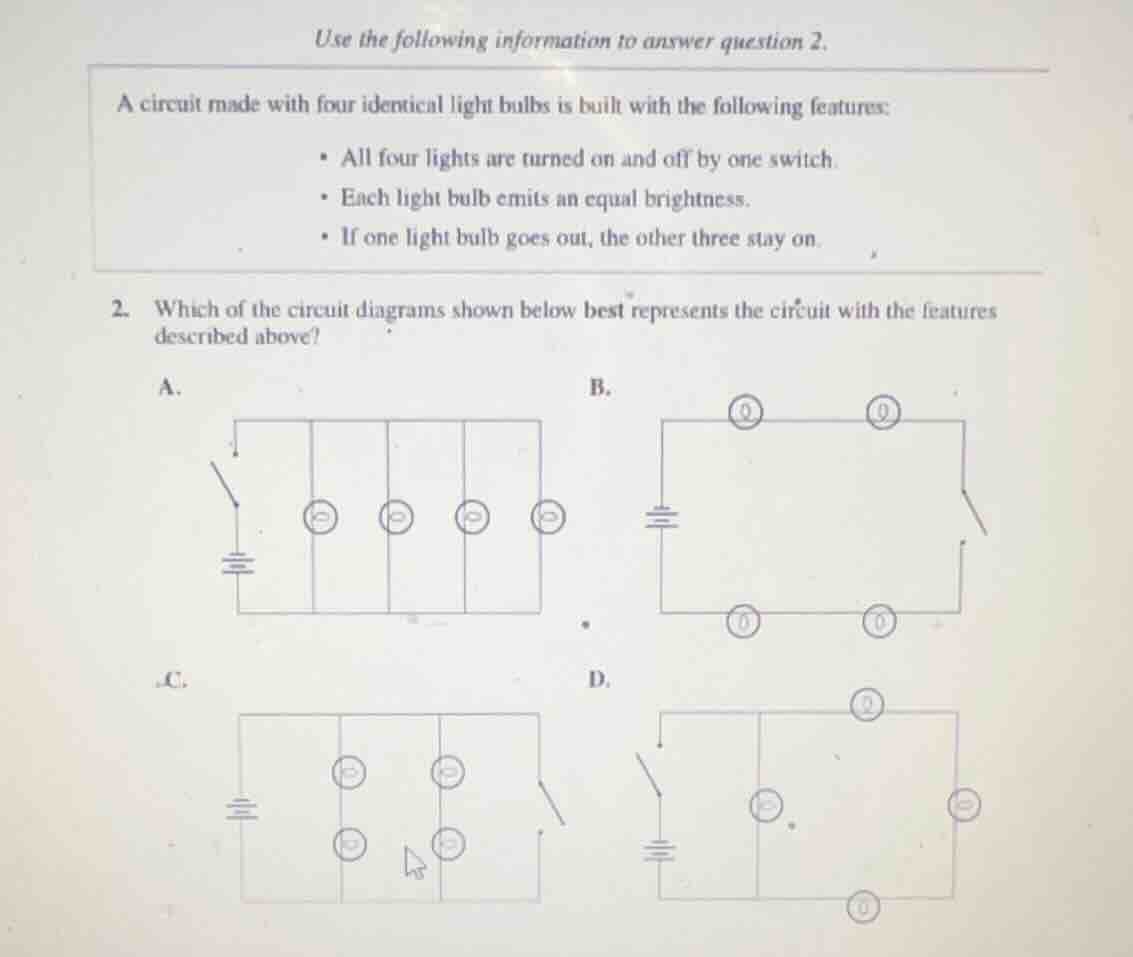
- which of the circuit diagrams shown below best represents the circuit with the features described above?
Analyze the switch requirement
The circuit must turn all four lights on and off using a single switch. This means the switch must be placed in the main branch of the circuit, in series with the power source, so that opening it cuts off current to all paths.
Analyze the independent operation requirement
The problem states that if one light bulb goes out, the other three must stay on. In a series circuit, if one component fails, the entire circuit is broken and all lights go out. Therefore, the bulbs cannot be in series with each other. They must be connected in parallel branches so that each bulb has its own independent path to the power source.
Analyze the equal brightness requirement
For identical bulbs to emit equal brightness, they must experience the same voltage and current. A fully parallel circuit where each of the four identical bulbs is in its own parallel branch across the same potential difference ensures they all have equal brightness and operate independently.
Evaluate the given circuit diagrams
- Diagram A: All four identical bulbs are connected in parallel with each other. The switch is located in the main branch next to the battery. If the switch is open, no current flows (all off). If closed, all four bulbs are in parallel across the battery, receiving equal voltage (equal brightness). If one bulb burns out (open circuit in its branch), the other three branches remain closed loops, so the other three bulbs stay on. This matches all criteria.
- Diagram B: All four bulbs are connected in series. If one bulb goes out, the circuit is broken and all go out.
- Diagram C: This shows a series-parallel combination (two parallel branches, each containing two bulbs in series). If one bulb goes out, its partner in series also goes out.
- Diagram D: This shows a complex series-parallel arrangement where the bulbs do not share identical operating conditions or independent paths.

Snap & solve any problem in the app
Get step-by-step solutions on Sovi AI
Photo-based solutions with guided steps
Explore more problems and detailed explanations
- (A) Four bulbs in parallel with a main-branch switch (Correct answer)
- (B) Four bulbs in series
- (C) Two parallel branches of two series bulbs
- (D) Mixed series-parallel bridge circuit