Sovi.AI - AI Math Tutor

Scan to solve math questions

QUESTION IMAGE

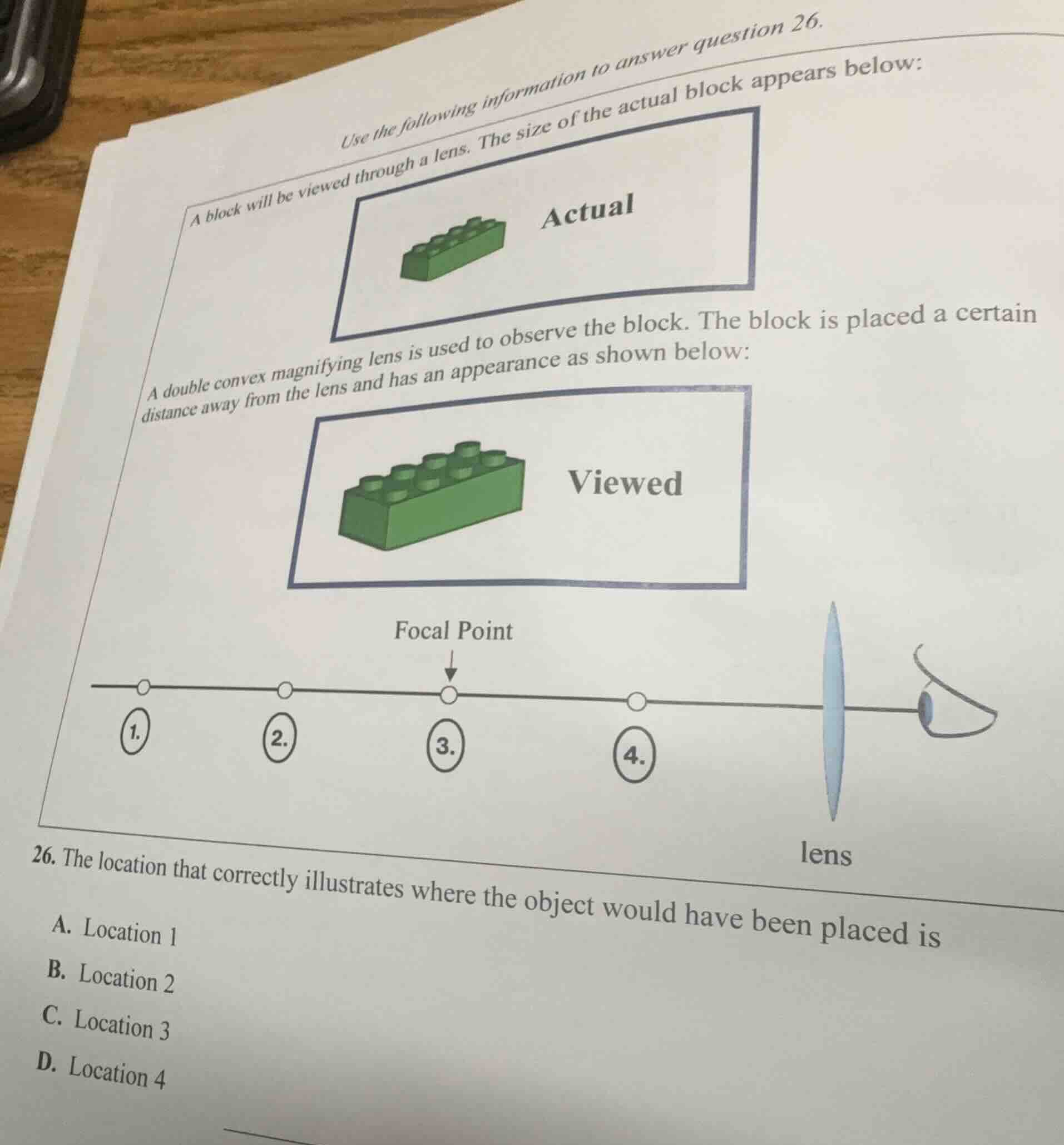
use the following information to answer question 26. a block will be vi…

Question

use the following information to answer question 26.

a block will be viewed through a lens. the size of the actual block appears below:
actual

a double convex magnifying lens is used to observe the block. the block is placed a certain distance away from the lens and has an appearance as shown below:
viewed

  1. the location that correctly illustrates where the object would have been placed is

a. location 1
b. location 2
c. location 3
d. location 4

Explanation:

Response

<pre_analysis>
{
"quality": "clear",
"question_count": 1,
"skills_matched": [
"direct_cot",
"multiple_choice_formatter",
"explain_then_answer",
"tutor"
],
"needs_drawing": false,
"concepts_used": [],
"new_concepts": [
"Convex Lens Imaging",
"Magnifying Glass Physics",
"Virtual Image Formation"
],
"current_concepts": [
"Convex Lens Imaging",
"Magnifying Glass Physics",
"Virtual Image Formation"
]
}
</pre_analysis>

<reasoning>

Analyze the observed image characteristics

The actual object is a small green toy block. When viewed through the double convex magnifying lens, the image is upright (not inverted) and magnified (larger than the actual block).

Determine the type of image formed

A double convex lens forms an upright, magnified image only when it acts as a magnifying glass. This type of image is a virtual image.

Identify the required object position

For a convex lens to produce an upright, magnified virtual image, the object must be placed between the lens and its focal point.

Match with the diagram locations

Looking at the provided diagram:

  • Location 3 is labeled as the "Focal Point".
  • Location 4 lies between the focal point (Location 3) and the lens.
  • Therefore, the object must be placed at Location 4.

</reasoning>

<answer>
<mcq-option>A. Location 1</mcq-option>
<mcq-option>B. Location 2</mcq-option>
<mcq-option>C. Location 3</mcq-option>
<mcq-correct>D. Location 4</mcq-correct>
</answer>

<post_analysis>
{
"subject": "Natural Science",
"question_type": "Multiple Choice",
"knowledge_point": [
"Natural Science",
"Physics",
"Optics and Light"
]
}
</post_analysis>

Answer:

<pre_analysis>
{
"quality": "clear",
"question_count": 1,
"skills_matched": [
"direct_cot",
"multiple_choice_formatter",
"explain_then_answer",
"tutor"
],
"needs_drawing": false,
"concepts_used": [],
"new_concepts": [
"Convex Lens Imaging",
"Magnifying Glass Physics",
"Virtual Image Formation"
],
"current_concepts": [
"Convex Lens Imaging",
"Magnifying Glass Physics",
"Virtual Image Formation"
]
}
</pre_analysis>

<reasoning>

Analyze the observed image characteristics

The actual object is a small green toy block. When viewed through the double convex magnifying lens, the image is upright (not inverted) and magnified (larger than the actual block).

Determine the type of image formed

A double convex lens forms an upright, magnified image only when it acts as a magnifying glass. This type of image is a virtual image.

Identify the required object position

For a convex lens to produce an upright, magnified virtual image, the object must be placed between the lens and its focal point.

Match with the diagram locations

Looking at the provided diagram:

  • Location 3 is labeled as the "Focal Point".
  • Location 4 lies between the focal point (Location 3) and the lens.
  • Therefore, the object must be placed at Location 4.

</reasoning>

<answer>
<mcq-option>A. Location 1</mcq-option>
<mcq-option>B. Location 2</mcq-option>
<mcq-option>C. Location 3</mcq-option>
<mcq-correct>D. Location 4</mcq-correct>
</answer>

<post_analysis>
{
"subject": "Natural Science",
"question_type": "Multiple Choice",
"knowledge_point": [
"Natural Science",
"Physics",
"Optics and Light"
]
}
</post_analysis>