QUESTION IMAGE
Question
use the data below to answer question 11-12.
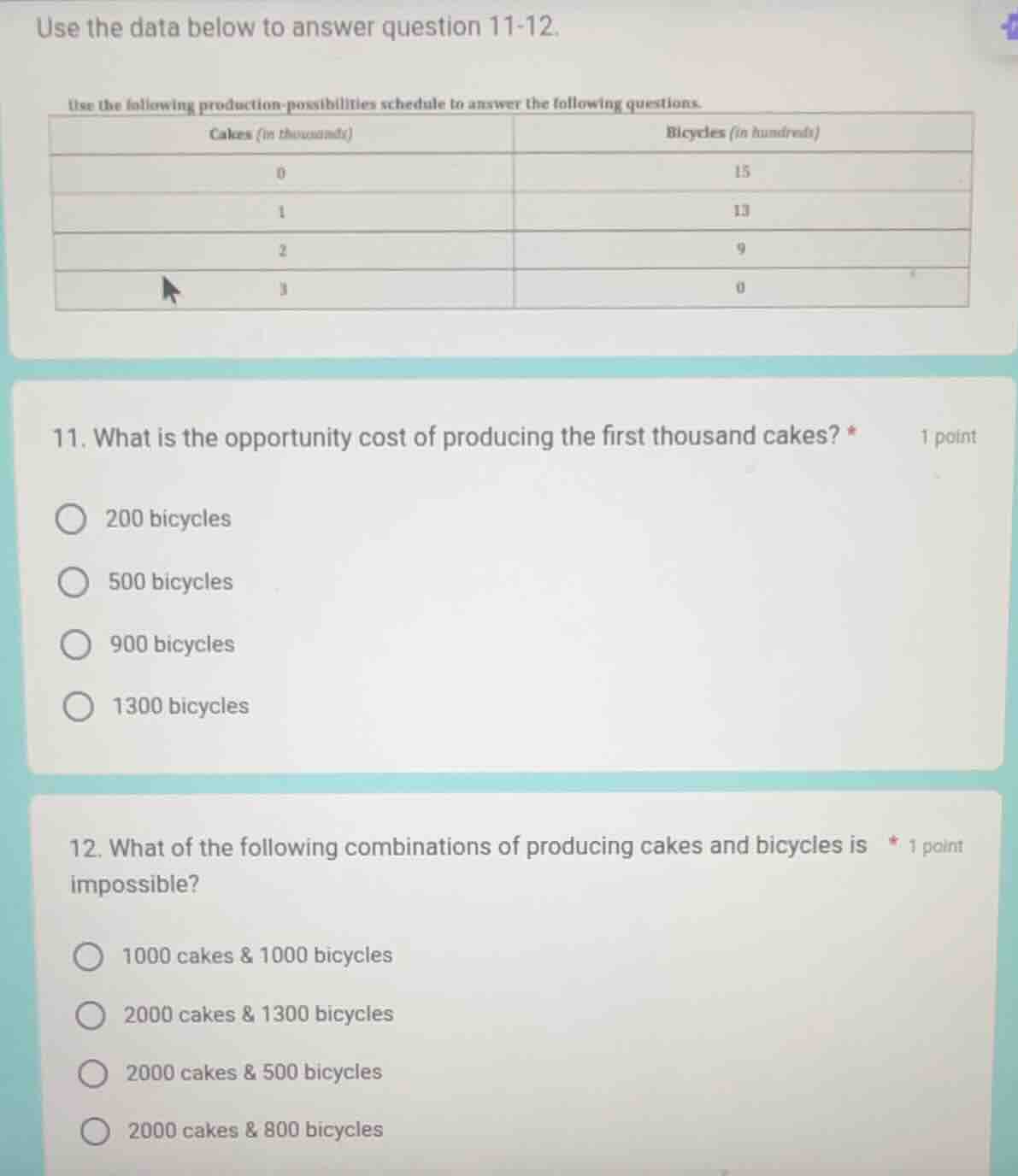
use the following production-possibilities schedule to answer the following questions.
\
$$\begin{tabular}{|c|c|}
\\hline
cakes (in thousands) & bicycles (in hundreds) \\\\
\\hline
0 & 15 \\\\
\\hline
1 & 13 \\\\
\\hline
2 & 9 \\\\
\\hline
3 & 0 \\\\
\\hline
\\end{tabular}$$
- what is the opportunity cost of producing the first thousand cakes?
- 200 bicycles
- 500 bicycles
- 900 bicycles
- 1300 bicycles
- what of the following combinations of producing cakes and bicycles is impossible?
- 1000 cakes & 1000 bicycles
- 2000 cakes & 1300 bicycles
- 2000 cakes & 500 bicycles
- 2000 cakes & 800 bicycles
Analyze the production schedule
The table shows the production possibilities for cakes (in thousands) and bicycles (in hundreds):
- Combination A: 0 cakes (0) and 15 hundred bicycles (1500)
- Combination B: 1 thousand cakes (1000) and 13 hundred bicycles (1300)
- Combination C: 2 thousand cakes (2000) and 9 hundred bicycles (900)
- Combination D: 3 thousand cakes (3000) and 0 bicycles (0)
Calculate opportunity cost for Question 11
Using the Opportunity Cost knowledge point:
- To produce the first thousand cakes (moving from 0 to 1 thousand cakes), bicycle production decreases from 15 hundred to 13 hundred.
- The decrease is:
$$
15 - 13 = 2\text{ hundred bicycles} = 200\text{ bicycles}
$$
- Thus, the opportunity cost is 200 bicycles.
Evaluate combinations for Question 12
Using the Opportunity Cost and production possibilities concepts:
- At 1000 cakes, the maximum possible bicycles is 1300. Thus, 1000 cakes & 1000 bicycles is possible (underutilization).
- At 2000 cakes, the maximum possible bicycles is 900.
- Comparing the options for 2000 cakes:
- 2000 cakes & 1300 bicycles: Requires more than the maximum possible (900), so it is impossible.
- 2000 cakes & 500 bicycles: Less than 900, so it is possible.
- 2000 cakes & 800 bicycles: Less than 900, so it is possible.
- Therefore, 2000 cakes & 1300 bicycles is impossible.

Snap & solve any problem in the app
Get step-by-step solutions on Sovi AI
Photo-based solutions with guided steps
Explore more problems and detailed explanations
Question 11
- (A) 200 bicycles (Correct answer)
- (B) 500 bicycles
- (C) 900 bicycles
- (D) 1300 bicycles
Question 12
- (A) 1000 cakes & 1000 bicycles
- (B) 2000 cakes & 1300 bicycles (Correct answer)
- (C) 2000 cakes & 500 bicycles
- (D) 2000 cakes & 800 bicycles