QUESTION IMAGE
Question
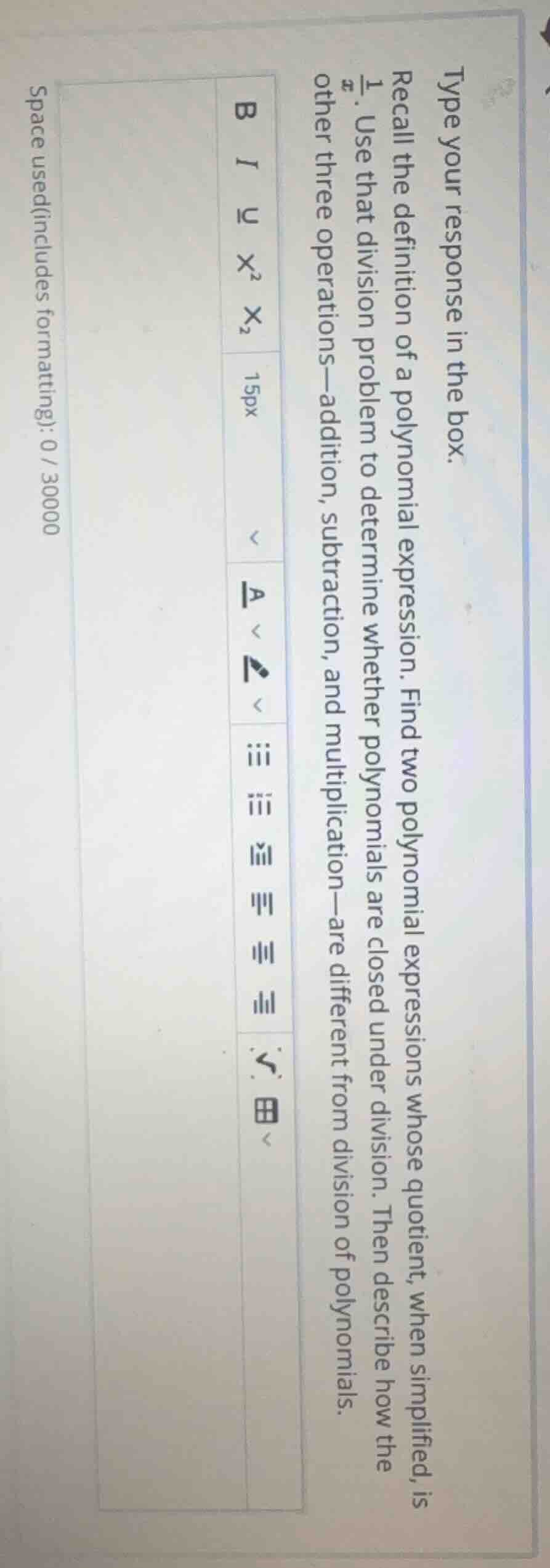
type your response in the box. recall the definition of a polynomial expression. find two polynomial expressions whose quotient, when simplified, is \\(\frac{1}{x}\\). use that division problem to determine whether polynomials are closed under division. then describe how the other three operations—addition, subtraction, and multiplication—are different from division of polynomials.
Step1: Choose Polynomials
Let's take two polynomials: \( f(x) = x^2 + x \) (a polynomial) and \( g(x) = x \) (also a polynomial).
Step2: Perform Division
Now, divide \( f(x) \) by \( g(x) \):
\( \frac{f(x)}{g(x)}=\frac{x^2 + x}{x} \)
Using the rule of dividing each term in the numerator by the denominator:
\( \frac{x^2}{x}+\frac{x}{x} = x + 1 \) (which is a polynomial).
But let's take another example where the quotient is not a polynomial. Let \( f(x)=x \) and \( g(x)=x^2 \). Then \( \frac{f(x)}{g(x)}=\frac{x}{x^2}=\frac{1}{x} \), which is not a polynomial (since polynomials have non - negative integer exponents, and \( \frac{1}{x}=x^{-1} \) has a negative exponent).
To show a case where the quotient is \( \frac{1}{x} \) (as per the problem's mention of \( \frac{1}{x} \)), let's use \( f(x) = 1 \) (a constant polynomial, which is a polynomial with degree 0) and \( g(x)=x \) (a polynomial). Then \( \frac{f(x)}{g(x)}=\frac{1}{x} \).
Now, let's check closure. Polynomials are closed under addition: if \( p(x)=\sum_{i = 0}^{n}a_ix^i \) and \( q(x)=\sum_{i = 0}^{m}b_ix^i \), then \( p(x)+q(x)=\sum_{i = 0}^{\max(n,m)}(a_i + b_i)x^i \) (with \( a_i = 0 \) or \( b_i = 0 \) if the degree of one polynomial is less than the other), which is a polynomial.
For subtraction: \( p(x)-q(x)=\sum_{i = 0}^{\max(n,m)}(a_i - b_i)x^i \), also a polynomial.
For multiplication: If \( p(x)=\sum_{i = 0}^{n}a_ix^i \) and \( q(x)=\sum_{i = 0}^{m}b_ix^i \), then \( p(x)\times q(x)=\sum_{k = 0}^{n + m}(\sum_{i + j=k}a_ib_j)x^k \), which is a polynomial.
But for division, as seen in the example \( \frac{1}{x} \), the result is not always a polynomial. So polynomials are not closed under division, while they are closed under addition, subtraction, and multiplication.

Snap & solve any problem in the app
Get step-by-step solutions on Sovi AI
Photo-based solutions with guided steps
Explore more problems and detailed explanations
Let the two polynomials be \( f(x)=1 \) (a polynomial) and \( g(x) = x \) (a polynomial). Their quotient is \( \frac{f(x)}{g(x)}=\frac{1}{x} \). Polynomials are closed under addition, subtraction, and multiplication (the sum, difference, or product of two polynomials is always a polynomial). However, polynomials are not closed under division because, as shown, the quotient of two polynomials may not be a polynomial (e.g., \( \frac{1}{x} \) is not a polynomial). For example, if we add \( p(x)=x^2 \) and \( q(x)=x \), we get \( p(x)+q(x)=x^2 + x \) (a polynomial). If we subtract \( q(x) \) from \( p(x) \), we get \( p(x)-q(x)=x^2 - x \) (a polynomial). If we multiply \( p(x) \) and \( q(x) \), we get \( p(x)\times q(x)=x^3 \) (a polynomial). But when we divide \( 1 \) by \( x \), the result \( \frac{1}{x} \) is not a polynomial.