Sovi.AI - AI Math Tutor

Scan to solve math questions

QUESTION IMAGE

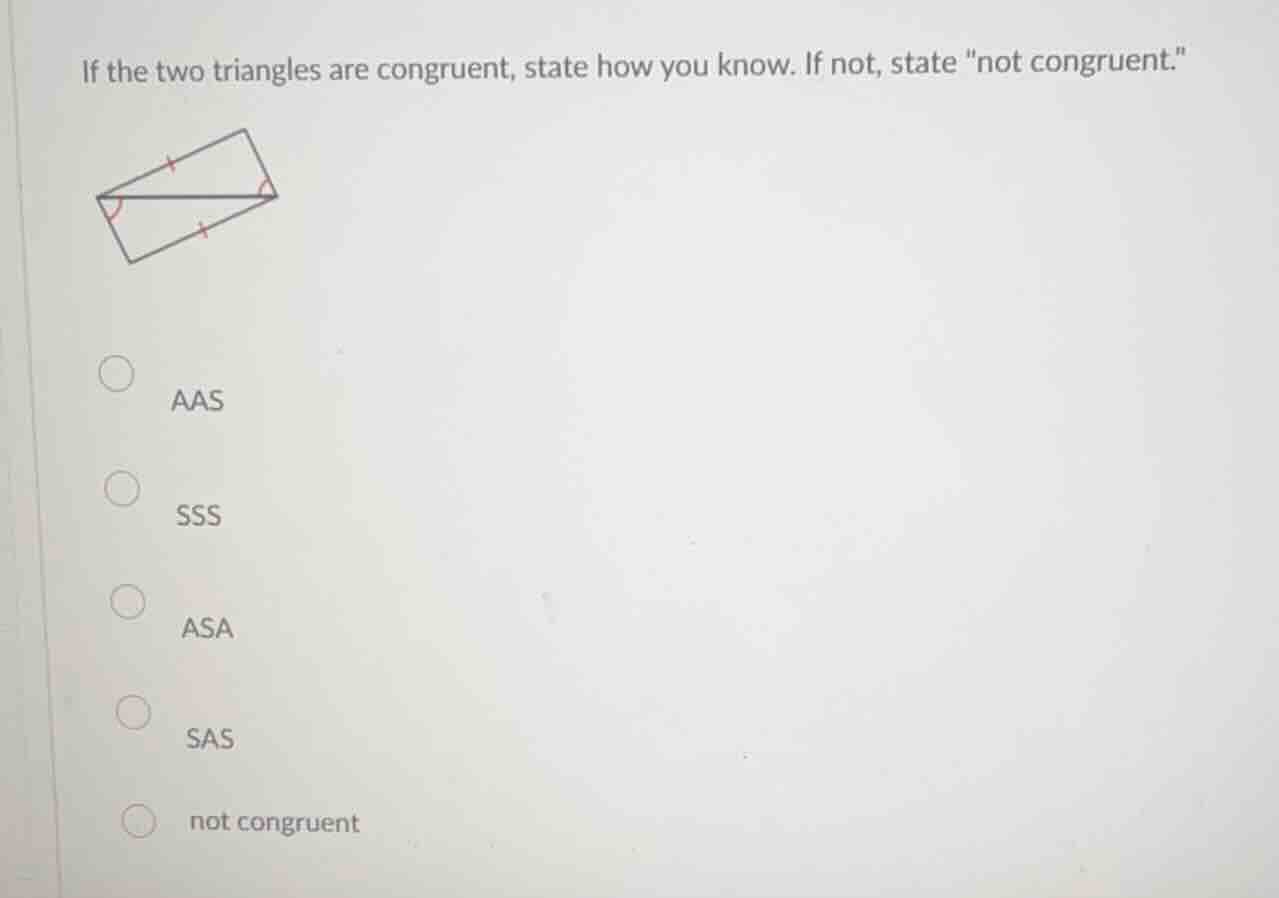
if the two triangles are congruent, state how you know. if not, state o…

Question

if the two triangles are congruent, state how you know. if not, state
ot congruent.\

aas

sss

asa

sas

not congruent

Explanation:

Response

<pre_analysis>
{
"quality": "clear",
"question_count": 1,
"skills_matched": [
"step_cot",
"multiple_choice_formatter",
"explain_then_answer",
"tutor"
],
"needs_drawing": false,
"concepts_used": [
"Triangle Congruence Postulates",
"SAS Congruence"
],
"new_concepts": [
"Reflexive Property of Congruence"
],
"current_concepts": [
"Triangle Congruence Postulates",
"SAS Congruence",
"Reflexive Property of Congruence"
]
}
</pre_analysis>

<reasoning>

Identify the given congruent parts

We analyze the markings on the two triangles sharing a common side.

  • One pair of sides has single tick marks, indicating they are congruent.
  • One pair of angles has single arc marks, indicating they are congruent.

Identify the shared side

Using the Triangle Congruence Postulates, we look for additional shared elements.

  • The two triangles share a common diagonal side.
  • By the Reflexive Property of Congruence, this shared side is congruent to itself.

Determine the congruence postulate

We evaluate the relative positions of the known congruent parts:

  • We have a congruent side (tick mark).
  • We have a congruent angle (arc mark).
  • We have the shared side.
  • The congruent angle is located between the marked side and the shared side.
  • This configuration corresponds to the Side-Angle-Side (SAS Congruence) postulate.

</reasoning>

<answer>
<mcq-option>AAS</mcq-option>
<mcq-option>SSS</mcq-option>
<mcq-option>ASA</mcq-option>
<mcq-correct>SAS</mcq-correct>
<mcq-option>not congruent</mcq-option>
</answer>

<post_analysis>
{
"subject": "Mathematics",
"question_type": "Multiple Choice",
"knowledge_point": [
"Mathematics",
"Geometry",
"Triangle Congruence Postulates"
]
}
</post_analysis>

Answer:

<pre_analysis>
{
"quality": "clear",
"question_count": 1,
"skills_matched": [
"step_cot",
"multiple_choice_formatter",
"explain_then_answer",
"tutor"
],
"needs_drawing": false,
"concepts_used": [
"Triangle Congruence Postulates",
"SAS Congruence"
],
"new_concepts": [
"Reflexive Property of Congruence"
],
"current_concepts": [
"Triangle Congruence Postulates",
"SAS Congruence",
"Reflexive Property of Congruence"
]
}
</pre_analysis>

<reasoning>

Identify the given congruent parts

We analyze the markings on the two triangles sharing a common side.

  • One pair of sides has single tick marks, indicating they are congruent.
  • One pair of angles has single arc marks, indicating they are congruent.

Identify the shared side

Using the Triangle Congruence Postulates, we look for additional shared elements.

  • The two triangles share a common diagonal side.
  • By the Reflexive Property of Congruence, this shared side is congruent to itself.

Determine the congruence postulate

We evaluate the relative positions of the known congruent parts:

  • We have a congruent side (tick mark).
  • We have a congruent angle (arc mark).
  • We have the shared side.
  • The congruent angle is located between the marked side and the shared side.
  • This configuration corresponds to the Side-Angle-Side (SAS Congruence) postulate.

</reasoning>

<answer>
<mcq-option>AAS</mcq-option>
<mcq-option>SSS</mcq-option>
<mcq-option>ASA</mcq-option>
<mcq-correct>SAS</mcq-correct>
<mcq-option>not congruent</mcq-option>
</answer>

<post_analysis>
{
"subject": "Mathematics",
"question_type": "Multiple Choice",
"knowledge_point": [
"Mathematics",
"Geometry",
"Triangle Congruence Postulates"
]
}
</post_analysis>