QUESTION IMAGE
Question
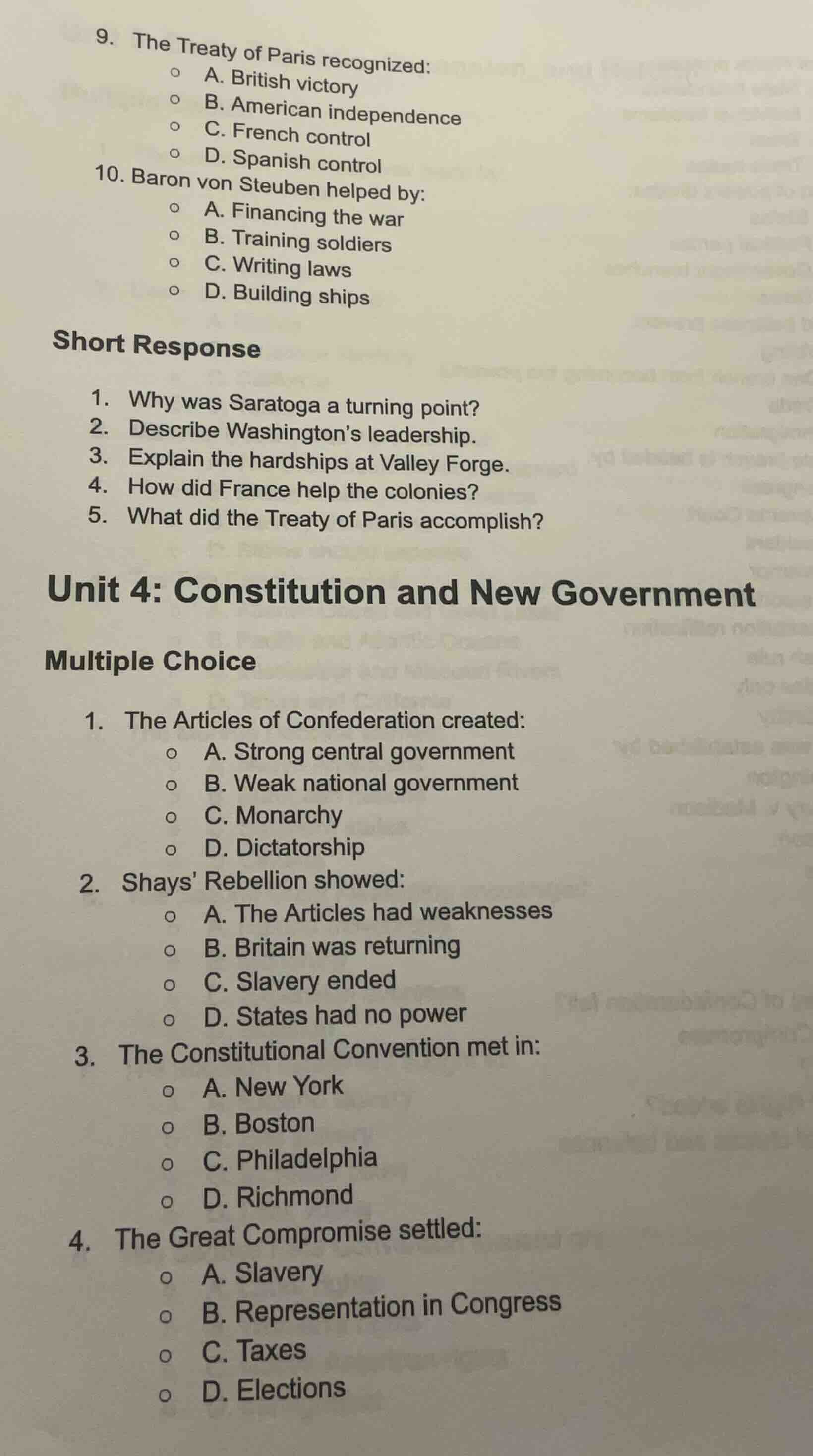
- the treaty of paris recognized:
- a. british victory
- b. american independence
- c. french control
- d. spanish control
- baron von steuben helped by:
- a. financing the war
- b. training soldiers
- c. writing laws
- d. building ships
short response
- why was saratoga a turning point?
- describe washingtons leadership.
- explain the hardships at valley forge.
- how did france help the colonies?
- what did the treaty of paris accomplish?
unit 4: constitution and new government
multiple choice
- the articles of confederation created:
- a. strong central government
- b. weak national government
- c. monarchy
- d. dictatorship
- shays rebellion showed:
- a. the articles had weaknesses
- b. britain was returning
- c. slavery ended
- d. states had no power
- the constitutional convention met in:
- a. new york
- b. boston
- c. philadelphia
- d. richmond
- the great compromise settled:
- a. slavery
- b. representation in congress
- c. taxes
- d. elections
Analyze the Revolutionary War questions
- Question 9: The Treaty of Paris (1783) officially ended the American Revolutionary War and recognized American independence from Great Britain.
- Question 10: Baron von Steuben was a Prussian military officer who arrived at Valley Forge and helped train the Continental Army in military drills and tactics.
- Short Response 1: Saratoga was a turning point because the American victory convinced France to enter the war as an official ally.
- Short Response 2: Washington's leadership was characterized by resilience, keeping the army together through hardships, and strategic retreats to preserve his forces.
- Short Response 3: Hardships at Valley Forge included severe shortages of food, clothing, and shelter, alongside freezing temperatures and rampant disease.
- Short Response 4: France helped by providing military troops, naval support, financial loans, and essential military supplies/weapons.
- Short Response 5: The Treaty of Paris accomplished the recognition of U.S. independence, established generous borders for the new nation, and ended the war.
Analyze the Constitution and New Government questions
- Question 1: The Articles of Confederation intentionally created a weak national government to prevent tyranny, leaving most power to the individual states.
- Question 2: Shays' Rebellion, an uprising of debt-ridden farmers in Massachusetts, exposed the weaknesses of the Articles of Confederation, particularly the national government's inability to maintain public order or raise an army.
- Question 3: The Constitutional Convention met in Philadelphia, Pennsylvania, in 1787 to revise the Articles of Confederation, ultimately drafting the U.S. Constitution.
- Question 4: The Great Compromise settled the debate over representation in Congress by creating a bicameral legislature: proportional representation in the House of Representatives and equal representation in the Senate.

Snap & solve any problem in the app
Get step-by-step solutions on Sovi AI
Photo-based solutions with guided steps
Explore more problems and detailed explanations
Question 9
- A. British victory
- B. American independence (Correct answer)
- C. French control
- D. Spanish control
Question 10
- A. Financing the war
- B. Training soldiers (Correct answer)
- C. Writing laws
- D. Building ships
Short Response 1
The Battle of Saratoga was a turning point because the American victory convinced France to sign a formal alliance and provide military and financial aid.
Short Response 2
George Washington's leadership was defined by his resilience, ability to maintain army morale during difficult times, and strategic patience to preserve his forces.
Short Response 3
Soldiers at Valley Forge faced extreme hardships, including freezing winter weather, starvation, lack of warm clothing/shoes, and deadly diseases like smallpox.
Short Response 4
France aided the colonies by sending naval fleets, ground troops, experienced military advisors, weapons, and critical financial loans.
Short Response 5
The Treaty of Paris (1783) formally ended the Revolutionary War, recognized the United States as an independent nation, and established its geographic boundaries.
Unit 4: Question 1
- A. Strong central government
- B. Weak national government (Correct answer)
- C. Monarchy
- D. Dictatorship
Unit 4: Question 2
- A. The Articles had weaknesses (Correct answer)
- B. Britain was returning
- C. Slavery ended
- D. States had no power
Unit 4: Question 3
- A. New York
- B. Boston
- C. Philadelphia (Correct answer)
- D. Richmond
Unit 4: Question 4
- A. Slavery
- B. Representation in Congress (Correct answer)
- C. Taxes
- D. Elections