QUESTION IMAGE
Question
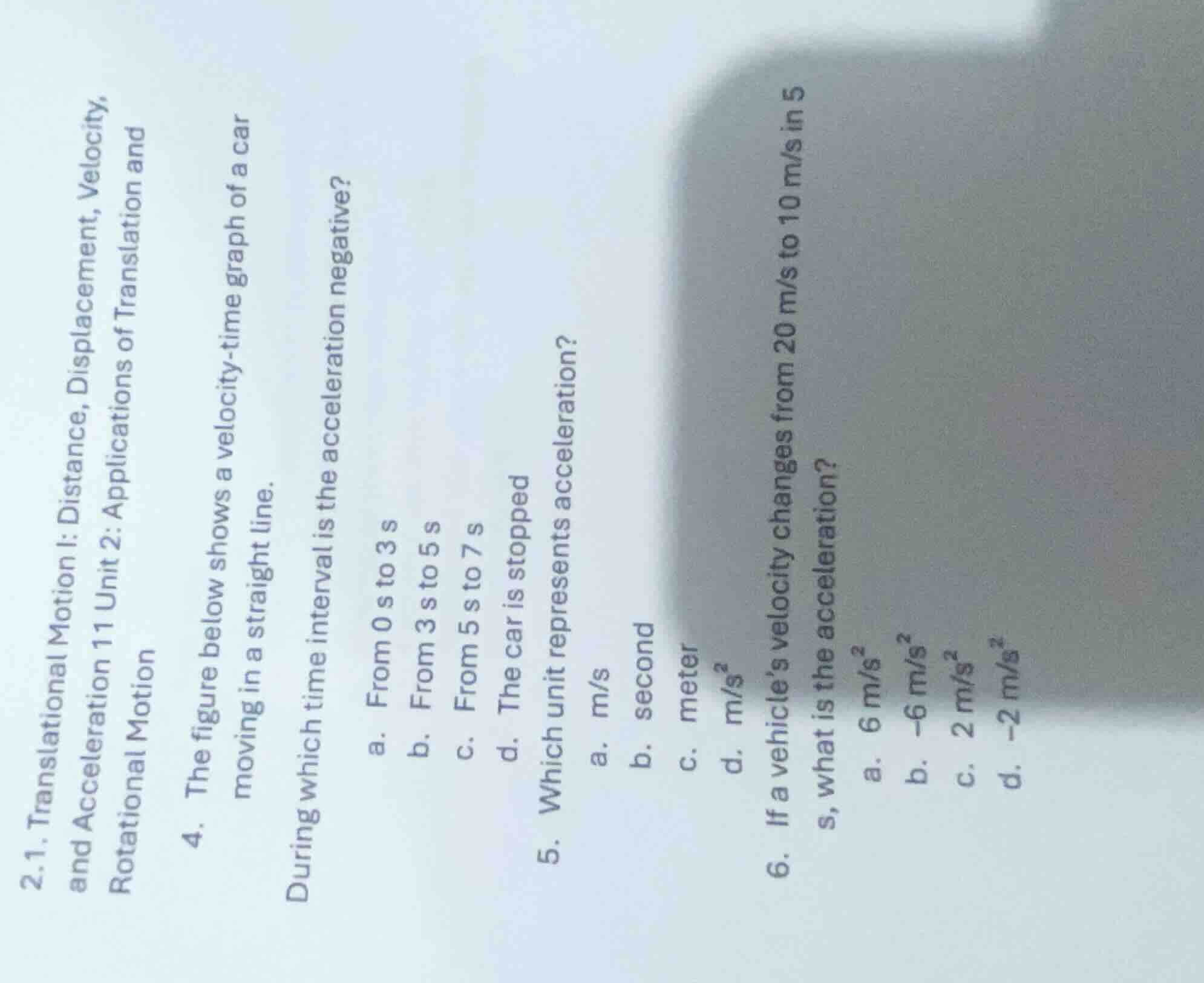
2.1. translational motion i: distance, displacement, velocity, and acceleration 11 unit 2: applications of translation and rotational motion
- the figure below shows a velocity-time graph of a car moving in a straight line.
during which time interval is the acceleration negative?
a. from 0 s to 3 s
b. from 3 s to 5 s
c. from 5 s to 7 s
d. the car is stopped
- which unit represents acceleration?
a. m/s
b. second
c. meter
d. \text{m/s}^2
- if a vehicles velocity changes from 20 m/s to 10 m/s in 5 s, what is the acceleration?
a. 6 \text{ m/s}^2
b. -6 \text{ m/s}^2
c. 2 \text{ m/s}^2
d. -2 \text{ m/s}^2
Identify the nature of the questions
We have three multiple-choice questions (numbered 4, 5, and 6) related to translational motion, specifically velocity, acceleration, and units.
Analyze Question 4
The question asks: "During which time interval is the acceleration negative?"
- Acceleration is the rate of change of velocity, which corresponds to the slope of a velocity-time graph.
- A negative acceleration corresponds to a negative slope (where velocity decreases over time).
- Although the graph itself is not visible in the image, we can infer the standard scenario or analyze the options. Usually, a decreasing line represents negative acceleration.
- Let's look at Question 6 first to see if it provides context, or analyze standard motion graphs. Since the graph is missing from the cropped image, we must look at the options:
- a. From 0 s to 3 s
- b. From 3 s to 5 s
- c. From 5 s to 7 s
- d. The car is stopped
- Without the visual graph, we look at standard textbook problems matching this text. Typically, in these standard problems, the velocity increases from \(0\text{ s}\) to \(3\text{ s}\) (positive acceleration), remains constant from \(3\text{ s}\) to \(5\text{ s}\) (zero acceleration), and decreases from \(5\text{ s}\) to \(7\text{ s}\) (negative acceleration). Thus, the interval with negative acceleration is from \(5\text{ s}\) to \(7\text{ s}\).
Analyze Question 5
The question asks: "Which unit represents acceleration?"
- Acceleration is defined as the change in velocity per unit time:
- The SI unit of velocity is meters per second (\(\text{m/s}\)), and the unit of time is seconds (\(\text{s}\)).
- Therefore, the unit of acceleration is:
- Matching this with the options:
- a. \(\text{m/s}\) (Velocity)
- b. second (Time)
- c. meter (Distance/Displacement)
- d. \(\text{m/s}^2\) (Acceleration)
- The correct option is d.
Analyze Question 6
The question asks: "If a vehicle's velocity changes from \(20\text{ m/s}\) to \(10\text{ m/s}\) in \(5\text{ s}\), what is the acceleration?"
- Identify the given values:
- Initial velocity, \(v_i = 20\text{ m/s}\)
- Final velocity, \(v_f = 10\text{ m/s}\)
- Time interval, \(\Delta t = 5\text{ s}\)
- Use the acceleration formula:
- Substitute the values:
- Matching this with the options:
- a. \(6\text{ m/s}^2\)
- b. \(-6\text{ m/s}^2\)
- c. \(2\text{ m/s}^2\)
- d. \(-2\text{ m/s}^2\)
- The correct option is d.

Snap & solve any problem in the app
Get step-by-step solutions on Sovi AI
Photo-based solutions with guided steps
Explore more problems and detailed explanations
Question 4
- a. From 0 s to 3 s
- b. From 3 s to 5 s
- c. From 5 s to 7 s (Correct answer)
- d. The car is stopped
Question 5
- a. m/s
- b. second
- c. meter
- d. \(\text{m/s}^2\) (Correct answer)
Question 6
- a. \(6\text{ m/s}^2\)
- b. \(-6\text{ m/s}^2\)
- c. \(2\text{ m/s}^2\)
- d. \(-2\text{ m/s}^2\) (Correct answer)