QUESTION IMAGE
Question
topic 5: converting exponential and logarithmic equations
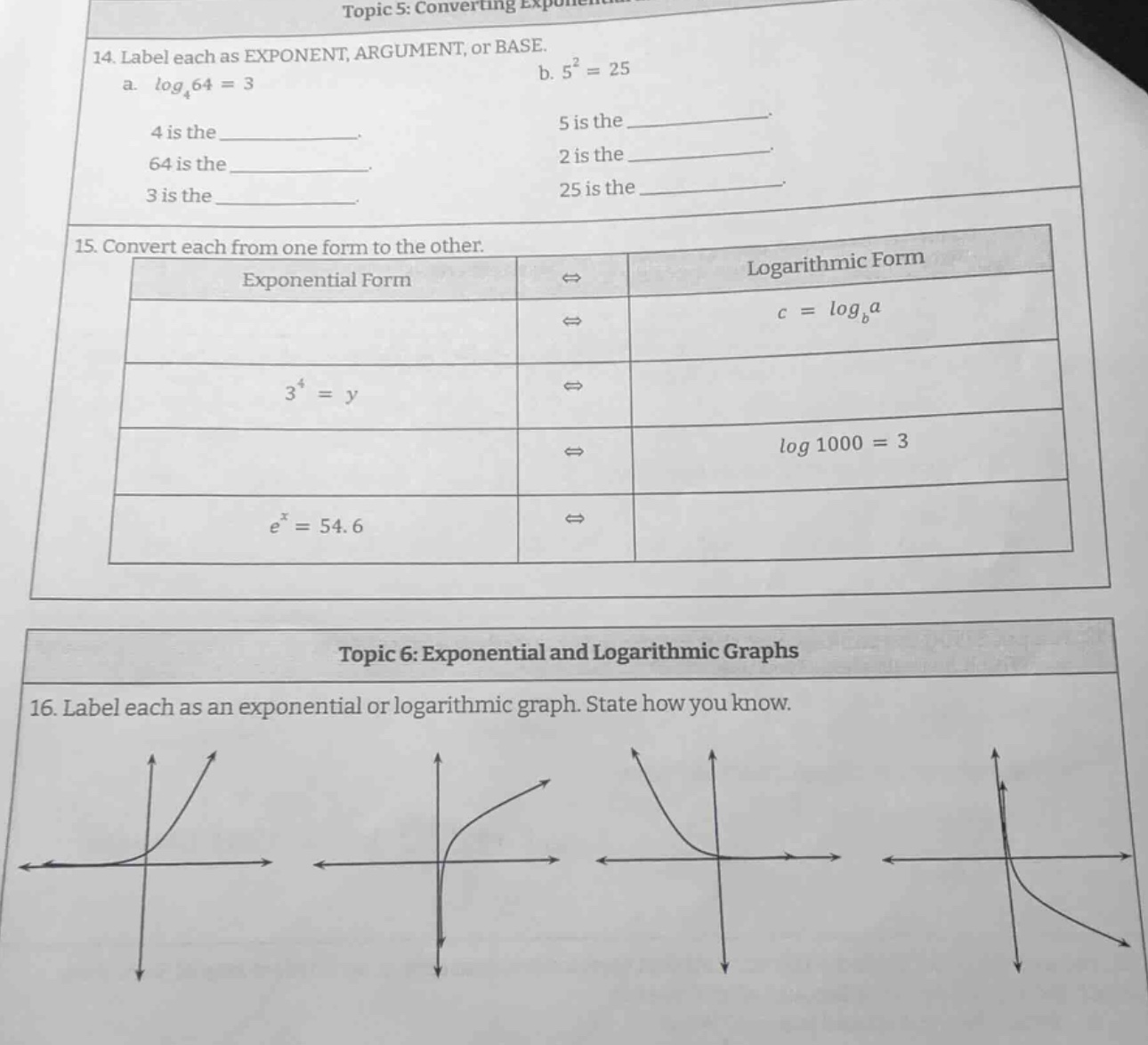
- label each as exponent, argument, or base.
a. \\(\log_{4} 64 = 3\\)
4 is the _______
64 is the _______
3 is the _______
b. \\(5^2 = 25\\)
5 is the _______
2 is the _______
25 is the _______
- convert each from one form to the other.
| exponential form | \\(\leftrightarrow\\) | logarithmic form |
|---|---|---|
| \\(3^4 = y\\) | \\(\leftrightarrow\\) | |
| \\(\leftrightarrow\\) | \\(\log 1000 = 3\\) | |
| \\(e^x = 54.6\\) | \\(\leftrightarrow\\) |
topic 6: exponential and logarithmic graphs
- label each as an exponential or logarithmic graph. state how you know.
Identify components of logarithmic and exponential equations
We define the parts of logarithmic and exponential equations to label Question 14.
For a logarithm \(\log_{b}(a) = c\):
- \(b\) is the BASE
- \(a\) is the ARGUMENT
- \(c\) is the EXPONENT (or logarithm value)
For an exponential equation \(b^c = a\):
- \(b\) is the BASE
- \(c\) is the EXPONENT
- \(a\) is the ARGUMENT (the result of raising the base to the exponent)
Applying this to:
a. \(\log_{4}64 = 3\)
- \(4\) is the BASE
- \(64\) is the ARGUMENT
- \(3\) is the EXPONENT
b. \(5^2 = 25\)
- \(5\) is the BASE
- \(2\) is the EXPONENT
- \(25\) is the ARGUMENT
Convert between exponential and logarithmic forms
We use the equivalence relation \(b^c = a \iff \log_{b}a = c\) to complete the table in Question 15:
- Row 1: Given Logarithmic Form \(c = \log_{b}a\). The equivalent Exponential Form is \(b^c = a\).
- Row 2: Given Exponential Form \(3^4 = y\). The equivalent Logarithmic Form is \(\log_{3}y = 4\).
- Row 3: Given Logarithmic Form \(\log 1000 = 3\) (common logarithm with base \(10\)). The equivalent Exponential Form is \(10^3 = 1000\).
- Row 4: Given Exponential Form \(e^x = 54.6\). The equivalent Logarithmic Form is \(\ln(54.6) = x\) or \(\log_{e}(54.6) = x\).
Analyze and classify the graphs
We identify the characteristic shapes and asymptotes of exponential and logarithmic functions to label the graphs in Question 16:
- Exponential graphs of the form \(y = b^x\) have a horizontal asymptote (usually \(y=0\)) and a domain of all real numbers \((-\infty, \infty)\).
- Logarithmic graphs of the form \(y = \log_b(x)\) have a vertical asymptote (usually \(x=0\)) and a domain restricted to positive real numbers \((0, \infty)\).
Let's classify each of the four graphs from left to right:
- First Graph: Has a horizontal asymptote on the left and grows rapidly on the right. This is an exponential graph.
- Second Graph: Has a vertical asymptote on the left and grows slowly to the right. This is a logarithmic graph.
- Third Graph: Has a horizontal asymptote on the right and grows rapidly to the left. This is a decaying exponential graph.
- Fourth Graph: Has a vertical asymptote on the left and decreases to the right. This is a decaying logarithmic graph.

Snap & solve any problem in the app
Get step-by-step solutions on Sovi AI
Photo-based solutions with guided steps
Explore more problems and detailed explanations
Question 14
a. \(\log_{4}64 = 3\)
- 4 is the BASE
- 64 is the ARGUMENT
- 3 is the EXPONENT
b. \(5^2 = 25\)
- 5 is the BASE
- 2 is the EXPONENT
- 25 is the ARGUMENT
Question 15
| Exponential Form | \(\iff\) | Logarithmic Form |
|---|---|---|
| \(3^4 = y\) | \(\iff\) | \(\log_{3}y = 4\) |
| \(10^3 = 1000\) | \(\iff\) | \(\log 1000 = 3\) |
| \(e^x = 54.6\) | \(\iff\) | \(\ln(54.6) = x\) |
Question 16
- First Graph: Exponential graph. We know this because it has a horizontal asymptote (\(y = 0\)) and a domain of all real numbers.
- Second Graph: Logarithmic graph. We know this because it has a vertical asymptote (\(x = 0\)) and a restricted domain of positive real numbers.
- Third Graph: Exponential graph. We know this because it has a horizontal asymptote (\(y = 0\)) and a domain of all real numbers.
- Fourth Graph: Logarithmic graph. We know this because it has a vertical asymptote (\(x = 0\)) and a restricted domain of positive real numbers.