QUESTION IMAGE
Question
thinking further
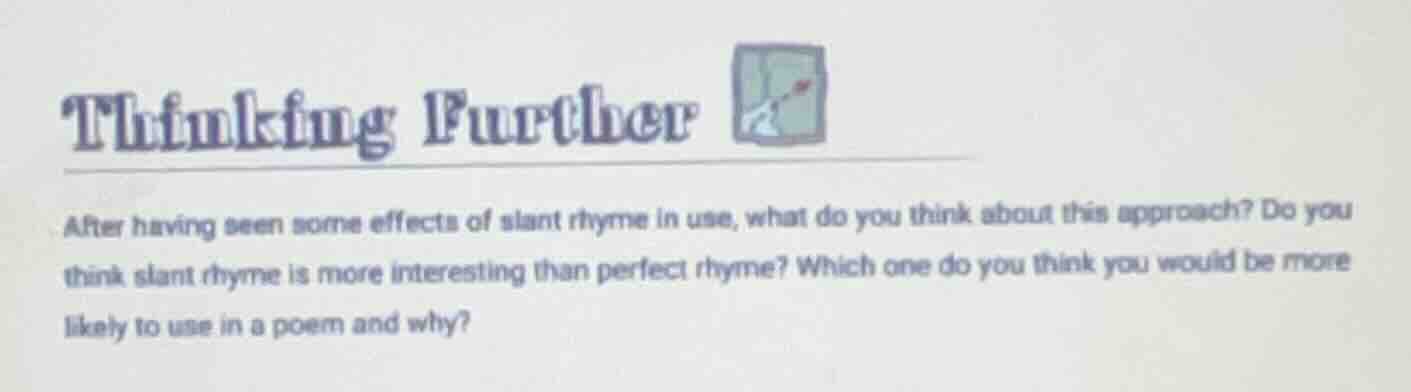
after having seen some effects of slant rhyme in use, what do you think about this approach? do you think slant rhyme is more interesting than perfect rhyme? which one do you think you would be more likely to use in a poem and why?
Brief Explanations
- Slant rhyme (near rhyme) creates a soft, unexpected sound connection between words, avoiding the predictability of perfect rhyme. It allows poets to choose words for meaning first, rather than forcing a rhyming pair, which makes verse feel more natural and layered.
- Unlike perfect rhyme, which can feel repetitive or overly formal in some contexts, slant rhyme draws readers' attention to the subtlety of language, creating a more thoughtful, engaging auditory experience that feels less formulaic.
- Slant rhyme offers greater creative freedom: it prioritizes thematic and tonal accuracy over strict sound matching. For poems focused on introspection, ambiguity, or everyday realism, it avoids the artificiality that perfect rhyme can introduce, making the work feel more authentic and emotionally resonant.

Snap & solve any problem in the app
Get step-by-step solutions on Sovi AI
Photo-based solutions with guided steps
Explore more problems and detailed explanations
- Slant rhyme is a flexible, nuanced poetic approach that adds subtlety to verse.
- Slant rhyme can be more interesting than perfect rhyme for its unique texture.
- I would be more likely to use slant rhyme in a poem.