QUESTION IMAGE
Question
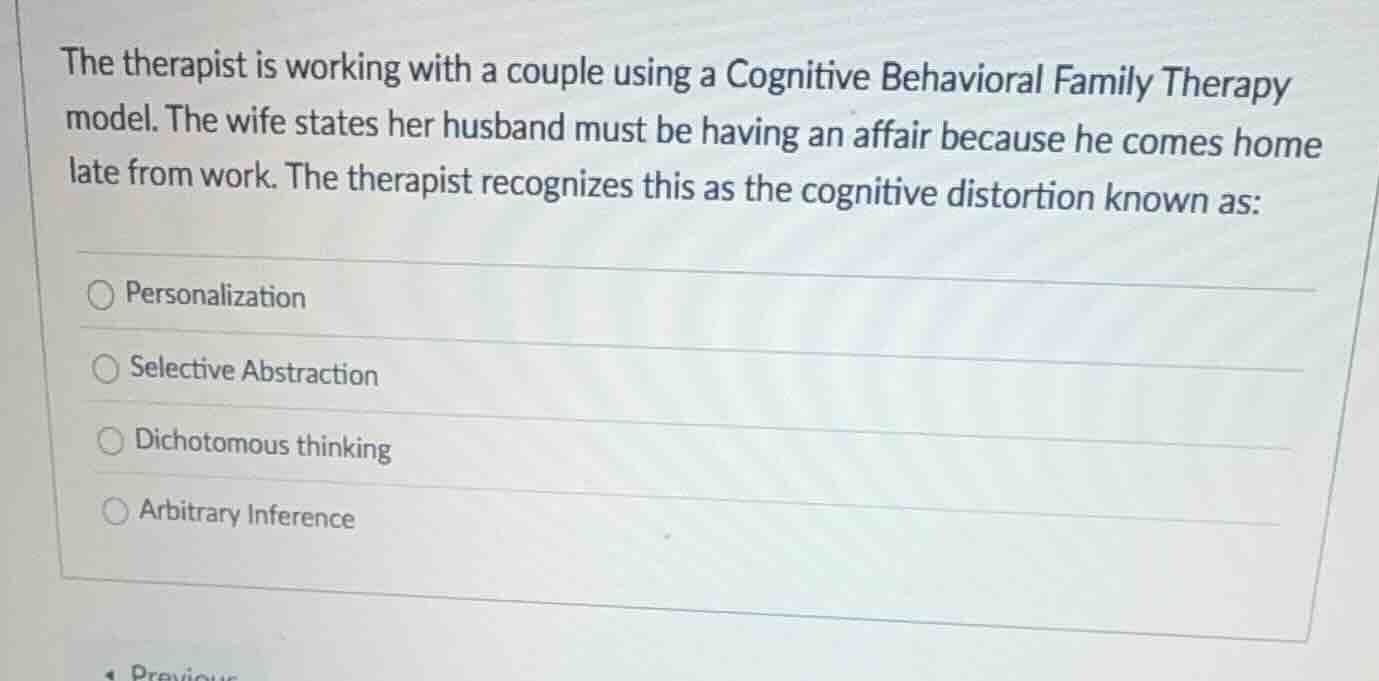
the therapist is working with a couple using a cognitive behavioral family therapy model. the wife states her husband must be having an affair because he comes home late from work. the therapist recognizes this as the cognitive distortion known as:
personalization
selective abstraction
dichotomous thinking
arbitrary inference
🆕 New Concept Discovered: Cognitive Distortions in CBFT
Identifying biased thinking patterns in family therapy.
Step 1: Analyze the wife's statement
The wife states: "My husband must be having an affair because he comes home late from work."
This statement draws a highly specific, extreme conclusion (he is having an affair) from a single piece of everyday behavior (coming home late) without any supporting evidence to connect the two.
Step 2: Define the candidate cognitive distortions
To find the correct match, let's look at what each term means in Cognitive Behavioral Therapy (CBT):
- Personalization: Believing that outside events or other people's behavior are directly related to oneself, without any logical basis (e.g., "It's raining because I wanted to go to the park").
- Selective Abstraction: Focusing entirely on one negative detail out of context while ignoring other, more relevant features of the situation (e.g., focusing on one critical comment in an otherwise glowing performance review).
- Dichotomous thinking: Thinking in "all-or-nothing" or black-and-white terms (e.g., "If I'm not perfect, I'm a total failure").
- Arbitrary Inference: Drawing a specific conclusion in the absence of supporting evidence or when the evidence actually contradicts the conclusion.
Step 3: Match the scenario to the correct distortion
The wife's conclusion that her husband is having an affair is an assumption made without concrete evidence. Coming home late can be caused by many common factors (such as traffic, workload, or meetings). Jumping directly to the conclusion of infidelity without supporting proof is a classic example of Arbitrary Inference.

Snap & solve any problem in the app
Get step-by-step solutions on Sovi AI
Photo-based solutions with guided steps
Explore more problems and detailed explanations
Arbitrary Inference