QUESTION IMAGE
Question
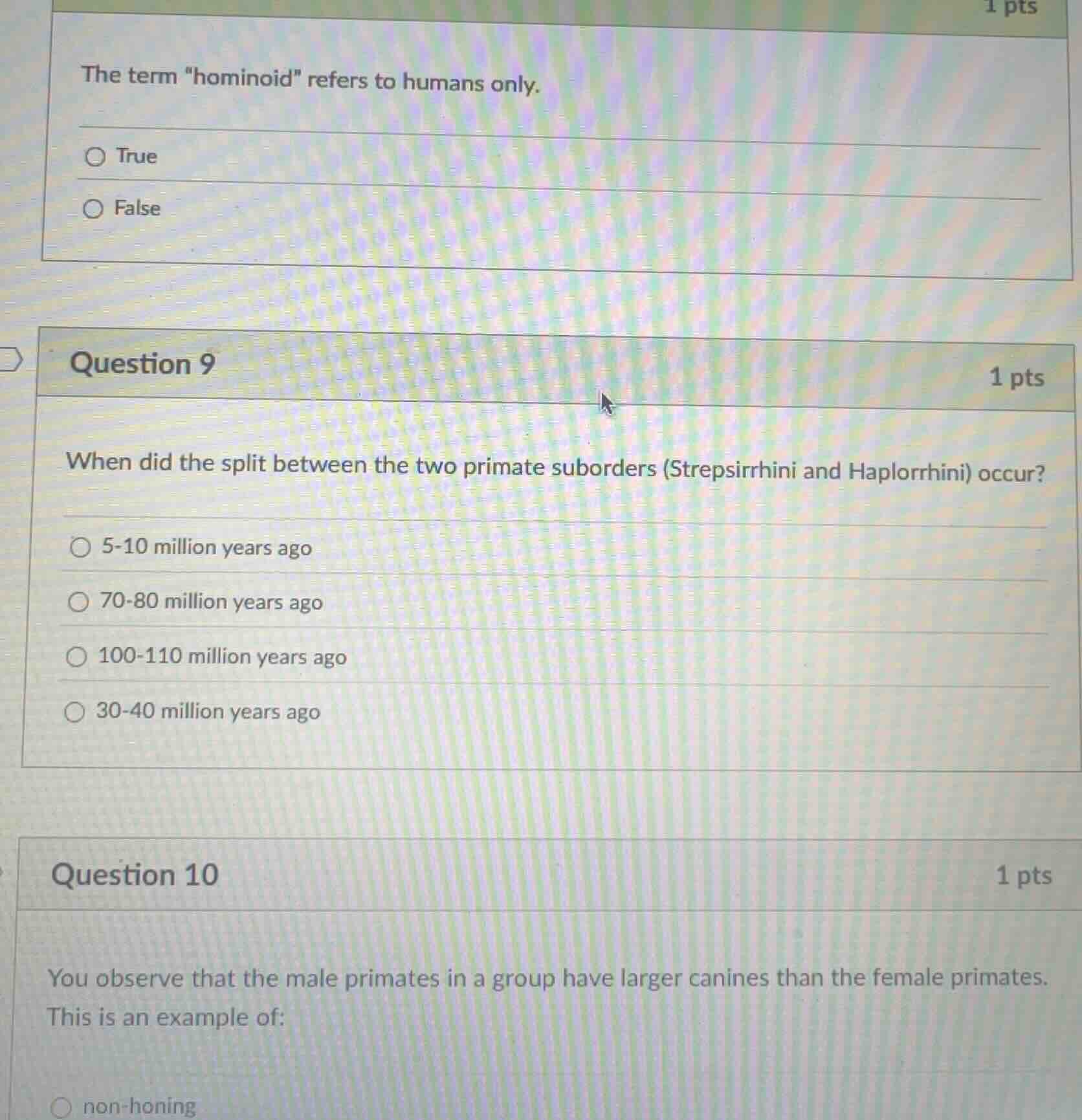
the term \hominoid\ refers to humans only.
true
false
question 9
when did the split between the two primate suborders (strepsirrhini and haplorrhini) occur?
5-10 million years ago
70-80 million years ago
100-110 million years ago
30-40 million years ago
question 10
you observe that the male primates in a group have larger canines than the female primates. this is an example of:
non-honing
Analyze the hominoid definition
The term "hominoid" refers to members of the superfamily Hominoidea, which includes both humans (hominins) and all apes (gibbons, orangutans, gorillas, and chimpanzees), not humans only. Therefore, the statement is false.
Determine the suborder split timing
The evolutionary split between the two major primate suborders, Strepsirrhini (wet-nosed primates like lemurs and lorises) and Haplorrhini (dry-nosed primates like tarsiers, monkeys, and apes), is estimated by genetic and fossil evidence to have occurred in the early Paleogene, approximately 70–80 million years ago.
Identify canine size differences
When male primates have significantly larger canine teeth than females, this physical difference between the sexes of the same species is a classic example of sexual dimorphism, often driven by male-male competition for mates.

Snap & solve any problem in the app
Get step-by-step solutions on Sovi AI
Photo-based solutions with guided steps
Explore more problems and detailed explanations
Question 8
- True
- False (Correct answer)
Question 9
- 5-10 million years ago
- 70-80 million years ago (Correct answer)
- 100-110 million years ago
- 30-40 million years ago
Question 10
- sexual dimorphism (Correct answer)
- non-honing