QUESTION IMAGE
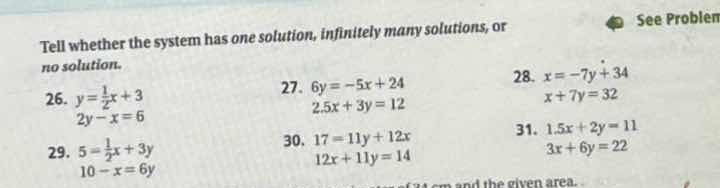
Question
tell whether the system has one solution, infinitely many solutions, or no solution.
- $y = \frac{1}{2}x + 3$
$2y - x = 6$
- $6y = -5x + 24$
$2.5x + 3y = 12$
- $x = -7y + 34$
$x + 7y = 32$
- $5 = \frac{1}{2}x + 3y$
$10 - x = 6y$
- $17 = 11y + 12x$
$12x + 11y = 14$
- $1.5x + 2y = 11$
$3x + 6y = 22$
Problem 26:
Step 1: Rewrite the second equation
The second equation is \(2y - x = 6\), we can rewrite it as \(x = 2y - 6\).
Step 2: Substitute into the first equation
The first equation is \(y=\frac{1}{2}x + 3\). Substitute \(x = 2y - 6\) into it:
\(y=\frac{1}{2}(2y - 6)+3\)
Step 3: Simplify the equation
Simplify the right - hand side: \(\frac{1}{2}(2y-6)+3=y - 3 + 3=y\)
We get \(y = y\), which is always true for any value of \(y\). And since \(x = 2y-6\), for every value of \(y\), there is a corresponding value of \(x\). So the system has infinitely many solutions.
Step 1: Rewrite the first equation
The first equation is \(6y=-5x + 24\), we can rewrite it as \(5x+6y = 24\).
The second equation is \(2.5x+3y = 12\), multiply both sides of the second equation by 2, we get \(5x + 6y=24\).
Step 2: Analyze the two equations
We can see that the two equations \(5x + 6y = 24\) (from the first equation) and \(5x+6y = 24\) (from the second equation after transformation) are the same.
So the system has infinitely many solutions.
Step 1: Rewrite the first equation
The first equation is \(x=-7y + 34\), we can rewrite it as \(x + 7y=34\).
The second equation is \(x + 7y=32\).
Step 2: Analyze the two equations
We have two equations of the form \(x + 7y=k_1\) and \(x + 7y=k_2\) where \(k_1 = 34\) and \(k_2 = 32\) and \(k_1
eq k_2\).
The left - hand sides of the two equations are the same, but the right - hand sides are different. So the system has no solution.

Snap & solve any problem in the app
Get step-by-step solutions on Sovi AI
Photo-based solutions with guided steps
Explore more problems and detailed explanations
infinitely many solutions