QUESTION IMAGE
Question
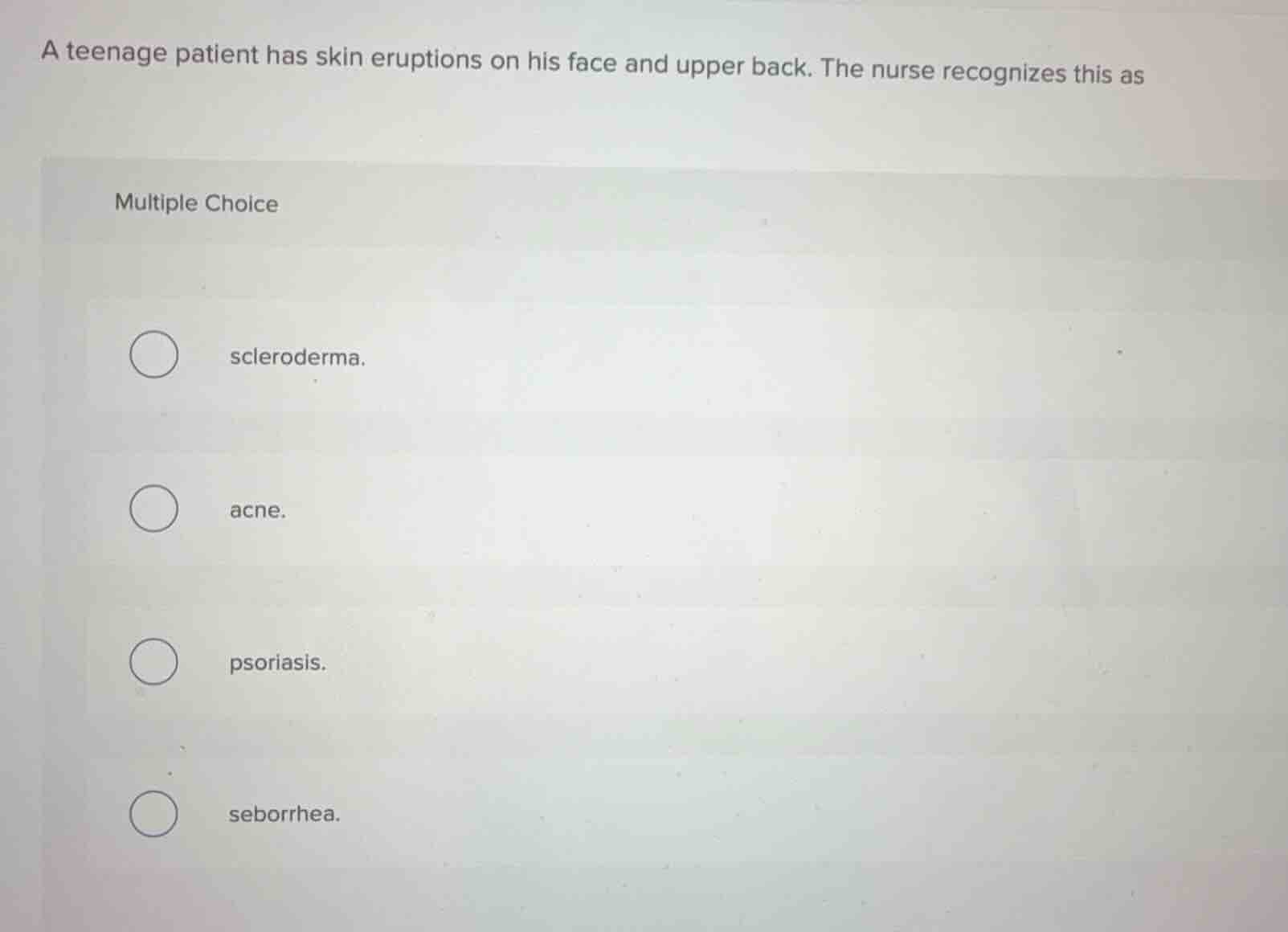
a teenage patient has skin eruptions on his face and upper back. the nurse recognizes this as
multiple choice
scleroderma.
acne.
psoriasis.
seborrhea.
Analyze the clinical presentation
The patient is described as a teenager presenting with skin eruptions on his face and upper back. This distribution (face and upper back) and demographic (teenage patient) are classic hallmarks of acne vulgaris, commonly referred to simply as acne.
Evaluate the options
Using the Scleroderma and Acne Vulgaris knowledge points:
- scleroderma: An autoimmune disorder characterized by chronic hardening and tightening of the skin and connective tissues, not typical teenage eruptions.
- acne: An inflammatory skin condition characterized by comedones, papules, pustules, and nodules, primarily affecting areas with a high density of sebaceous glands (face, upper chest, and back), highly prevalent in teenagers.
- psoriasis: A chronic autoimmune condition causing rapid buildup of skin cells, leading to scaling and silvery plaques, typically on elbows, knees, and scalp.
- seborrhea: Excessive discharge of sebum from the sebaceous glands, causing oily skin or dandruff, but not characterized primarily by inflammatory eruptive lesions on the face and back in this manner.
Therefore, the correct clinical recognition is acne.

Snap & solve any problem in the app
Get step-by-step solutions on Sovi AI
Photo-based solutions with guided steps
Explore more problems and detailed explanations
- (A) scleroderma.
- (B) acne. (Correct answer)
- (C) psoriasis.
- (D) seborrhea.