QUESTION IMAGE
Question
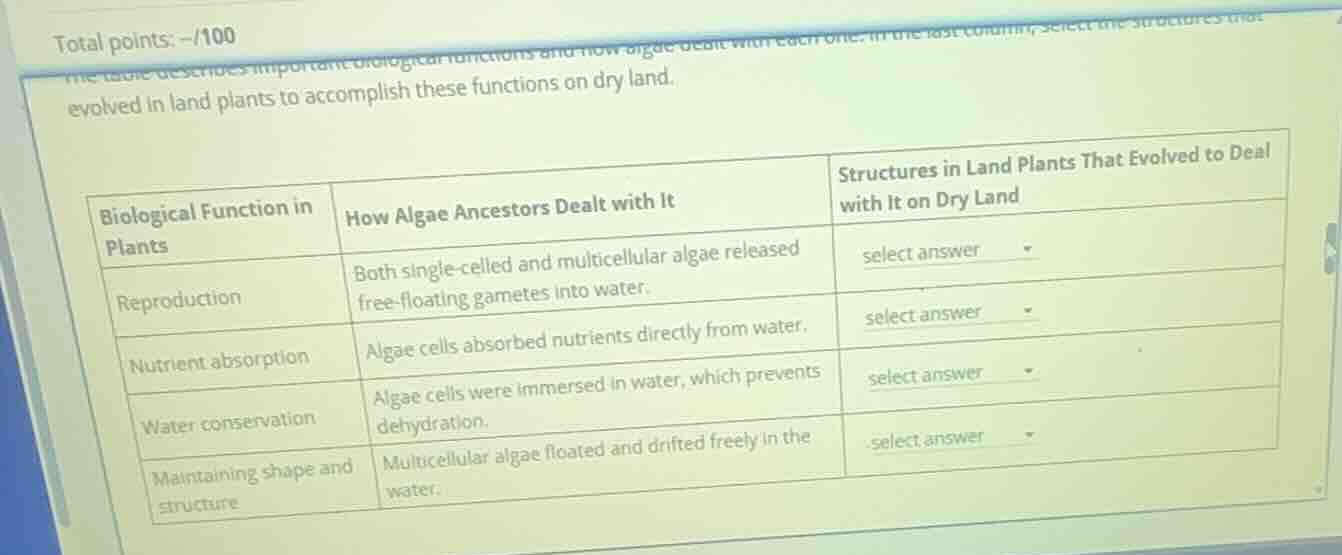
the table describes important biological functions and how algae dealt with each one. in the last column, select the structures that evolved in land plants to accomplish these functions on dry land.
\
Identify terrestrial challenges
Transitioning from water to land required plants to overcome major physical challenges: desiccation, gravity, nutrient uptake from soil, and gamete dispersal without water.
Analyze reproduction adaptation
Algae release free-floating gametes into water. On dry land, plants evolved specialized structures to protect gametes and embryos from drying out. Key adaptations include pollen for dispersal without water, seeds to protect embryos, and gametangia (like archegonia and antheridia) to protect gametes.
Analyze nutrient absorption adaptation
Algae absorb nutrients directly from the surrounding water. Land plants evolved roots to anchor themselves and absorb water and minerals from the soil, often aided by symbiotic mycorrhizae.
Analyze water conservation adaptation
Algae are constantly immersed in water. Land plants evolved a waxy cuticle covering their leaves and stems to prevent water loss, along with stomata to regulate gas exchange.
Analyze structural support adaptation
Algae float freely, supported by water buoyancy. Land plants evolved rigid cell walls reinforced with lignin (and vascular tissues like xylem) to maintain shape and stand upright against gravity.

Snap & solve any problem in the app
Get step-by-step solutions on Sovi AI
Photo-based solutions with guided steps
Explore more problems and detailed explanations
The structures in land plants that evolved to deal with each biological function on dry land are:
- Reproduction: Pollen and seeds (or protective gametangia/spores)
- Nutrient absorption: Roots (and vascular tissue)
- Water conservation: Waxy cuticle (and stomata)
- Maintaining shape and structure: Lignin (and cell walls/vascular tissue)