QUESTION IMAGE
Question
svlc algebra 1a - standard (15260)
solving linear equations:
distributive property
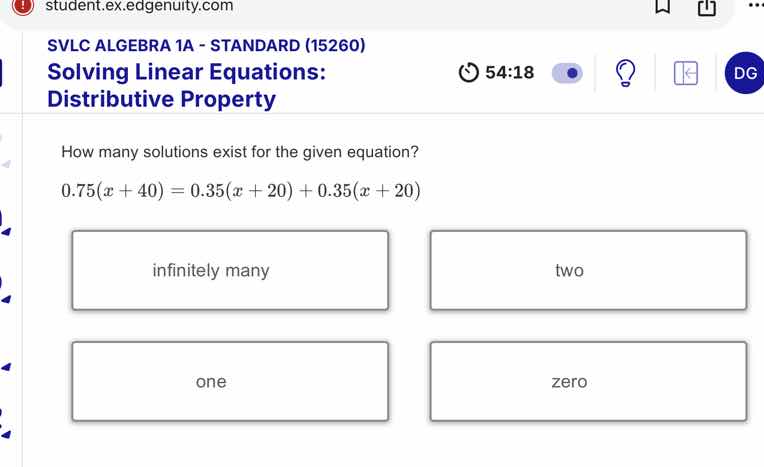
how many solutions exist for the given equation?
$0.75(x + 40) = 0.35(x + 20) + 0.35(x + 20)$
infinitely many
two
one
zero
Step1: Simplify right - hand side
First, we notice that the right - hand side has two identical terms \(0.35(x + 20)\). So we can combine them. Using the distributive property \(a\times c+b\times c=(a + b)\times c\), here \(a = 0.35\), \(b=0.35\) and \(c=(x + 20)\). So \(0.35(x + 20)+0.35(x + 20)=(0.35 + 0.35)(x + 20)=0.7(x + 20)\)
Step2: Expand both sides
Expand the left - hand side: \(0.75(x + 40)=0.75x+0.75\times40=0.75x + 30\)
Expand the right - hand side: \(0.7(x + 20)=0.7x+0.7\times20=0.7x + 14\)
Step3: Rearrange the equation
Subtract \(0.7x\) from both sides: \(0.75x-0.7x + 30=0.7x-0.7x + 14\), which simplifies to \(0.05x+30 = 14\)
Then subtract 30 from both sides: \(0.05x+30 - 30=14 - 30\), so \(0.05x=-16\)
Step4: Solve for x
Divide both sides by 0.05: \(x=\frac{-16}{0.05}=- 320\)
Wait, but let's check our steps again. Wait, in step 1, we made a mistake. Wait, the original right - hand side is \(0.35(x + 20)+0.35(x + 20)\). Wait, actually, \(x + 20+x + 20 = 2x+40\), so \(0.35(x + 20)+0.35(x + 20)=0.35\times(2x + 40)=0.7x+14\) (this part was correct). The left - hand side is \(0.75(x + 40)=0.75x+30\) (correct). Then \(0.75x + 30=0.7x+14\)
Subtract \(0.7x\) from both sides: \(0.05x+30 = 14\)
Subtract 30: \(0.05x=14 - 30=-16\)
\(x=\frac{-16}{0.05}=-320\). But wait, let's check by plugging back into the original equation.
Left - hand side: \(0.75(-320 + 40)=0.75\times(-280)=-210\)
Right - hand side: \(0.35(-320 + 20)+0.35(-320 + 20)=0.35\times(-300)+0.35\times(-300)=-105-105=-210\)
Wait, but wait, another way: Let's simplify the original equation again.
Original equation: \(0.75(x + 40)=0.35(x + 20)+0.35(x + 20)\)
Notice that \(0.35(x + 20)+0.35(x + 20)=0.7(x + 20)\)
And the left - hand side is \(0.75(x + 40)\). Let's rewrite \(x + 40\) as \(2(x + 20)\)? No, \(x+40=(x + 20)+20\)
Wait, \(0.75(x + 40)=0.75((x + 20)+20)=0.75(x + 20)+15\)
The right - hand side is \(0.7(x + 20)\)
So the equation becomes \(0.75(x + 20)+15=0.7(x + 20)\)
Let \(y=x + 20\), then \(0.75y+15 = 0.7y\)
Subtract \(0.7y\) from both sides: \(0.05y+15 = 0\)
Subtract 15: \(0.05y=-15\)
\(y=\frac{-15}{0.05}=-300\)
Then \(x+20=-300\), so \(x=-320\). Wait, but when we plug \(x = - 320\) into the original equation, left - hand side: \(0.75(-320 + 40)=0.75\times(-280)=-210\)
Right - hand side: \(0.35(-320 + 20)+0.35(-320 + 20)=0.35\times(-300)+0.35\times(-300)=-105-105=-210\). So there is one solution? Wait, but wait, maybe I made a mistake in the first analysis. Wait, let's start over.
Original equation: \(0.75(x + 40)=0.35(x + 20)+0.35(x + 20)\)
Simplify RHS: \(0.35(x + 20)+0.35(x + 20)=0.35\times2\times(x + 20)=0.7(x + 20)\)
LHS: \(0.75(x + 40)=0.75x+30\)
RHS: \(0.7x + 14\)
Set equal: \(0.75x+30=0.7x + 14\)
Subtract \(0.7x\) from both sides: \(0.05x+30 = 14\)
Subtract 30: \(0.05x=14 - 30=-16\)
\(x=\frac{-16}{0.05}=-320\)
Since we can find a unique value of \(x\) that satisfies the equation, there is one solution. Wait, but let's check the arithmetic again. \(0.75\times40 = 30\), \(0.7\times20 = 14\), correct. \(0.75x-0.7x=0.05x\), \(14 - 30=-16\), \(x=\frac{-16}{0.05}=-320\). So the equation has one solution.
Wait, but maybe I made a mistake in the first step of combining terms. Let's do it again. The right - hand side: \(0.35(x + 20)+0.35(x + 20)\). Factor out 0.35: \(0.35[(x + 20)+(x + 20)]=0.35(2x + 40)=0.7x+14\). Left - hand side: \(0.75(x + 40)=0.75x+30\). Then \(0.75x+30=0.7x + 14\). Subtract \(0.7x\): \(0.05x=-16\). So \(x = - 320\). So there is one solution.

Snap & solve any problem in the app
Get step-by-step solutions on Sovi AI
Photo-based solutions with guided steps
Explore more problems and detailed explanations
one