QUESTION IMAGE
Question
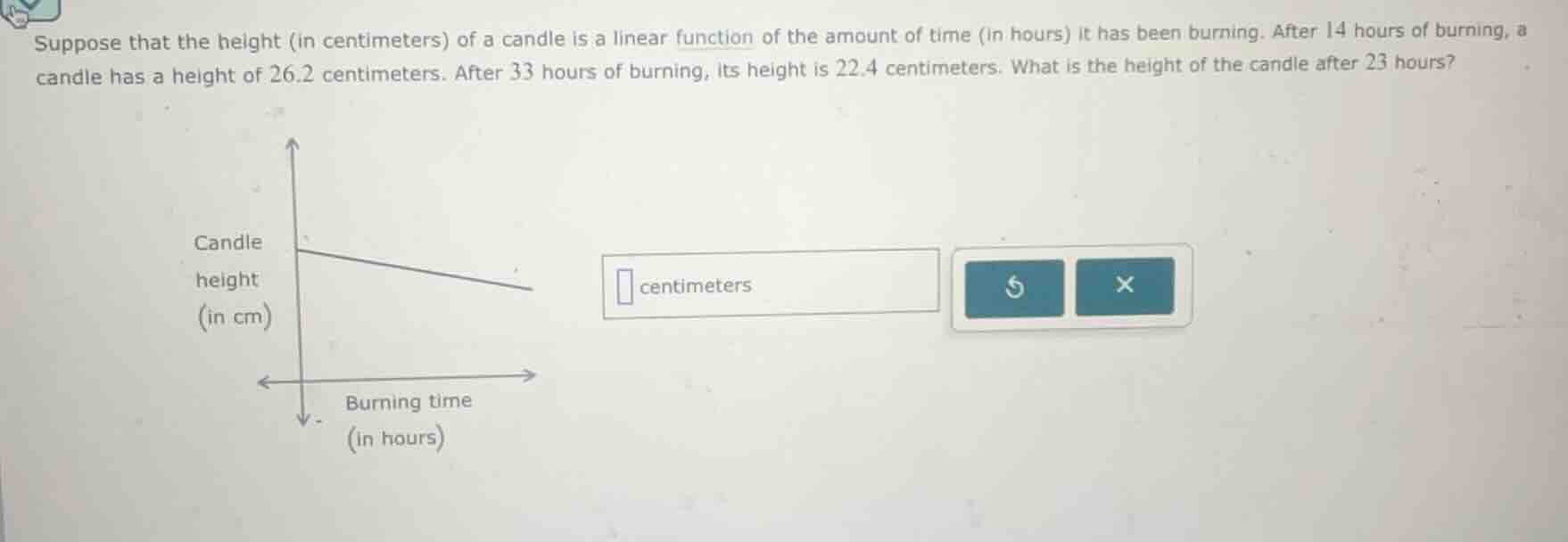
suppose that the height (in centimeters) of a candle is a linear function of the amount of time (in hours) it has been burning. after 14 hours of burning, a candle has a height of 26.2 centimeters. after 33 hours of burning, its height is 22.4 centimeters. what is the height of the candle after 23 hours?
Identify the given data points
Let \(t\) represent the burning time in hours, and \(h(t)\) represent the height of the candle in centimeters.
Calculate the rate of change
Find the height at the target time
Using the point-slope form with \(t = 23\):

Snap & solve any problem in the app
Get step-by-step solutions on Sovi AI
Photo-based solutions with guided steps
Explore more problems and detailed explanations
Suppose that the height (in centimeters) of a candle is a linear function of the amount of time (in hours) it has been burning. After 14 hours of burning, a candle has a height of 26.2 centimeters. After 33 hours of burning, its height is 22.4 centimeters. What is the height of the candle after 23 hours?
<blank>24.4</blank> centimeters