QUESTION IMAGE
Question
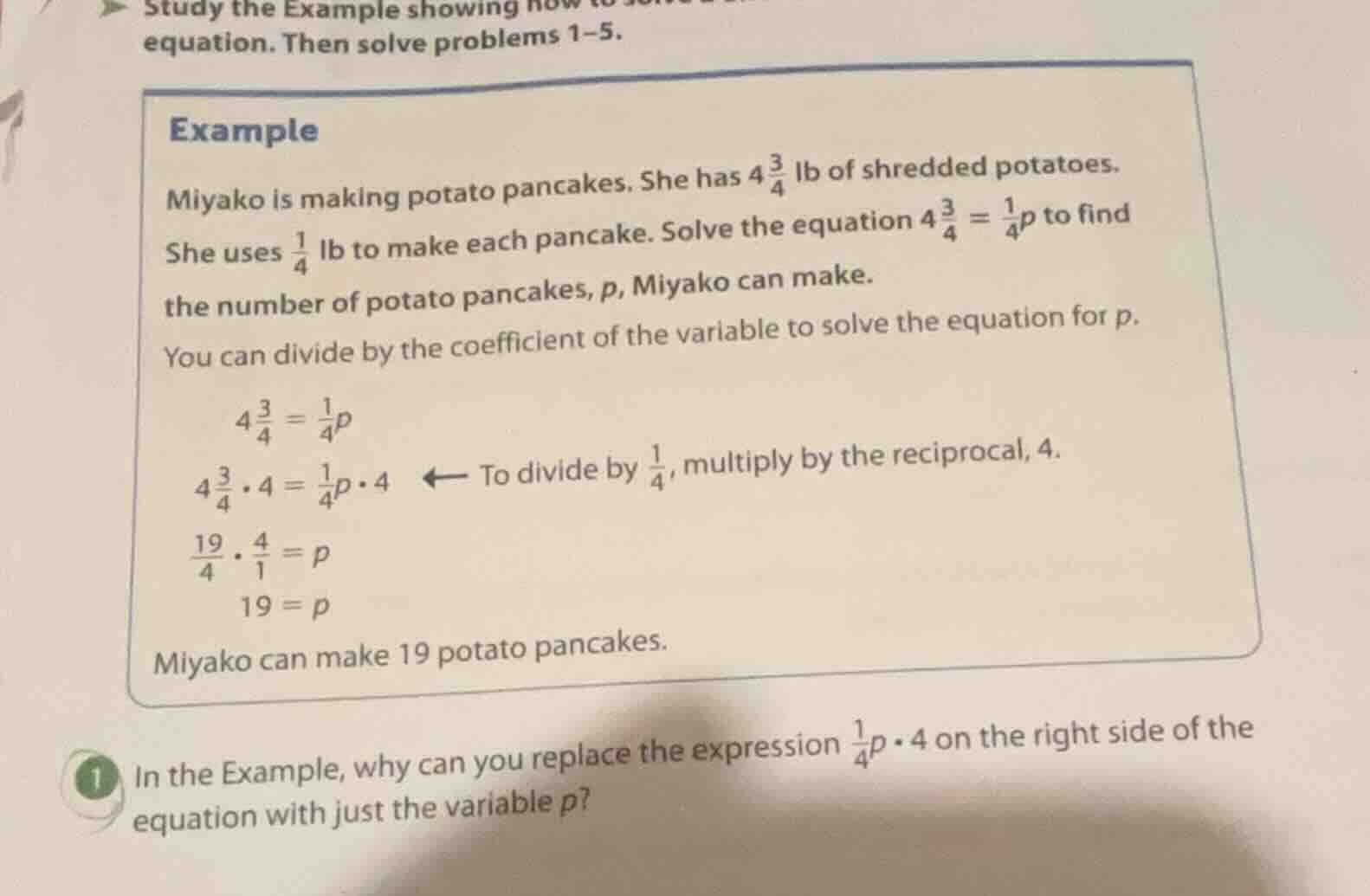
study the example showing how to solve equation. then solve problems 1–5.
example
miyako is making potato pancakes. she has $4\frac{3}{4}$ lb of shredded potatoes. she uses $\frac{1}{4}$ lb to make each pancake. solve the equation $4\frac{3}{4} = \frac{1}{4}p$ to find the number of potato pancakes, $p$, miyako can make.
you can divide by the coefficient of the variable to solve the equation for $p$.
$\quad 4\frac{3}{4} = \frac{1}{4}p$
$\quad 4\frac{3}{4} \cdot 4 = \frac{1}{4}p \cdot 4 \quad \longleftarrow$ to divide by $\frac{1}{4}$, multiply by the reciprocal, 4.
$\quad \frac{19}{4} \cdot \frac{4}{1} = p$
$\quad \quad 19 = p$
miyako can make 19 potato pancakes.
1 in the example, why can you replace the expression $\frac{1}{4}p \cdot 4$ on the right side of the equation with just the variable $p$?
To determine why \(\frac{1}{4}p \cdot 4\) can be replaced with \(p\), we analyze the multiplication of \(\frac{1}{4}\) and \(4\). The fraction \(\frac{1}{4}\) and the integer \(4\) are multiplicative inverses (reciprocals) of each other. By the property of multiplicative inverses, when a number is multiplied by its reciprocal, the product is \(1\). So, \(\frac{1}{4} \times 4 = 1\). When we multiply \(\frac{1}{4}p\) by \(4\), we can use the associative property of multiplication to group \(\frac{1}{4}\) and \(4\) together: \((\frac{1}{4} \times 4) \times p\). Since \(\frac{1}{4} \times 4 = 1\), this simplifies to \(1 \times p\), and by the multiplicative identity property, any number multiplied by \(1\) is the number itself, so \(1 \times p = p\).

Snap & solve any problem in the app
Get step-by-step solutions on Sovi AI
Photo-based solutions with guided steps
Explore more problems and detailed explanations
We can replace \(\frac{1}{4}p \cdot 4\) with \(p\) because \(\frac{1}{4}\) and \(4\) are multiplicative inverses (their product is \(1\)). When we multiply \(\frac{1}{4}p\) by \(4\), we use the associative property of multiplication to group \(\frac{1}{4}\) and \(4\) first: \((\frac{1}{4} \times 4) \times p\). Since \(\frac{1}{4} \times 4 = 1\), this becomes \(1 \times p\), and by the multiplicative identity property, \(1 \times p = p\).