QUESTION IMAGE
Question
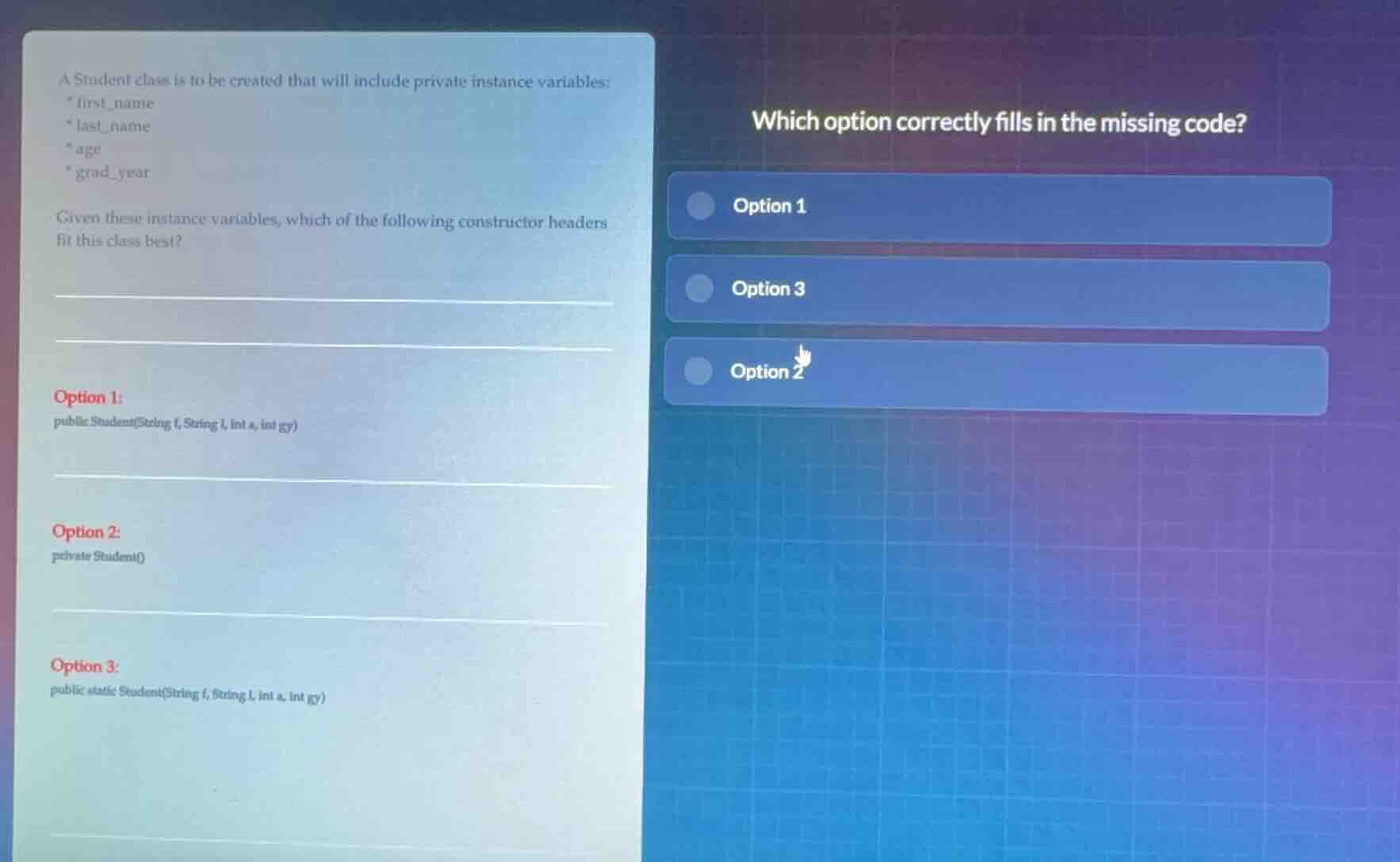
a student class is to be created that will include private instance variables:
- first_name
- last_name
- age
- grad_year
given these instance variables, which of the following constructor headers fit this class best?
option 1:
public student(string f, string l, int a, int gy)
option 2:
private student()
option 3:
public static student(string f, string l, int a, int gy)
which option correctly fills in the missing code?
- option 1
- option 3
- option 2
🆕 New Concept Discovered: Object-Oriented Constructors in Java
Setting up initial values for a new object.
Step 1: Analyze the Instance Variables
The Student class requires four private instance variables:
first_name(typically aString)last_name(typically aString)age(typically anint)grad_year(typically anint)
A standard constructor should accept parameters to initialize all of these instance variables when a new Student object is created.
Step 2: Evaluate Constructor Rules in Java
In Java, constructors must follow specific syntax rules:
- Access Modifier: Usually
publicso other classes can instantiate the object. - No Return Type: Constructors do not have a return type (not even
void). - No
staticKeyword: Constructors cannot be declared asstaticbecause they are used to create individual, non-static instances of a class. - Name: Must match the class name exactly (
Student).
Step 3: Compare the Options
- Option 1:
public Student(String f, String l, int a, int gy) - Correct. It is
public, has no return type, does not usestatic, and provides parameters matching the types of the four instance variables. - Option 2:
private Student() - Incorrect. It is marked
private(which prevents normal instantiation from outside the class) and takes no parameters, leaving the required instance variables uninitialized. - Option 3:
public static Student(String f, String l, int a, int gy) - Incorrect. Constructors cannot be declared
static.

Snap & solve any problem in the app
Get step-by-step solutions on Sovi AI
Photo-based solutions with guided steps
Explore more problems and detailed explanations
Option 1