QUESTION IMAGE
Question
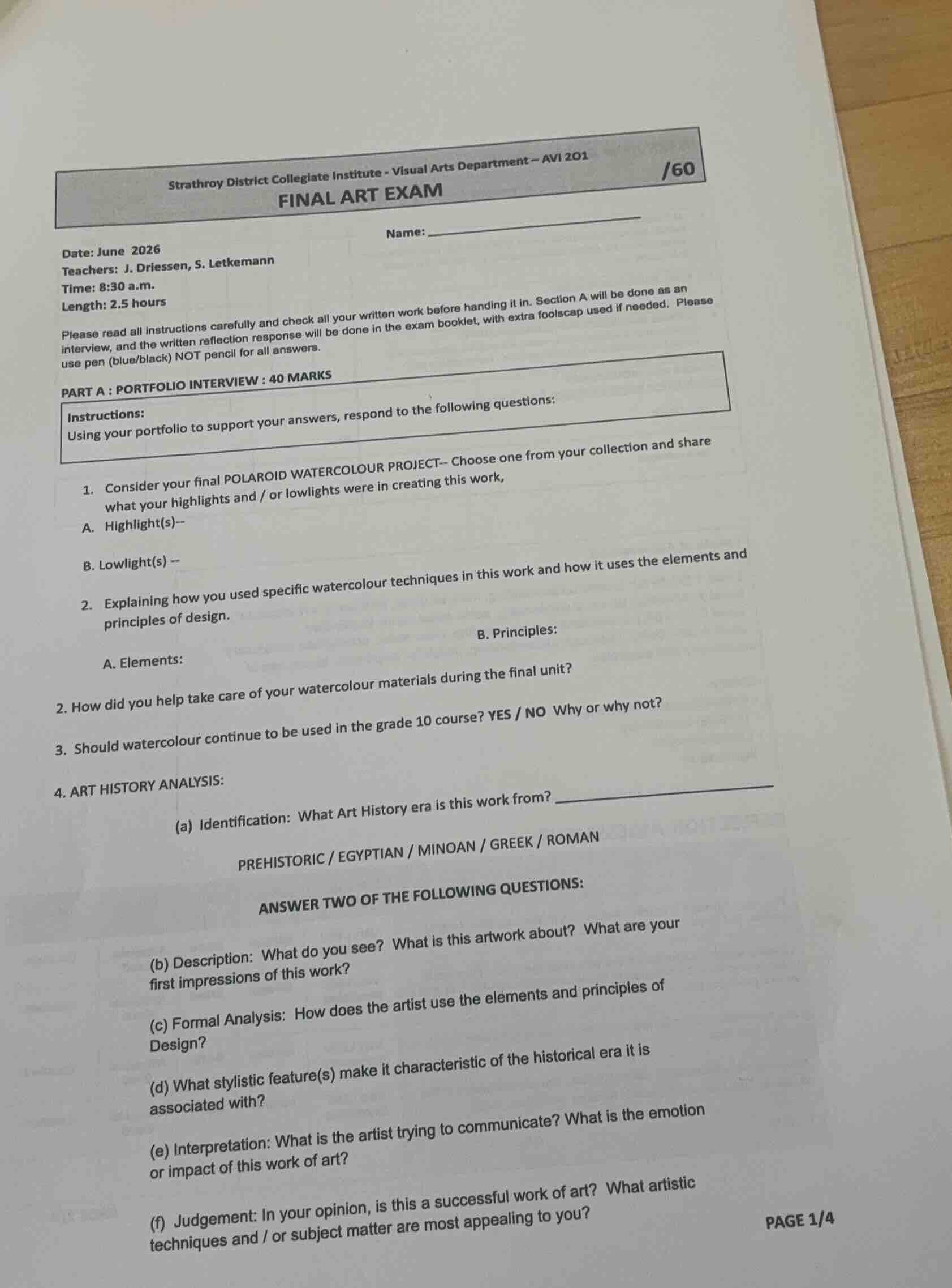
strathroy district collegiate institute - visual arts department - avi 201
final art exam
/60
date: june 2026
name:
teachers: j. driessen, s. letkemann
time: 8:30 a.m.
length: 2.5 hours
please read all instructions carefully and check all your written work before handing it in. section a will be done as an interview, and the written reflection response will be done in the exam booklet, with extra foolscap used if needed. please use pen (blue/black) not pencil for all answers.
part a: portfolio interview: 40 marks
instructions:
using your portfolio to support your answers, respond to the following questions:
- consider your final polaroid watercolour project-- choose one from your collection and share what your highlights and / or lowlights were in creating this work,
a. highlight(s)--
b. lowlight(s) --
- explaining how you used specific watercolour techniques in this work and how it uses the elements and principles of design.
a. elements:
b. principles:
- how did you help take care of your watercolour materials during the final unit?
- should watercolour continue to be used in the grade 10 course? yes / no why or why not?
- art history analysis:
(a) identification: what art history era is this work from?
prehistoric / egyptian / minoan / greek / roman
answer two of the following questions:
(b) description: what do you see? what is this artwork about? what are your first impressions of this work?
(c) formal analysis: how does the artist use the elements and principles of design?
(d) what stylistic feature(s) make it characteristic of the historical era it is associated with?
(e) interpretation: what is the artist trying to communicate? what is the emotion or impact of this work of art?
(f) judgement: in your opinion, is this a successful work of art? what artistic techniques and / or subject matter are most appealing to you?
page 1/4
Analyze portfolio reflection prompts
We will address the portfolio interview questions (Questions 1, 2, 3) based on a standard Grade 10 watercolor landscape project. This utilizes Art Reflection and Self Evaluation to assess personal growth, successes, and challenges.
Detail watercolor techniques and design
We will explain how specific Watercolor Techniques (such as wet-on-wet, dry brush, or washes) are applied alongside the elements and Principles of Design (such as color, value, contrast, and balance) to create a cohesive landscape composition.
Address studio maintenance and curriculum
We will outline standard classroom practices for maintaining watercolor materials (brushes, palettes, water cups) to demonstrate responsibility, and provide a thoughtful rationale for keeping watercolor in the Grade 10 curriculum.
Analyze art history era identification
For the Art History Analysis section, we identify the era options provided: Prehistoric, Egyptian, Minoan, Greek, and Roman. We will provide a structured framework to answer these historical analysis prompts.
Formulate formal and interpretive analysis
We will apply Visual Analysis to guide the description, formal analysis, stylistic features, interpretation, and judgment of historical artworks, helping the student structure their exam responses.

Snap & solve any problem in the app
Get step-by-step solutions on Sovi AI
Photo-based solutions with guided steps
Explore more problems and detailed explanations
Question 1: Polaroid Watercolour Project Reflection
- A. Highlight(s): Achieving a smooth, luminous sky gradient using a wet-on-wet wash, which allowed the colors to blend seamlessly without harsh edges.
- B. Lowlight(s): Controlling the water-to-pigment ratio during the foreground details, which initially caused some unwanted bleeding (blooms) that had to be lifted with a thirsty brush.
---
Question 2: Elements and Principles of Design
- A. Elements:
- Color & Value: Using diluted blue and purple washes to create light values in the background, establishing atmospheric perspective.
- Texture: Applying dry brush techniques on rough paper to mimic the natural texture of tree bark and foliage.
- B. Principles:
- Contrast: Placing highly saturated, dark-valued silhouettes in the foreground against the pale, soft background wash to create depth.
- Balance: Distributing visual weight by placing a dominant tree on the left third of the composition, balanced by smaller distant hills on the right.
---
Question 3: Material Care and Maintenance
- Response: I thoroughly rinsed my brushes in clean water, reshaped their bristles to a point, and stored them flat or brush-side up to protect the ferrule. I also wiped down my mixing palette to prevent color contamination for the next class and emptied my water container.
---
Question 4: Watercolor Curriculum Feedback
- Response: YES. Watercolor should continue to be used because it teaches crucial skills in patience, water control, and embracing happy accidents. It offers a unique transparency that cannot be replicated by acrylics, helping students understand value layering.
---
Question 5: Art History Analysis (Identification)
- Response: (Select the era corresponding to the artwork shown in your exam booklet, typically chosen from: PREHISTORIC / EGYPTIAN / MINOAN / GREEK / ROMAN).
---
Question 6: Art History Analysis (Choose Two)
(Example responses for options b and c to guide your selection)
- (b) Description: I see a stylized wall painting depicting figures in profile with simplified, elegant outlines. The artwork appears to depict a ritual or daily activity. My first impression is one of rhythmic movement and flat, vibrant color fields.
- (c) Formal Analysis: The artist uses strong, rhythmic lines to define the figures, creating a sense of movement. The color palette is limited to earthy ochres, terracottas, and blues, which establishes a harmonious, balanced composition despite the lack of three-dimensional shading.