QUESTION IMAGE
Question
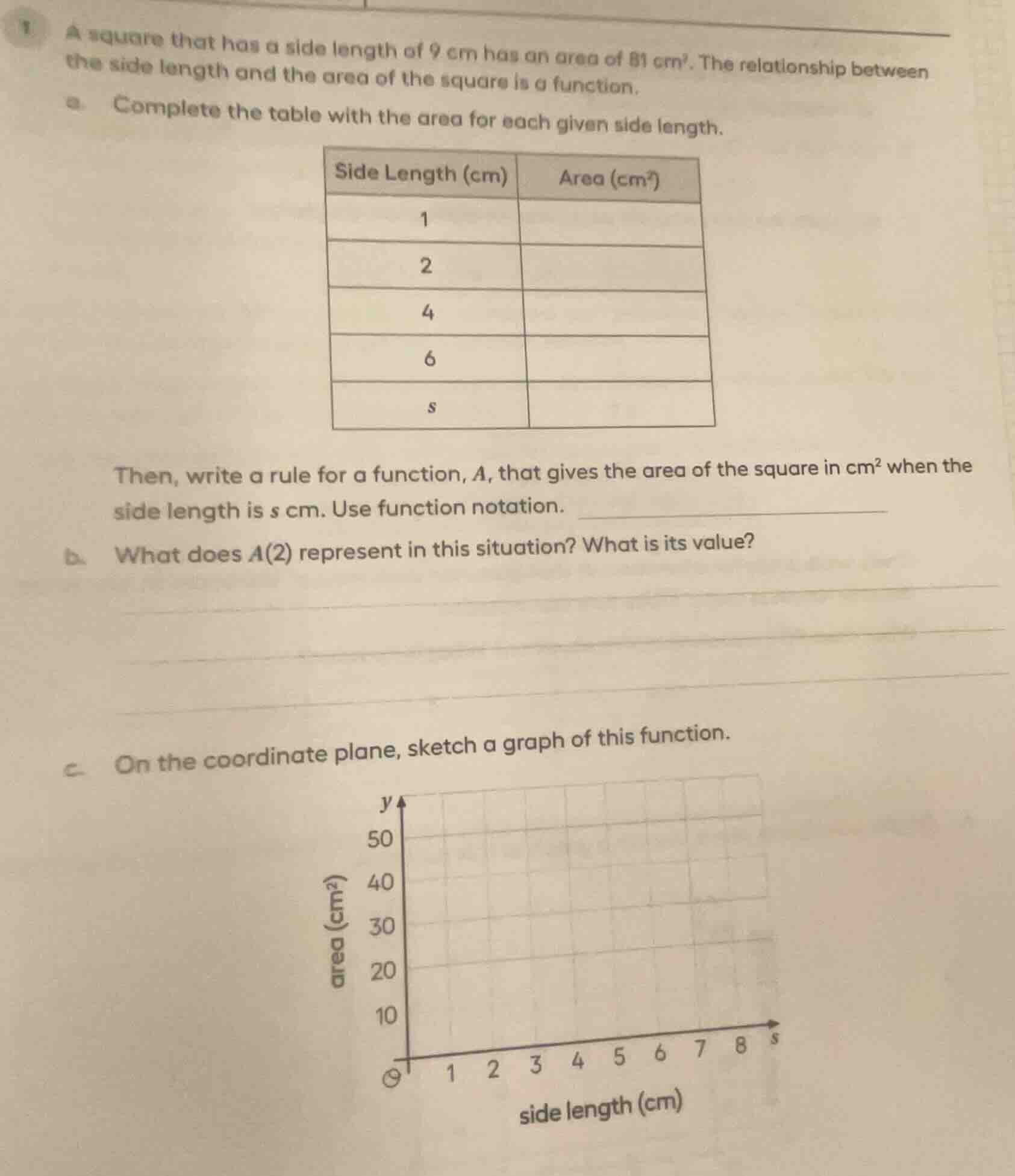
a square that has a side length of 9 cm has an area of 81 cm². the relationship between the side length and the area of the square is a function.
a. complete the table with the area for each given side length.
| side length (cm) | area (cm²) |
|---|---|
| 2 | |
| 4 | |
| 6 | |
| s |
then, write a rule for a function, a, that gives the area of the square in cm² when the side length is s cm. use function notation.
b. what does a(2) represent in this situation? what is its value?
c. on the coordinate plane, sketch a graph of this function.
(coordinate plane with y - axis labeled area (cm²) from 0 to 50 and x - axis labeled side length (cm) from 0 to 8)
Part (a)
Step 1: Recall the formula for the area of a square
The area \( A \) of a square with side length \( s \) is given by \( A = s^2 \).
Step 2: Calculate the area for each side length
- For \( s = 1 \): \( A = 1^2 = 1 \)
- For \( s = 2 \): \( A = 2^2 = 4 \)
- For \( s = 4 \): \( A = 4^2 = 16 \)
- For \( s = 6 \): \( A = 6^2 = 36 \)
- For a general side length \( s \): \( A(s) = s^2 \)
Filling the table:
| Side Length (cm) | Area (cm²) |
|---|---|
| 2 | 4 |
| 4 | 16 |
| 6 | 36 |
| \( s \) | \( s^2 \) |
The function rule is \( A(s) = s^2 \).
Part (b)
- \( A(2) \) represents the area of the square when the side length is \( 2 \) cm.
- To find its value, we use the function \( A(s) = s^2 \). Substitute \( s = 2 \): \( A(2) = 2^2 = 4 \).

Snap & solve any problem in the app
Get step-by-step solutions on Sovi AI
Photo-based solutions with guided steps
Explore more problems and detailed explanations
\( A(2) \) represents the area of the square with side length \( 2 \) cm, and its value is \( 4 \) \( \text{cm}^2 \).
Part (c)
To sketch the graph of \( A(s) = s^2 \) (where \( s \geq 0 \) since side length can't be negative):
- Identify key points: Use the values from the table: \( (1, 1) \), \( (2, 4) \), \( (4, 16) \), \( (6, 36) \).
- Plot the points: On the coordinate plane, plot these points where the x - axis is the side length \( s \) (in cm) and the y - axis is the area \( A \) (in \( \text{cm}^2 \)).
- Draw the curve: Since \( A(s)=s^2 \) is a quadratic function, the graph is a parabola opening upwards. Connect the plotted points with a smooth curve. For example, when \( s = 3 \), \( A(3)=9 \), so the point \( (3,9) \) is also on the graph, and we can include such additional points for a more accurate sketch.