Sovi.AI - AI Math Tutor

Scan to solve math questions

QUESTION IMAGE

someone standing in front of a smooth surface from which a sound is ref…

Question

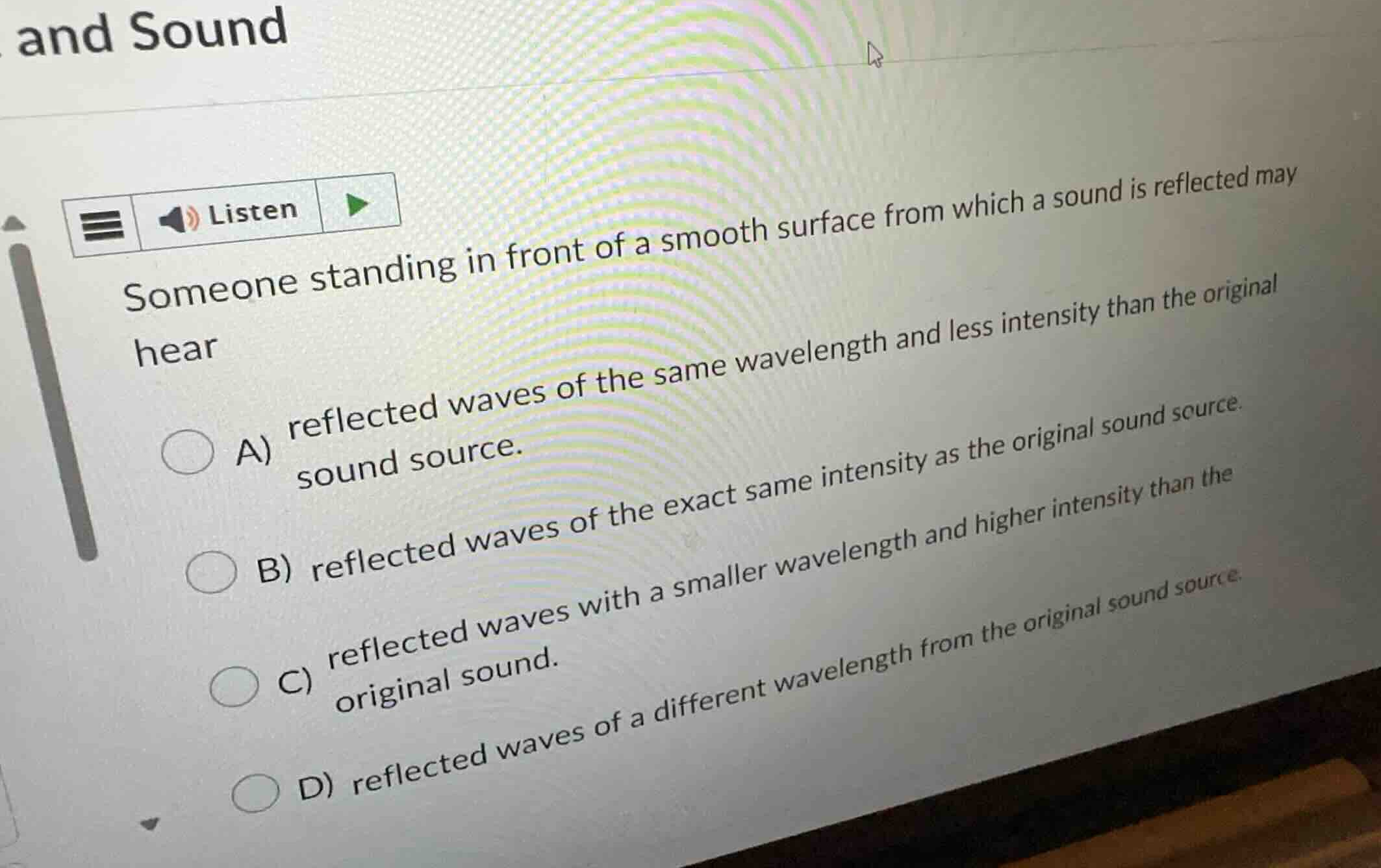
someone standing in front of a smooth surface from which a sound is reflected may hear

a) reflected waves of the same wavelength and less intensity than the original sound source.
b) reflected waves of the exact same intensity as the original sound source.
c) reflected waves with a smaller wavelength and higher intensity than the original sound.
d) reflected waves of a different wavelength from the original sound source.

Explanation:

Response

<pre_analysis>
{
"quality": "clear",
"question_count": 1,
"skills_matched": [
"direct_cot",
"multiple_choice_formatter",
"explain_then_answer",
"tutor",
"mastery_adaptive_brevity"
],
"needs_drawing": false,
"concepts_used": [
"Sound Reflection"
],
"new_concepts": [
"Wave Intensity",
"Reflection Properties"
],
"current_concepts": [
"Sound Reflection",
"Wave Intensity",
"Reflection Properties"
]
}
</pre_analysis>

<reasoning>

Analyze reflection properties

Using the Sound Reflection knowledge point
When a sound wave reflects off a smooth surface, its frequency and wavelength remain unchanged because the medium and the source frequency do not change.

Analyze wave intensity

As a sound wave travels through air and reflects off a surface, some energy is absorbed by the medium and the reflecting surface, and the wave spreads out, resulting in a lower intensity (volume) than the original sound source.

Evaluate the options

  • Option A correctly states that the reflected waves have the same wavelength but less intensity.
  • Option B is incorrect because intensity decreases due to absorption and spreading.
  • Option C is incorrect because wavelength does not change and intensity does not increase.
  • Option D is incorrect because wavelength remains the same.

</reasoning>

<answer>
<mcq-correct>A) reflected waves of the same wavelength and less intensity than the original sound source.</mcq-correct>
<mcq-option>B) reflected waves of the exact same intensity as the original sound source.</mcq-option>
<mcq-option>C) reflected waves with a smaller wavelength and higher intensity than the original sound.</mcq-option>
<mcq-option>D) reflected waves of a different wavelength from the original sound source.</mcq-option>
</answer>

<post_analysis>
{
"subject": "Natural Science",
"question_type": "Multiple Choice",
"knowledge_point": [
"Natural Science",
"Physics",
"Sound Reflection"
]
}
</post_analysis>

Answer:

<pre_analysis>
{
"quality": "clear",
"question_count": 1,
"skills_matched": [
"direct_cot",
"multiple_choice_formatter",
"explain_then_answer",
"tutor",
"mastery_adaptive_brevity"
],
"needs_drawing": false,
"concepts_used": [
"Sound Reflection"
],
"new_concepts": [
"Wave Intensity",
"Reflection Properties"
],
"current_concepts": [
"Sound Reflection",
"Wave Intensity",
"Reflection Properties"
]
}
</pre_analysis>

<reasoning>

Analyze reflection properties

Using the Sound Reflection knowledge point
When a sound wave reflects off a smooth surface, its frequency and wavelength remain unchanged because the medium and the source frequency do not change.

Analyze wave intensity

As a sound wave travels through air and reflects off a surface, some energy is absorbed by the medium and the reflecting surface, and the wave spreads out, resulting in a lower intensity (volume) than the original sound source.

Evaluate the options

  • Option A correctly states that the reflected waves have the same wavelength but less intensity.
  • Option B is incorrect because intensity decreases due to absorption and spreading.
  • Option C is incorrect because wavelength does not change and intensity does not increase.
  • Option D is incorrect because wavelength remains the same.

</reasoning>

<answer>
<mcq-correct>A) reflected waves of the same wavelength and less intensity than the original sound source.</mcq-correct>
<mcq-option>B) reflected waves of the exact same intensity as the original sound source.</mcq-option>
<mcq-option>C) reflected waves with a smaller wavelength and higher intensity than the original sound.</mcq-option>
<mcq-option>D) reflected waves of a different wavelength from the original sound source.</mcq-option>
</answer>

<post_analysis>
{
"subject": "Natural Science",
"question_type": "Multiple Choice",
"knowledge_point": [
"Natural Science",
"Physics",
"Sound Reflection"
]
}
</post_analysis>