QUESTION IMAGE
Question
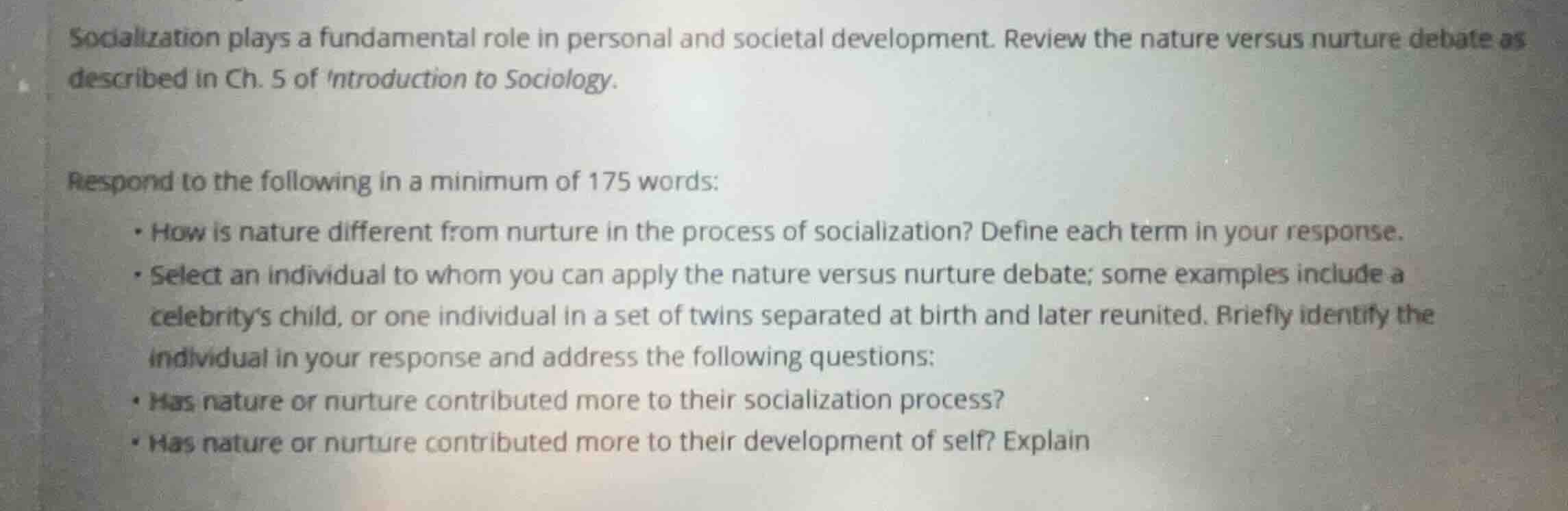
socialization plays a fundamental role in personal and societal development. review the nature versus nurture debate as described in ch. 5 of introduction to sociology.
respond to the following in a minimum of 175 words:
- how is nature different from nurture in the process of socialization? define each term in your response.
- select an individual to whom you can apply the nature versus nurture debate; some examples include a celebritys child, or one individual in a set of twins separated at birth and later reunited. briefly identify the individual in your response and address the following questions:
- has nature or nurture contributed more to their socialization process?
- has nature or nurture contributed more to their development of self? explain
Define nature and nurture
In sociology, the debate centers on human development.
Nature refers to genetic and biological heredity.
Nurture represents environmental influences and social interactions.
Both shape individual behavior and socialization.
Select an analytical subject
Consider twins separated at birth, like Oskar and Jack.
They share identical genetic profiles (nature).
However, they were raised in different cultures (nurture).
This case highlights how environments modify genetic predispositions.
Analyze socialization contributions
Nurture contributed more to their socialization process.
Socialization requires learning language, norms, and values.
These elements are entirely acquired through social interaction.
Genetic makeup cannot transmit cultural practices or beliefs.
Evaluate development of self
Using Sociological Theories, self-development relies heavily on nurture.
The self emerges through social interaction and feedback.
While nature provides the physical and cognitive foundation,
nurture determines how one perceives and defines identity.
Therefore, social environment plays the dominant role.

Snap & solve any problem in the app
Get step-by-step solutions on Sovi AI
Photo-based solutions with guided steps
Explore more problems and detailed explanations
The nature versus nurture debate is central to understanding human development and socialization.
Nature refers to the biological and genetic predispositions that individuals inherit from their parents, such as physical traits, temperament, and certain cognitive capacities. In contrast, nurture encompasses the social environment, cultural context, personal relationships, and experiences that shape an individual throughout their life.
To analyze this debate, we can look at the famous case of identical twins Oskar Stöhr and Jack Yufe, who were separated at birth. Oskar was raised as a Catholic in Nazi-occupied Europe, while Jack was raised Jewish in Trinidad.
In terms of their socialization process, nurture contributed far more. While they shared identical genetics, their distinct social environments taught them completely different languages, political ideologies, religious beliefs, and cultural habits. Socialization is fundamentally an interactive process of learning and internalizing the norms of a group, which cannot occur through biology alone.
Regarding the development of self, nurture also played the dominant role. According to Sociological Theories of self-development, such as Charles Horton Cooley's "looking-glass self" or George Herbert Mead's stages of socialization, the "self" is not present at birth. It is constructed entirely through social interactions, symbolic communication, and learning to view oneself from the perspective of others. While their shared genetics (nature) gave Oskar and Jack similar temperaments and physical mannerisms, their distinct identities, values, and self-concepts were forged by their unique social environments (nurture).