QUESTION IMAGE
Question
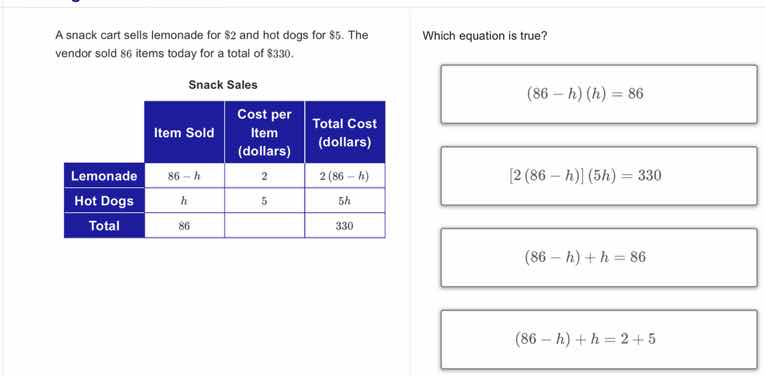
a snack cart sells lemonade for $2 and hot dogs for $5. the vendor sold 86 items today for a total of $330.
snack sales
| item sold | cost per item (dollars) | total cost (dollars) | |
|---|---|---|---|
| hot dogs | h | 5 | 5h |
| total | 86 | 330 |
which equation is true?
(86 - h)(h) = 86
2(86 - h)(5h) = 330
(86 - h) + h = 86
(86 - h) + h = 2 + 5
Step1: Analyze the number of items
The total number of items sold is 86, which is the sum of the number of lemonades sold (\(86 - h\)) and the number of hot dogs sold (\(h\)). So the equation representing the total number of items should be \((86 - h)+h = 86\).
Step2: Check other options
- For \((86 - h)(h)=86\): This would imply a product relationship, but we need a sum for the number of items, so this is incorrect.
- For \([2(86 - h)](5h)=330\): The total cost is the sum of the cost of lemonades and hot dogs, not the product, so this is incorrect.
- For \((86 - h)+h = 2 + 5\): The left side is the number of items and the right side is the sum of costs per item, which are not equal, so this is incorrect.

Snap & solve any problem in the app
Get step-by-step solutions on Sovi AI
Photo-based solutions with guided steps
Explore more problems and detailed explanations
\((86 - h)+h = 86\) (the third option)