QUESTION IMAGE
Question
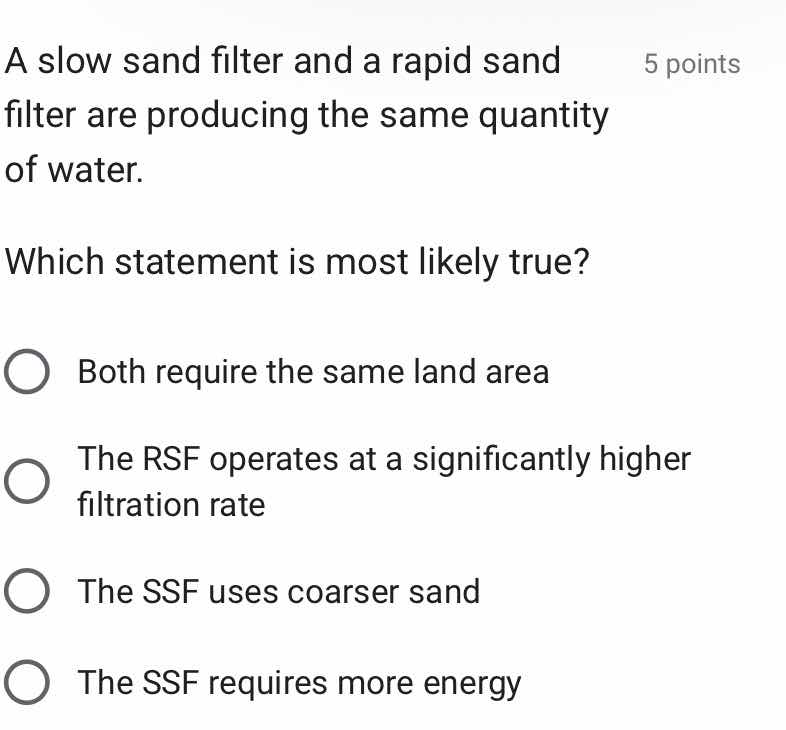
a slow sand filter and a rapid sand filter are producing the same quantity of water.
which statement is most likely true?
both require the same land area
the rsf operates at a significantly higher filtration rate
the ssf uses coarser sand
the ssf requires more energy
🆕 New Concept Discovered: Water Filtration Design
Comparing slow and rapid sand filters
Step 1: Understand the filtration rate difference
Slow Sand Filters (SSF) and Rapid Sand Filters (RSF) are two primary types of sand filters used in water treatment. By definition, their filtration rates differ significantly:
- Slow Sand Filter (SSF): Operates at a very low filtration rate, typically \( 0.1 \) to \( 0.4\text{ m}^3/\text{m}^2\cdot\text{h} \).
- Rapid Sand Filter (RSF): Operates at a much higher filtration rate, typically \( 5 \) to \( 15\text{ m}^3/\text{m}^2\cdot\text{h} \) (about 50 to 100 times faster than SSF).
Therefore, the statement "The RSF operates at a significantly higher filtration rate" is inherently true based on their design principles.
Step 2: Evaluate the other options
- Both require the same land area: Since flow rate \( Q = \text{Filtration Rate} \times \text{Area} \), and they produce the same quantity of water (\( Q \)), the filter with the much lower filtration rate (SSF) requires a much larger surface area. Thus, their land areas are not the same.
- The SSF uses coarser sand: SSF actually uses finer sand (effective size \( 0.15 - 0.35\text{ mm} \)) compared to RSF (effective size \( 0.45 - 0.70\text{ mm} \)) to facilitate biological treatment in the top layer (schmutzdecke).
- The SSF requires more energy: SSF operates mainly via gravity head and does not require backwashing systems, meaning it generally requires less mechanical energy than RSF, which needs energy-intensive backwashing pumps and air scourers.

Snap & solve any problem in the app
Get step-by-step solutions on Sovi AI
Photo-based solutions with guided steps
Explore more problems and detailed explanations
The RSF operates at a significantly higher filtration rate