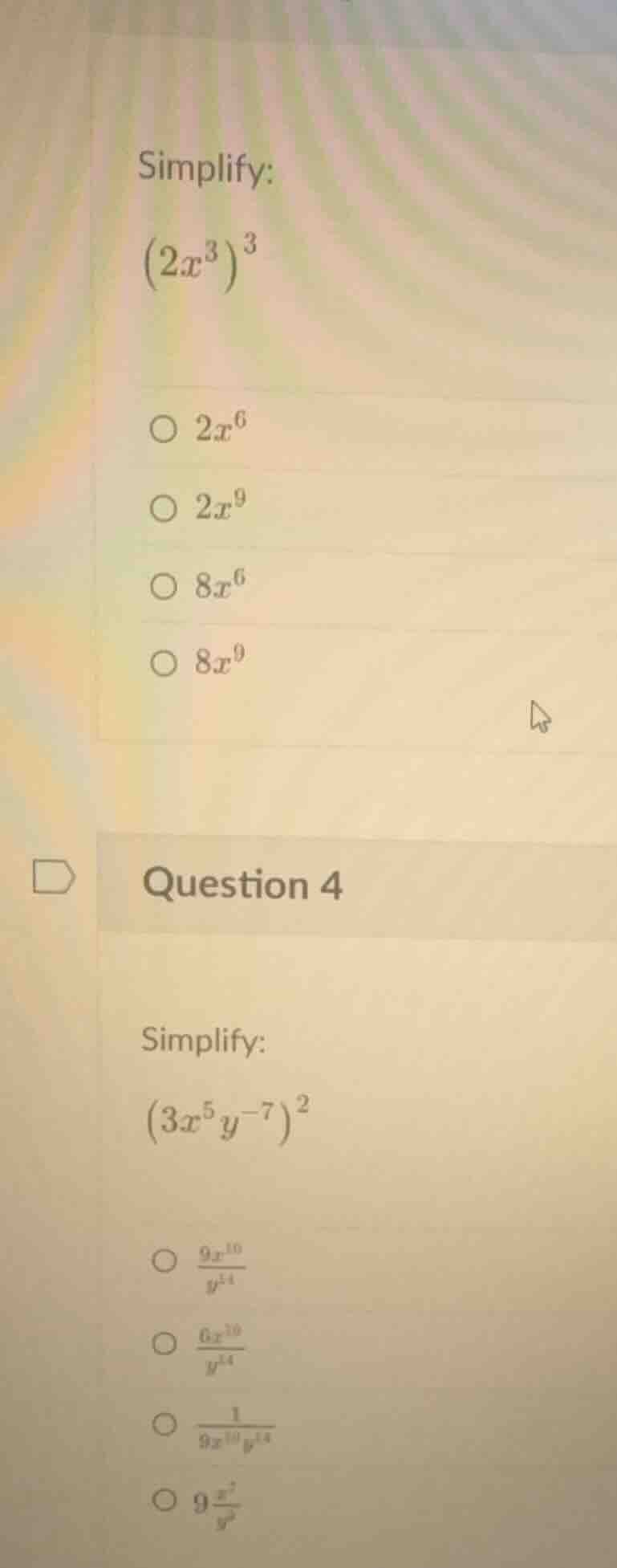
QUESTION IMAGE
Question
simplify:
\\((2x^3)^3\\)
- \\(2x^6\\)
- \\(2x^9\\)
- \\(8x^6\\)
- \\(8x^9\\)
question 4
simplify:
\\((3x^5y^{-7})^2\\)
- \\(\frac{9x^{10}}{y^{14}}\\)
- \\(\frac{6x^{10}}{y^{14}}\\)
- \\(\frac{1}{9x^{10}y^{14}}\\)
- \\(9\frac{x^7}{y^9}\\)
<pre_analysis>
{
"quality": "clear",
"question_count": 2,
"skills_matched": [
"step_cot",
"multiple_choice_formatter",
"explain_then_answer",
"quick"
],
"needs_drawing": false,
"concepts_used": [
"Exponent Rules",
"Negative Exponents"
],
"new_concepts": [],
"current_concepts": [
"Exponent Rules",
"Negative Exponents"
]
}
</pre_analysis>
<reasoning>
Distribute the outer exponent to each factor in the first expression
\[
(2x^3)^3 = 2^3 \cdot (x^3)^3
\]
Simplify the numerical base and apply the power of a power rule
\[
2^3 = 8
\]
\[
(x^3)^3 = x^{3 \cdot 3} = x^9
\]
\[
(2x^3)^3 = 8x^9
\]
Distribute the outer exponent and apply negative exponent rules to the second expression
\[
(3x^5y^{-7})^2 = 3^2 \cdot (x^5)^2 \cdot (y^{-7})^2
\]
\[
3^2 = 9
\]
\[
(x^5)^2 = x^{5 \cdot 2} = x^{10}
\]
\[
(y^{-7})^2 = y^{-7 \cdot 2} = y^{-14} = \frac{1}{y^{14}}
\]
\[
(3x^5y^{-7})^2 = \frac{9x^{10}}{y^{14}}
\]
</reasoning>
<answer>
Question 1
<mcq-option>(A) \(2x^6\)</mcq-option>
<mcq-option>(B) \(2x^9\)</mcq-option>
<mcq-option>(C) \(8x^6\)</mcq-option>
<mcq-correct>(D) \(8x^9\)</mcq-correct>
Question 2
<mcq-correct>(A) \(\frac{9x^{10}}{y^{14}}\)</mcq-correct>
<mcq-option>(B) \(\frac{6x^{10}}{y^{14}}\)</mcq-option>
<mcq-option>(C) \(\frac{1}{9x^{10}y^{14}}\)</mcq-option>
<mcq-option>(D) \(9\frac{x^7}{y^9}\)</mcq-option>
</answer>
<post_analysis>
{
"subject": "Mathematics",
"question_type": "Multiple Choice",
"knowledge_point": [
"Mathematics",
"Algebra",
"Exponent Rules"
]
}
</post_analysis>
Snap & solve any problem in the app
Get step-by-step solutions on Sovi AI
Photo-based solutions with guided steps
Explore more problems and detailed explanations
<pre_analysis>
{
"quality": "clear",
"question_count": 2,
"skills_matched": [
"step_cot",
"multiple_choice_formatter",
"explain_then_answer",
"quick"
],
"needs_drawing": false,
"concepts_used": [
"Exponent Rules",
"Negative Exponents"
],
"new_concepts": [],
"current_concepts": [
"Exponent Rules",
"Negative Exponents"
]
}
</pre_analysis>
<reasoning>
Distribute the outer exponent to each factor in the first expression
\[
(2x^3)^3 = 2^3 \cdot (x^3)^3
\]
Simplify the numerical base and apply the power of a power rule
\[
2^3 = 8
\]
\[
(x^3)^3 = x^{3 \cdot 3} = x^9
\]
\[
(2x^3)^3 = 8x^9
\]
Distribute the outer exponent and apply negative exponent rules to the second expression
\[
(3x^5y^{-7})^2 = 3^2 \cdot (x^5)^2 \cdot (y^{-7})^2
\]
\[
3^2 = 9
\]
\[
(x^5)^2 = x^{5 \cdot 2} = x^{10}
\]
\[
(y^{-7})^2 = y^{-7 \cdot 2} = y^{-14} = \frac{1}{y^{14}}
\]
\[
(3x^5y^{-7})^2 = \frac{9x^{10}}{y^{14}}
\]
</reasoning>
<answer>
Question 1
<mcq-option>(A) \(2x^6\)</mcq-option>
<mcq-option>(B) \(2x^9\)</mcq-option>
<mcq-option>(C) \(8x^6\)</mcq-option>
<mcq-correct>(D) \(8x^9\)</mcq-correct>
Question 2
<mcq-correct>(A) \(\frac{9x^{10}}{y^{14}}\)</mcq-correct>
<mcq-option>(B) \(\frac{6x^{10}}{y^{14}}\)</mcq-option>
<mcq-option>(C) \(\frac{1}{9x^{10}y^{14}}\)</mcq-option>
<mcq-option>(D) \(9\frac{x^7}{y^9}\)</mcq-option>
</answer>
<post_analysis>
{
"subject": "Mathematics",
"question_type": "Multiple Choice",
"knowledge_point": [
"Mathematics",
"Algebra",
"Exponent Rules"
]
}
</post_analysis>