Sovi.AI - AI Math Tutor

Scan to solve math questions

QUESTION IMAGE

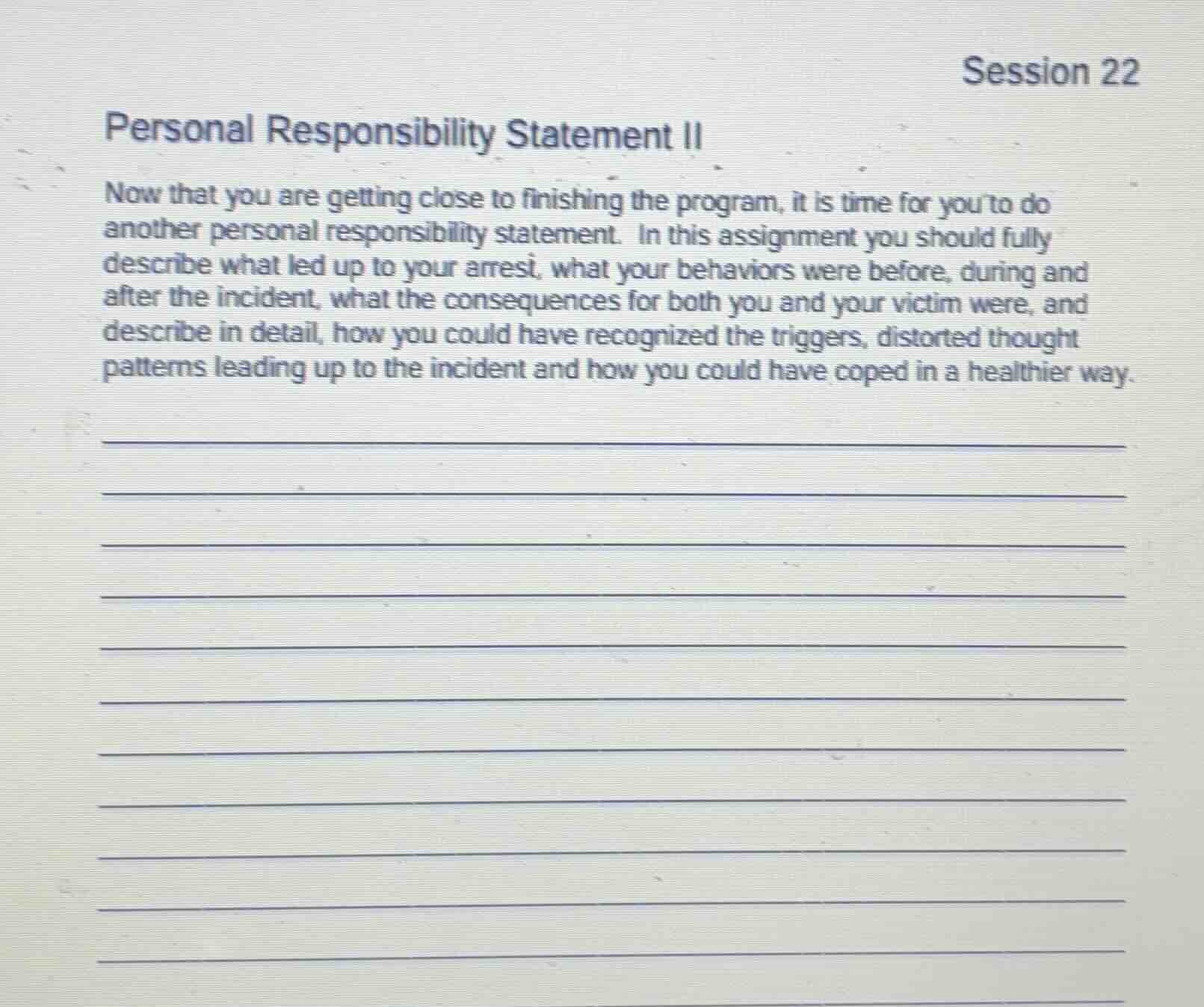
session 22 personal responsibility statement ii now that you are gettin…

Question

session 22

personal responsibility statement ii

now that you are getting close to finishing the program, it is time for you to do another personal responsibility statement. in this assignment you should fully describe what led up to your arrest, what your behaviors were before, during and after the incident, what the consequences for both you and your victim were, and describe in detail, how you could have recognized the triggers, distorted thought patterns leading up to the incident and how you could have coped in a healthier way.

Explanation:

Response

<pre_analysis>
{
"quality": "clear",
"question_count": 1,
"skills_matched": [
"direct_cot",
"explain_then_answer",
"quick"
],
"needs_drawing": false,
"concepts_used": [],
"new_concepts": [
"Personal Responsibility Statement",
"Offense Cycle Analysis",
"Cognitive Restructuring"
],
"current_concepts": [
"Personal Responsibility Statement",
"Offense Cycle Analysis",
"Cognitive Restructuring"
]
}
</pre_analysis>

<reasoning>

Analyze the prompt requirements

The worksheet titled "Session 22: Personal Responsibility Statement II" requires a comprehensive written reflection addressing several key components:

  1. What led up to the arrest.
  2. Behaviors before, during, and after the incident.
  3. Consequences of the incident for both the individual and the victim.
  4. Identification of triggers and distorted thought patterns leading to the incident.
  5. Healthier coping mechanisms that could have been utilized.

Structure the response template

To complete this assignment effectively, a structured outline is needed to address each prompt requirement systematically:

  • Introduction & Context: Describe the events and circumstances leading to the arrest.
  • Behavioral Timeline: Detail actions and behaviors before, during, and after the incident.
  • Impact & Consequences: Analyze the direct and indirect consequences on oneself and the victim.
  • Cognitive Analysis: Identify the specific triggers and distorted thought patterns (cognitive distortions) that influenced the behavior.
  • Alternative Coping Strategies: Propose constructive, healthy coping mechanisms and prevention strategies for the future.

</reasoning>

<answer>
To complete your Personal Responsibility Statement II, you can use the following structured template to draft your response on the lines provided:

  1. The Lead-Up to the Incident
  • Describe the situational, emotional, and environmental factors that preceded your arrest (e.g., stress, substance use, interpersonal conflict, financial pressure).
  1. Behavioral Timeline
  • Before: What specific actions were you taking? How were you acting or reacting to your environment?
  • During: Describe your exact behaviors during the incident without minimizing or shifting blame.
  • After: How did you react immediately following the incident? What were your immediate choices?
  1. Consequences and Impact
  • For the Victim: Identify the physical, emotional, psychological, or financial harm caused to the victim.
  • For Yourself: List the legal, personal, relational, and professional consequences you have faced or are currently facing.
  1. Triggers and Distorted Thought Patterns
  • Triggers: Identify the internal triggers (e.g., anger, rejection, fear) and external triggers (e.g., specific people, places, or situations) that initiated the cycle.
  • Distorted Thoughts: Pinpoint the cognitive distortions you experienced (e.g., justification, minimization, blaming others, emotional reasoning).
  1. Healthy Coping and Future Prevention
  • Detail specific, actionable strategies you will use to manage triggers in the future (e.g., utilizing a respectful timeout, practicing cognitive restructuring, seeking professional support, or applying de-escalation techniques).

</answer>

<post_analysis>
{
"subject": "Social Science",
"question_type": "Free Response",
"knowledge_point": [
"Social Science",
"Behavioral Therapy",
"Relapse Prevention"
]
}
</post_analysis>

Answer:

<pre_analysis>
{
"quality": "clear",
"question_count": 1,
"skills_matched": [
"direct_cot",
"explain_then_answer",
"quick"
],
"needs_drawing": false,
"concepts_used": [],
"new_concepts": [
"Personal Responsibility Statement",
"Offense Cycle Analysis",
"Cognitive Restructuring"
],
"current_concepts": [
"Personal Responsibility Statement",
"Offense Cycle Analysis",
"Cognitive Restructuring"
]
}
</pre_analysis>

<reasoning>

Analyze the prompt requirements

The worksheet titled "Session 22: Personal Responsibility Statement II" requires a comprehensive written reflection addressing several key components:

  1. What led up to the arrest.
  2. Behaviors before, during, and after the incident.
  3. Consequences of the incident for both the individual and the victim.
  4. Identification of triggers and distorted thought patterns leading to the incident.
  5. Healthier coping mechanisms that could have been utilized.

Structure the response template

To complete this assignment effectively, a structured outline is needed to address each prompt requirement systematically:

  • Introduction & Context: Describe the events and circumstances leading to the arrest.
  • Behavioral Timeline: Detail actions and behaviors before, during, and after the incident.
  • Impact & Consequences: Analyze the direct and indirect consequences on oneself and the victim.
  • Cognitive Analysis: Identify the specific triggers and distorted thought patterns (cognitive distortions) that influenced the behavior.
  • Alternative Coping Strategies: Propose constructive, healthy coping mechanisms and prevention strategies for the future.

</reasoning>

<answer>
To complete your Personal Responsibility Statement II, you can use the following structured template to draft your response on the lines provided:

  1. The Lead-Up to the Incident
  • Describe the situational, emotional, and environmental factors that preceded your arrest (e.g., stress, substance use, interpersonal conflict, financial pressure).
  1. Behavioral Timeline
  • Before: What specific actions were you taking? How were you acting or reacting to your environment?
  • During: Describe your exact behaviors during the incident without minimizing or shifting blame.
  • After: How did you react immediately following the incident? What were your immediate choices?
  1. Consequences and Impact
  • For the Victim: Identify the physical, emotional, psychological, or financial harm caused to the victim.
  • For Yourself: List the legal, personal, relational, and professional consequences you have faced or are currently facing.
  1. Triggers and Distorted Thought Patterns
  • Triggers: Identify the internal triggers (e.g., anger, rejection, fear) and external triggers (e.g., specific people, places, or situations) that initiated the cycle.
  • Distorted Thoughts: Pinpoint the cognitive distortions you experienced (e.g., justification, minimization, blaming others, emotional reasoning).
  1. Healthy Coping and Future Prevention
  • Detail specific, actionable strategies you will use to manage triggers in the future (e.g., utilizing a respectful timeout, practicing cognitive restructuring, seeking professional support, or applying de-escalation techniques).

</answer>

<post_analysis>
{
"subject": "Social Science",
"question_type": "Free Response",
"knowledge_point": [
"Social Science",
"Behavioral Therapy",
"Relapse Prevention"
]
}
</post_analysis>