QUESTION IMAGE
Question
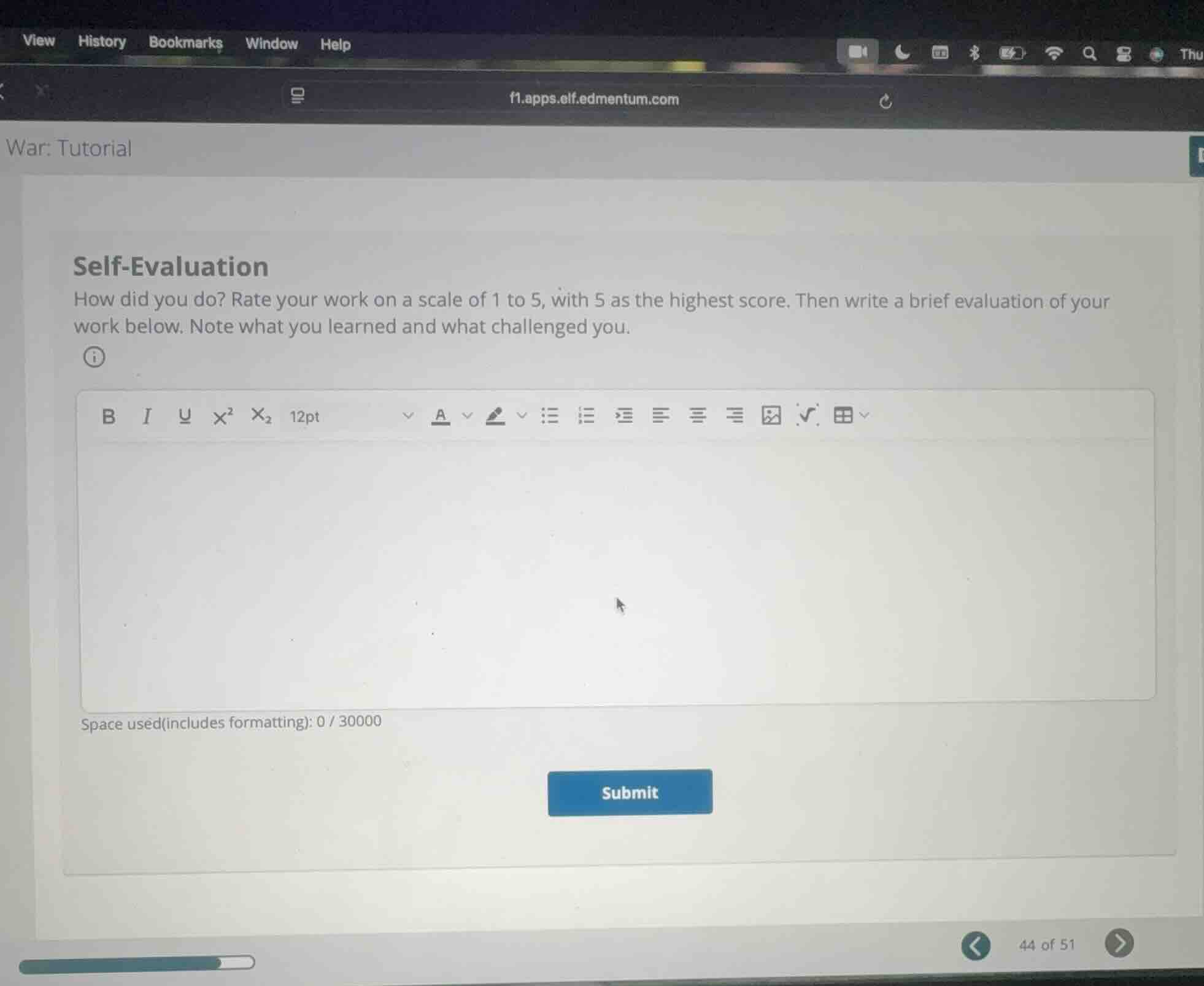
self-evaluation
how did you do? rate your work on a scale of 1 to 5, with 5 as the highest score. then write a brief evaluation of your work below. note what you learned and what challenged you.
Identify the prompt requirements
The prompt asks to rate your own work on a scale of 1 to 5 (with 5 being the highest) and write a brief self-evaluation. It requires noting what was learned and what was challenging.
Determine the context
The page header shows "War: Tutorial" and the student's profile indicates mastery in World War I topics (Alliances, Technology, Casualties) and the Russian Revolution. The evaluation should reflect on these specific historical topics.
Draft the rating
A rating of 4 or 5 is appropriate for a student who has mastered these core concepts. Let's select 4 out of 5 to leave room for constructive reflection on challenges.
Formulate what was learned
Reflect on the key mastered concepts: the complex web of alliances (Triple Alliance and Triple Entente), the devastating impact of World War I technology and casualties, and the political shifts of the Russian Revolution.
Formulate the challenges
Identify potential challenges, such as analyzing the multi-faceted causes of the Russian Civil War or connecting Marxist theory to Bolshevik promises.

Snap & solve any problem in the app
Get step-by-step solutions on Sovi AI
Photo-based solutions with guided steps
Explore more problems and detailed explanations
Rating: 4/5
Evaluation:
During this unit on World War I and the Russian Revolution, I gained a deep understanding of how the system of alliances, specifically the Triple Alliance and the Triple Entente, escalated a regional conflict into a global war. I also learned about the devastating impact of new military technologies on casualty rates. Additionally, exploring the Russian Revolution helped me understand how Bolshevik promises of "Peace, Land, and Bread" resonated with a struggling population to overthrow the Romanov Dynasty.
The most challenging part was tracing the transition from Marxist theory to the practical realities of the Russian Civil War, as the ideological shifts and military maneuvers were highly complex to follow. To improve, I plan to spend more time analyzing primary source documents from this era.