QUESTION IMAGE
Question
select the correct text in the passage.
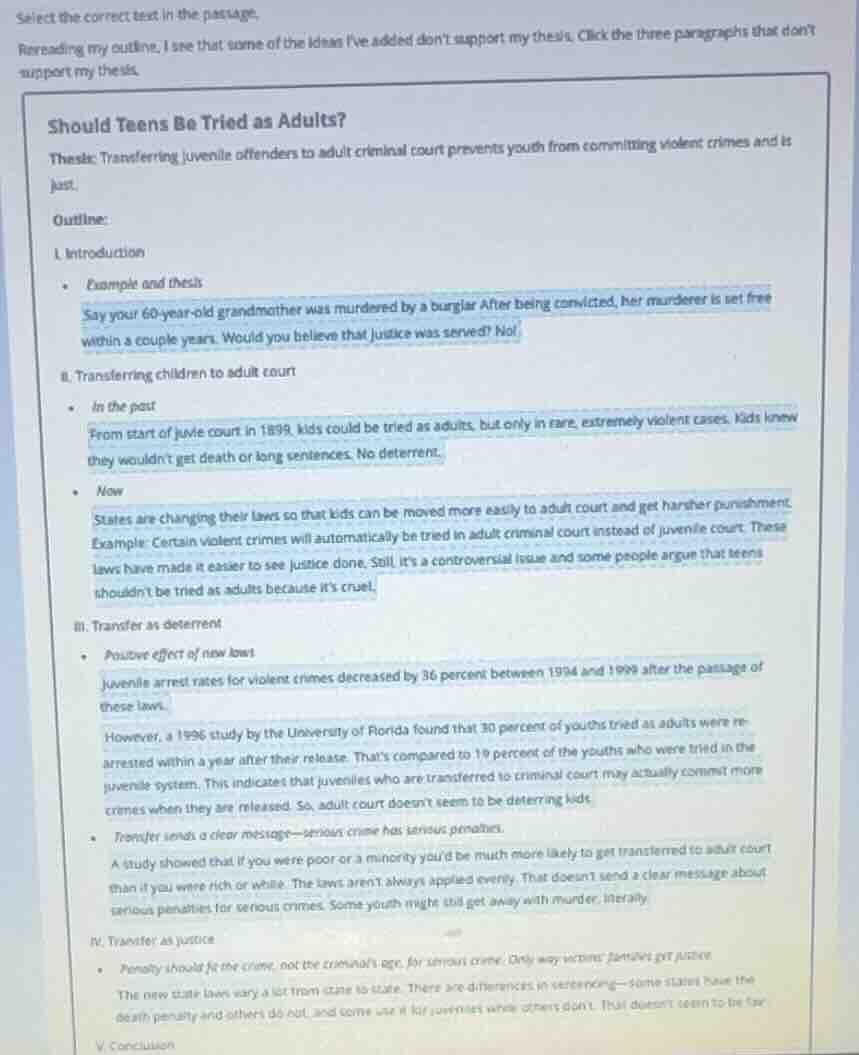
rereading my outline, i see that some of the ideas ive added dont support my thesis. click the three paragraphs that dont support my thesis.
should teens be tried as adults?
thesis: transferring juvenile offenders to adult criminal court prevents youth from committing violent crimes and is just.
outline:
i. introduction
- example and thesis
say your 60-year-old grandmother was murdered by a burglar. after being convicted, her murderer is set free within a couple years. would you believe that justice was served? no!
ii. transferring children to adult court
- in the past
from start of juvie court in 1899, kids could be tried as adults, but only in rare, extremely violent cases. kids knew they wouldnt get death or long sentences. no deterrent.
- now
states are changing their laws so that kids can be moved more easily to adult court and get harsher punishment. example: certain violent crimes will automatically be tried in adult criminal court instead of juvenile court. these laws have made it easier to see justice done. still, its a controversial issue and some people argue that teens shouldnt be tried as adults because its cruel.
iii. transfer as deterrent
- positive effect of new laws
juvenile arrest rates for violent crimes decreased by 36 percent between 1994 and 1999 after the passage of these laws.
however, a 1996 study by the university of florida found that 30 percent of youths tried as adults were re-arrested within a year after their release. thats compared to 19 percent of the youths who were tried in the juvenile system. this indicates that juveniles who are transferred to criminal court may actually commit more crimes when they are released. so, adult court doesnt seem to be deterring kids.
- transfer sends a clear message-serious crime has serious penalties.
a study showed that if you were poor or a minority youd be much more likely to get transferred to adult court than if you were rich or white. the laws arent always applied evenly. that doesnt send a clear message about serious penalties for serious crimes. some youth might still get away with murder, literally.
iv. transfer as justice
- penalty should fit the crime, not the criminals age, for serious crime. only way victims families get justice.
the new state laws vary a lot from state to state. there are differences in sentencing-some states have the death penalty and others do not, and some use it for juveniles while others dont. that doesnt seem to be fair.
v. conclusion
Analyze the thesis statement
The thesis statement is: "Transferring juvenile offenders to adult criminal court prevents youth from committing violent crimes and is just." This thesis makes two main claims:
- Transferring youth to adult court acts as a deterrent (prevents crime).
- Transferring youth to adult court is just (fair/equitable).
Evaluate paragraph 1 under Section III
The paragraph states: "Juvenile arrest rates for violent crimes decreased by 36 percent between 1994 and 1999 after the passage of these laws." This supports the thesis by providing evidence that the laws successfully deterred/prevented crime.
Evaluate paragraph 2 under Section III
The paragraph states: "However, a 1996 study by the University of Florida found that 30 percent of youths tried as adults were re-arrested within a year after their release. That's compared to 19 percent of the youths who were tried in the juvenile system. This indicates that juveniles who are transferred to criminal court may actually commit more crimes when they are released. So, adult court doesn't seem to be deterring kids."
Using Evaluating Claims, we see this paragraph directly contradicts the thesis by arguing that adult court does not act as a deterrent. Thus, this paragraph does not support the thesis.
Evaluate paragraph 3 under Section III
The paragraph states: "A study showed that if you were poor or a minority you'd be much more likely to get transferred to adult court than if you were rich or white. The laws aren't always applied evenly. That doesn't send a clear message about serious penalties for serious crimes. Some youth might still get away with murder, literally."
This paragraph argues that the system is unjust and unevenly applied, which directly contradicts the "is just" part of the thesis. Thus, this paragraph does not support the thesis.
Evaluate paragraph 1 under Section IV
The paragraph states: "The new state laws vary a lot from state to state. There are differences in sentencing—some states have the death penalty and others do not, and some use it for juveniles while others don't. That doesn't seem to be fair."
This paragraph argues that the variation in laws is unfair, which directly contradicts the "is just" part of the thesis. Thus, this paragraph does not support the thesis.

Snap & solve any problem in the app
Get step-by-step solutions on Sovi AI
Photo-based solutions with guided steps
Explore more problems and detailed explanations
The three paragraphs that do not support the thesis are:
- "However, a 1996 study by the University of Florida found that 30 percent of youths tried as adults were re-arrested within a year after their release. That's compared to 19 percent of the youths who were tried in the juvenile system. This indicates that juveniles who are transferred to criminal court may actually commit more crimes when they are released. So, adult court doesn't seem to be deterring kids."
- "A study showed that if you were poor or a minority you'd be much more likely to get transferred to adult court than if you were rich or white. The laws aren't always applied evenly. That doesn't send a clear message about serious penalties for serious crimes. Some youth might still get away with murder, literally."
- "The new state laws vary a lot from state to state. There are differences in sentencing—some states have the death penalty and others do not, and some use it for juveniles while others don't. That doesn't seem to be fair."