QUESTION IMAGE
Question
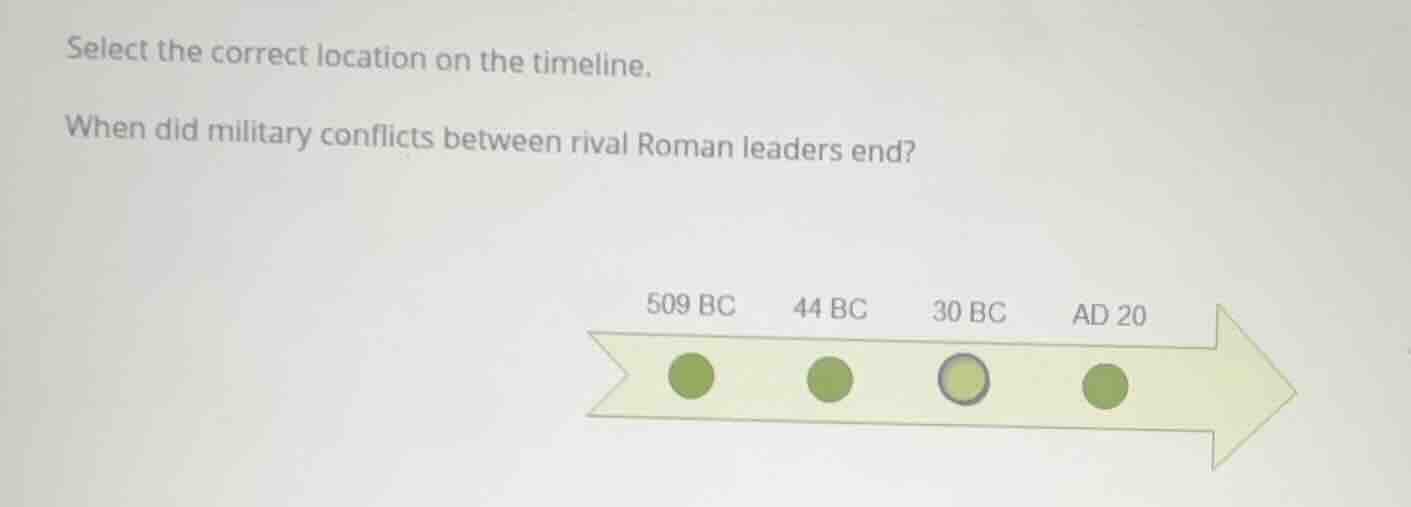
select the correct location on the timeline.
when did military conflicts between rival roman leaders end?
509 bc
44 bc
30 bc
ad 20
Identify the historical context of Roman civil wars
The question asks when military conflicts between rival Roman leaders ended. This period of internal conflict is known as the Roman Civil Wars, which marked the transition from the Roman Republic to the Roman Empire. The final civil war of the Roman Republic was fought between Octavian (later Augustus) and Mark Antony (allied with Cleopatra VII of Egypt).
Analyze the timeline options
- 509 BC: This marks the traditional founding of the Roman Republic after the overthrow of the Roman monarchy, not the end of civil wars.
- 44 BC: This is the year Julius Caesar was assassinated, which actually triggered further rounds of civil wars rather than ending them.
- 30 BC: This year marks the defeat and deaths of Mark Antony and Cleopatra following the Battle of Actium (31 BC). With their defeat, Octavian became the sole ruler of the Roman world, effectively ending the era of major civil wars between rival Roman leaders and initiating the Pax Romana (Roman Peace).
- AD 20: This is well into the reign of Tiberius, long after the consolidation of the Roman Empire.
Connect to student knowledge
Building upon your understanding of Roman Expansion, the rapid growth of Rome's territories created immense wealth and social inequality, leading to the rise of powerful military generals who fought each other for supreme control. This era of internal strife finally concluded in 30 BC when Octavian consolidated power, establishing the Roman Empire.

Snap & solve any problem in the app
Get step-by-step solutions on Sovi AI
Photo-based solutions with guided steps
Explore more problems and detailed explanations
- 509 BC
- 44 BC
- 30 BC (Correct answer)
- AD 20