QUESTION IMAGE
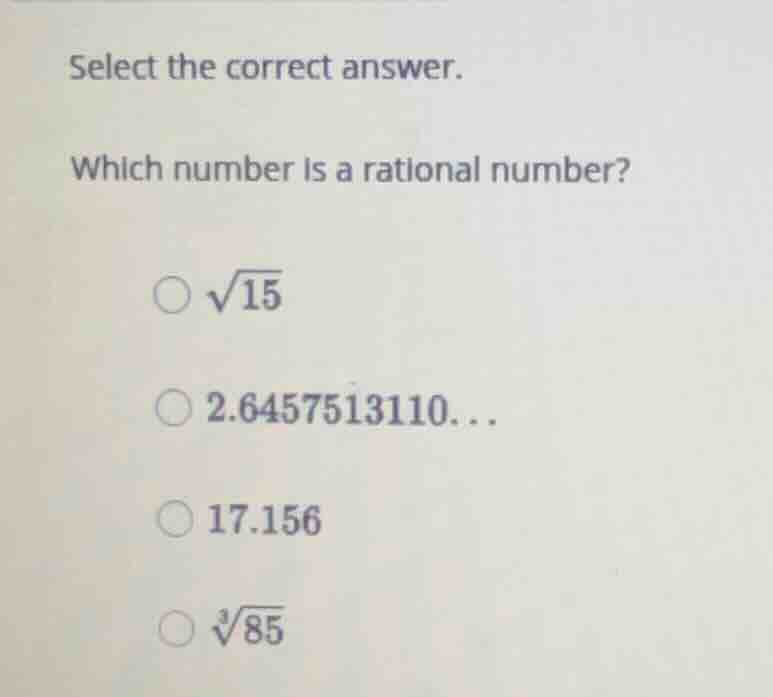
Question
select the correct answer.
which number is a rational number?
\\(\sqrt{15}\\)
\\(2.6457513110...\\)
\\(17.156\\)
\\(\sqrt3{85}\\)
Define rational and irrational numbers
A rational number is any number that can be expressed as a fraction \(\frac{a}{b}\), where \(a\) and \(b\) are integers and \(b
eq 0\). In decimal form, rational numbers either terminate (end) or repeat a specific pattern. An irrational number cannot be written as a simple fraction, and its decimal representation goes on forever without repeating.
Analyze the first option
The first option is \(\sqrt{15}\). Since \(15\) is not a perfect square, its square root is an irrational number. Its decimal representation is non-terminating and non-repeating.
Analyze the second option
The second option is \(2.6457513110\dots\). The ellipsis (\(\dots\)) indicates that the decimal continues infinitely. Since there is no repeating pattern in the digits, this is a non-terminating, non-repeating decimal, which represents an irrational number (specifically, this is the decimal approximation of \(\sqrt{7}\)).
Analyze the third option
Using the Repeating Decimals and Fraction Conversion knowledge points:
The third option is \(17.156\). This is a terminating decimal because it ends after three decimal places. Any terminating decimal can be converted into a fraction with a denominator that is a power of \(10\):
Since it can be written as a ratio of two integers, \(17.156\) is a rational number.
Analyze the fourth option
The fourth option is \(\sqrt[3]{85}\). Since \(85\) is not a perfect cube, its cube root is an irrational number. Its decimal representation is non-terminating and non-repeating.

Snap & solve any problem in the app
Get step-by-step solutions on Sovi AI
Photo-based solutions with guided steps
Explore more problems and detailed explanations
- (A) \(\sqrt{15}\)
- (B) \(2.6457513110\dots\)
- (C) \(17.156\) (Correct answer)
- (D) \(\sqrt[3]{85}\)