QUESTION IMAGE
Question
select the correct answer.
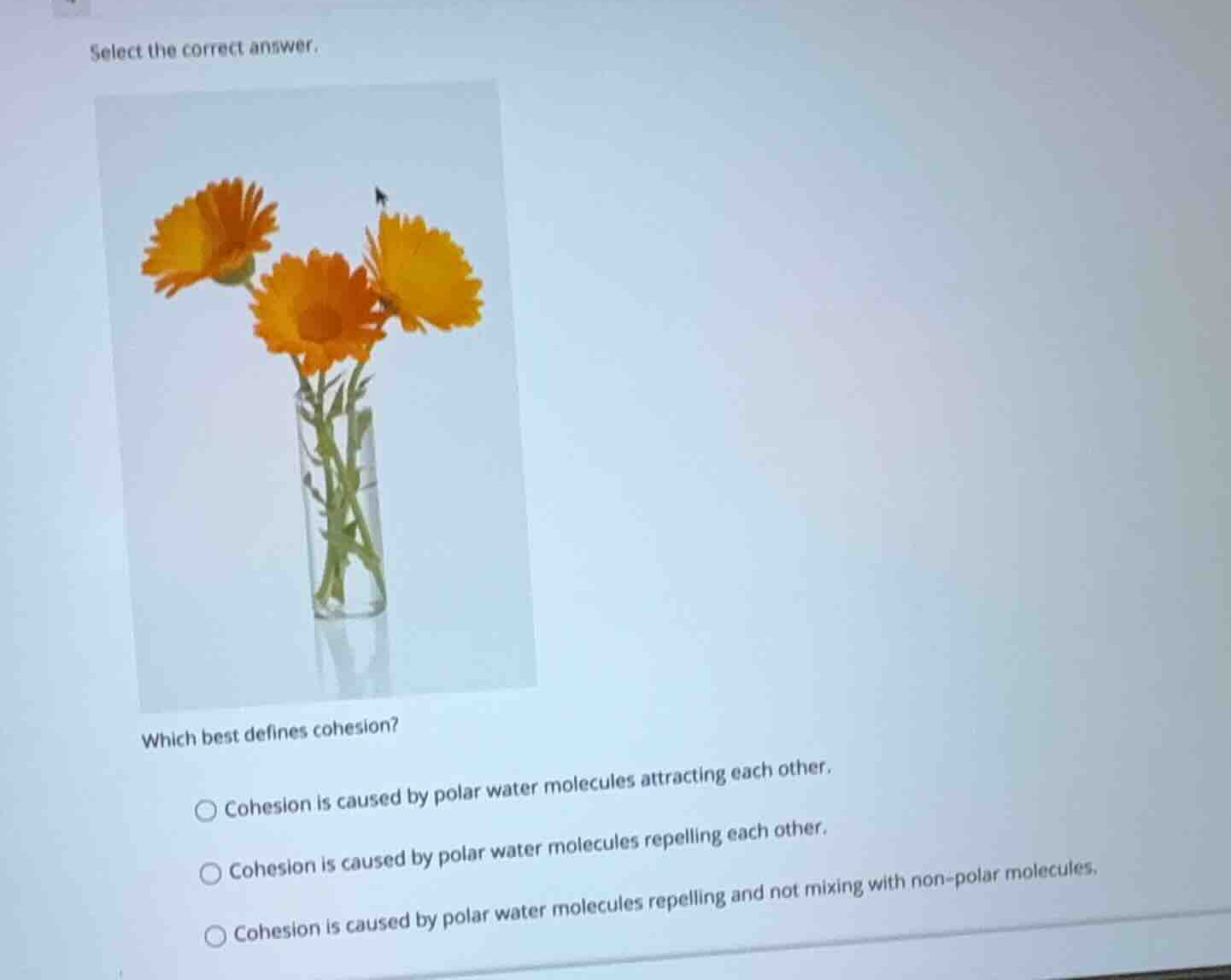
which best defines cohesion?
cohesion is caused by polar water molecules attracting each other.
cohesion is caused by polar water molecules repelling each other.
cohesion is caused by polar water molecules repelling and not mixing with non-polar molecules.
<pre_analysis>
{
"quality": "clear",
"question_count": 1,
"skills_matched": [
"direct_cot",
"multiple_choice_formatter",
"explain_then_answer",
"tutor",
"mastery_adaptive_brevity"
],
"needs_drawing": false,
"concepts_used": [
"Cohesion",
"Properties of Water"
],
"new_concepts": [],
"current_concepts": [
"Cohesion",
"Properties of Water",
"Hydrogen Bonding"
]
}
</pre_analysis>
<reasoning>
Definir la cohesión del agua
Using the Cohesion and Properties of Water knowledge points
\[
\text{Cohesión} \implies \text{Atracción entre moléculas del mismo tipo (agua-agua)}
\]
Las moléculas de agua son polares y forman enlaces de hidrógeno entre sí, lo que genera una fuerza de atracción mutua.
Evaluar las opciones presentadas
- Opción 1: Afirma que la cohesión es causada por la atracción entre moléculas polares de agua. Esto es correcto y describe con precisión las fuerzas intermoleculares.
- Opción 2: Afirma que las moléculas se repelen, lo cual es incorrecto.
- Opción 3: Se refiere a la repulsión y falta de mezcla con moléculas no polares, lo cual describe la hidrofobicidad, no la cohesión.
</reasoning>
<answer>
<mcq-correct>Cohesion is caused by polar water molecules attracting each other.</mcq-correct>
<mcq-option>Cohesion is caused by polar water molecules repelling each other.</mcq-option>
<mcq-option>Cohesion is caused by polar water molecules repelling and not mixing with non-polar molecules.</mcq-option>
</answer>
<post_analysis>
{
"subject": "Natural Science",
"question_type": "Multiple Choice",
"knowledge_point": [
"Natural Science",
"Chemistry",
"Properties of Water"
]
}
</post_analysis>
Snap & solve any problem in the app
Get step-by-step solutions on Sovi AI
Photo-based solutions with guided steps
Explore more problems and detailed explanations
<pre_analysis>
{
"quality": "clear",
"question_count": 1,
"skills_matched": [
"direct_cot",
"multiple_choice_formatter",
"explain_then_answer",
"tutor",
"mastery_adaptive_brevity"
],
"needs_drawing": false,
"concepts_used": [
"Cohesion",
"Properties of Water"
],
"new_concepts": [],
"current_concepts": [
"Cohesion",
"Properties of Water",
"Hydrogen Bonding"
]
}
</pre_analysis>
<reasoning>
Definir la cohesión del agua
Using the Cohesion and Properties of Water knowledge points
\[
\text{Cohesión} \implies \text{Atracción entre moléculas del mismo tipo (agua-agua)}
\]
Las moléculas de agua son polares y forman enlaces de hidrógeno entre sí, lo que genera una fuerza de atracción mutua.
Evaluar las opciones presentadas
- Opción 1: Afirma que la cohesión es causada por la atracción entre moléculas polares de agua. Esto es correcto y describe con precisión las fuerzas intermoleculares.
- Opción 2: Afirma que las moléculas se repelen, lo cual es incorrecto.
- Opción 3: Se refiere a la repulsión y falta de mezcla con moléculas no polares, lo cual describe la hidrofobicidad, no la cohesión.
</reasoning>
<answer>
<mcq-correct>Cohesion is caused by polar water molecules attracting each other.</mcq-correct>
<mcq-option>Cohesion is caused by polar water molecules repelling each other.</mcq-option>
<mcq-option>Cohesion is caused by polar water molecules repelling and not mixing with non-polar molecules.</mcq-option>
</answer>
<post_analysis>
{
"subject": "Natural Science",
"question_type": "Multiple Choice",
"knowledge_point": [
"Natural Science",
"Chemistry",
"Properties of Water"
]
}
</post_analysis>